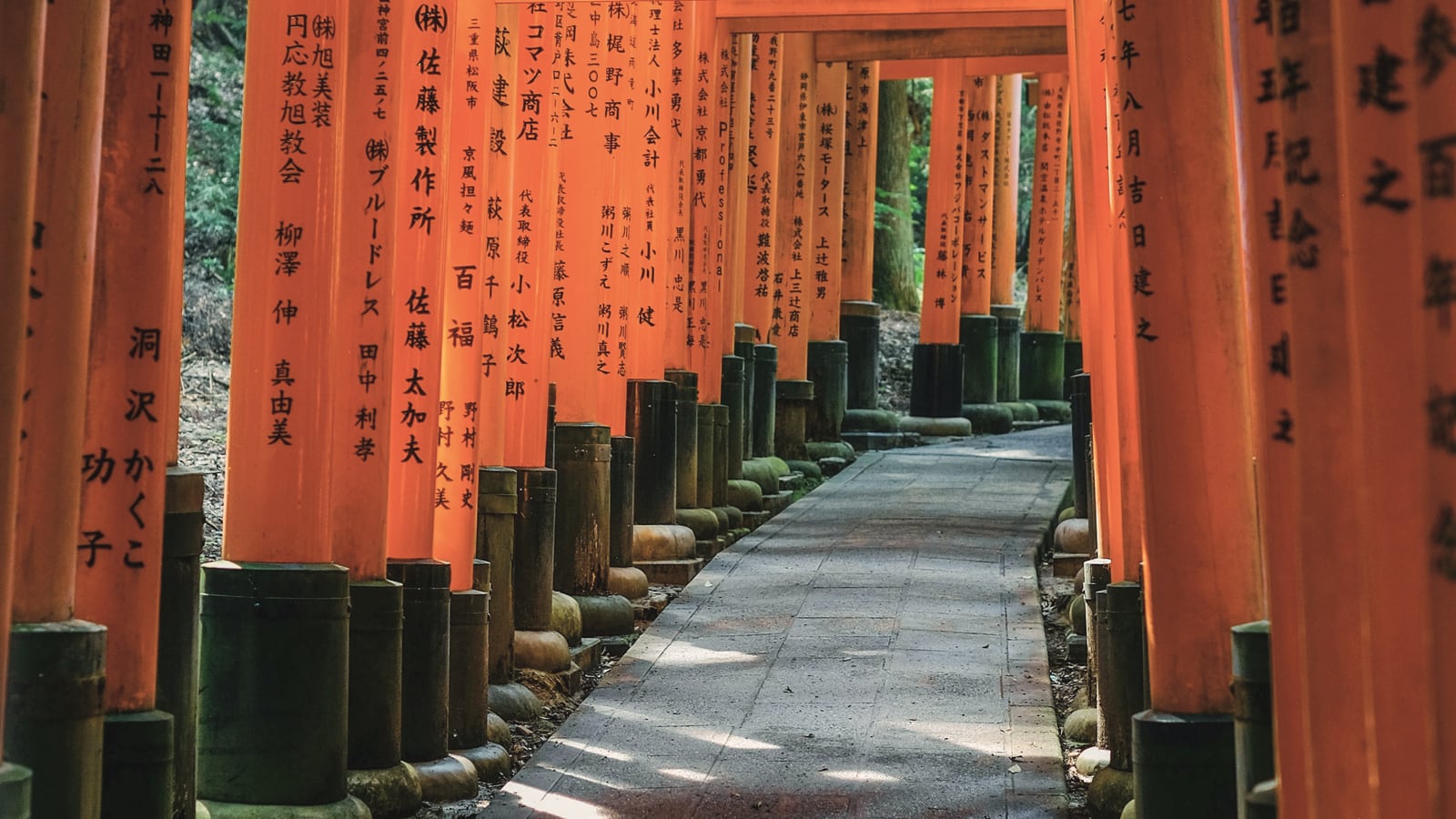
If you have spent any time in Japan, you have encountered Inari. The red torii gates, the fox statues, the small shrines tucked into hillsides and alleyways — these are Inari’s domain.
Inari is one of the most widely worshipped kami in Japan, with more shrine locations than any other deity in the Shinto tradition. And yet Inari is also one of the most frequently misunderstood figures in Japanese religious life, partly because Inari covers more ground than any single explanation can hold.
What Inari is associated with
In the oldest layers of Japanese religious practice, Inari was connected primarily to rice — to the harvest, to the success of crops, to food and survival. The name itself is thought by some scholars to derive from ine (rice plant) combined with nari (growing or becoming).
But Inari’s domain expanded significantly over time.
By the medieval period, Inari had become associated with commerce and business success. Merchants and craftspeople — particularly blacksmiths, who sometimes worked with foxfire imagery — adopted Inari as a patron. Many of the major Inari shrines in urban areas were established by guilds, merchant houses, or craft associations.
Later still, Inari became associated with worldly success in a more general sense: prosperity, safety, fertility, protection from misfortune, and even artistic skill.
Today, Inari shrines are approached for an enormous range of purposes — starting a business, seeking a good harvest, praying for family health, asking for safe travel, or simply giving thanks.
Inari is not a single figure
This is what makes Inari genuinely different from many religious traditions’ understanding of a god.
Inari is not depicted consistently as a single person or form. In different shrines and different regional traditions, Inari appears as:
- an old man carrying rice
- a young woman
- an androgynous figure
- a fox directly
This flexibility is not contradiction. It reflects how Inari’s nature was understood: as a force or presence that could take whatever form was needed. Inari is less like a character with fixed attributes and more like a concentrated principle — rice, growth, transformation, mediation — that could manifest differently depending on context.
The role of the fox
Foxes (kitsune) are Inari’s messengers, not Inari itself. This distinction gets blurred in popular usage, but it is meaningful in practice.
The fox statues at an Inari shrine are intermediaries. They are positioned at the threshold — between the human space and the sacred one — because that is where messengers operate. Approaching them is not worshipping the fox; it is acknowledging the link between your request and the kami the fox represents.
Why Inari shrines feel different
Inari shrines often have a particular atmosphere. The famous image — hundreds of vermillion torii gates marching up a hillside — comes from Fushimi Inari-taisha in Kyoto, where each gate was donated by a worshipper or business as an offering. The gates mark a path, and the path itself is the approach to the divine.
At smaller Inari shrines, the atmosphere is more contained. Often there is a narrow approach, dense with offerings and fox statues. The smell of incense. Red everywhere.
The density of presence is intentional. Inari’s space is meant to feel like an active exchange is happening — not a monument to visit, but a place where requests are made and received.
What to notice when you visit
At any Inari shrine, look for:
- What the foxes are holding — a key (access), a scroll (knowledge), rice sheaves (abundance), a jewel (spiritual power). Each gives context for the tradition at that particular shrine.
- Who donated the torii gates — business names are often written on them, making visible the long history of commercial prayer at Inari sites.
- The main hall inscription — it will usually confirm the kami enshrined, often listed with multiple names reflecting different aspects of Inari.
You do not need to understand everything to be present at the place. But knowing even this much changes what you see.