Most visitors to Nagano come for Matsumoto Castle, the snow monkeys, or the ski slopes. Ueda, an hour east of Matsumoto and an hour southwest of Nagano City, rarely makes the list.
This is a small puzzle, because Ueda has one of the more interesting histories in the region — and a castle that survived two sieges by forces that vastly outnumbered its defenders.
The castle and the man who held it
Ueda Castle was built in 1583 by Sanada Masayuki, a warlord whose reputation rested almost entirely on his ability to hold positions no one expected him to hold.
In 1585, Tokugawa Ieyasu — at the time the most powerful daimyo in eastern Japan — sent a force estimated at seven to eight thousand soldiers to take the castle. Sanada’s garrison numbered around two thousand. The siege failed. Tokugawa’s forces withdrew.
In 1600, during the chaos preceding the Battle of Sekigahara, Tokugawa sent another force — this time estimated at thirty-eight thousand — to neutralize Ueda before moving west. Again the castle held. Sanada Masayuki and his son Yukimura harassed the besieging forces for weeks, keeping a significant Tokugawa army occupied while the decisive battle was fought without them.
Tokugawa eventually won the war, and Ueda’s defenders were exiled. But the castle’s record remained: besieged twice by the largest military force in Japan, never taken.
What Sanada Yukimura became
Sanada Yukimura — the son who fought at Ueda in 1600 and later died at the Siege of Osaka in 1615 — became one of the most celebrated figures in Japanese popular history. He was on the losing side of almost every engagement he fought in. He died defending a cause that was already lost.
What made him legendary was the quality of his resistance. He was said to have led a charge at Osaka that broke through the Tokugawa lines and came within reach of Ieyasu himself before being turned back. The phrase attached to him in later popular tradition translates roughly as “the greatest warrior in Japan” — a title given posthumously, by people who admired the way he fought rather than whether he won.
The Sanada family’s red armor and distinctive crest are visible throughout Ueda today: on street signs, restaurant logos, festival decorations, the souvenir shops near the castle.
The castle grounds now
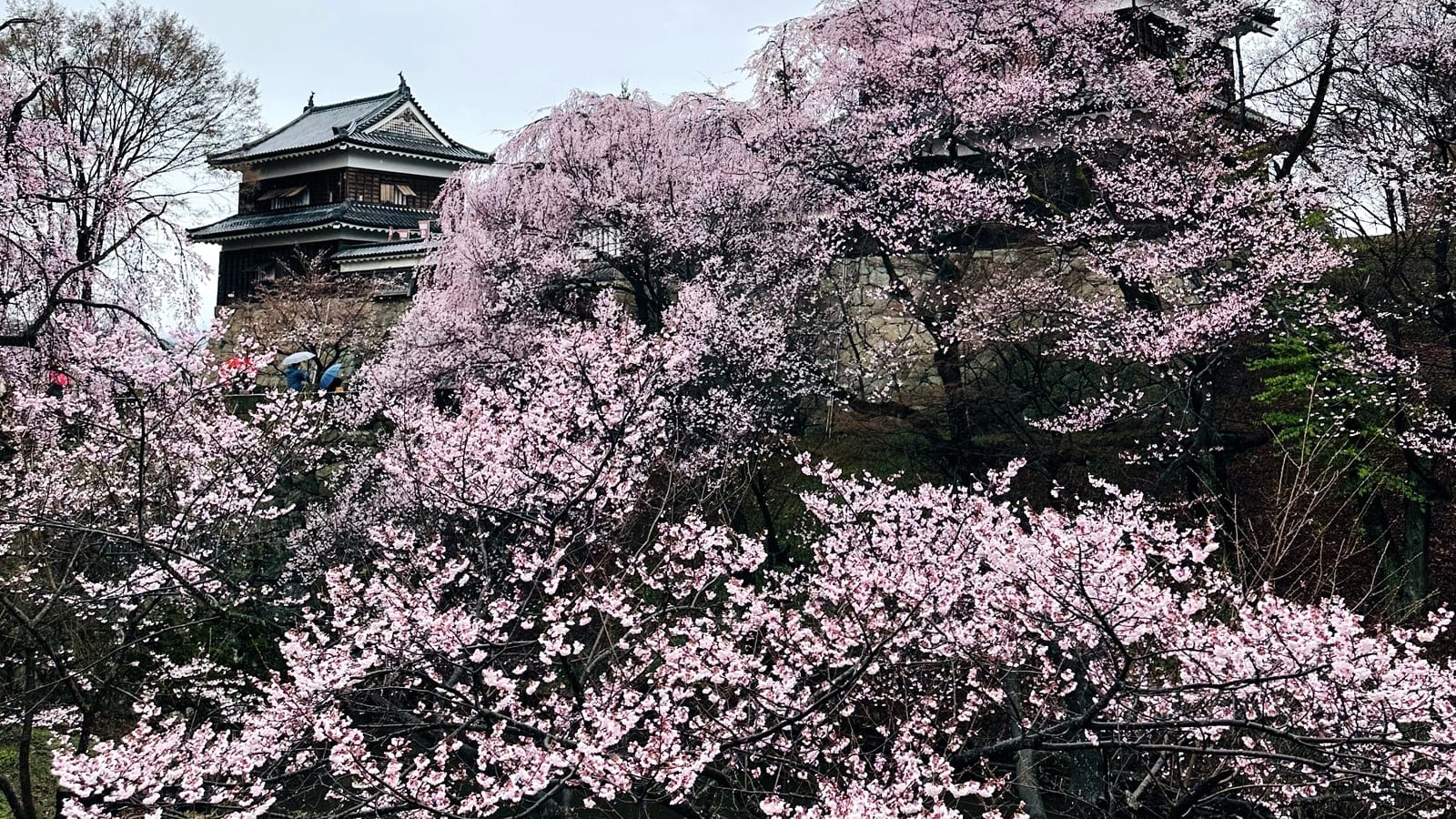
The main keep was demolished after the Tokugawa consolidation, and what stands today is a partial reconstruction — three smaller corner towers (yagura) and the walls, rebuilt in the early twentieth century on the original stone foundations. The reconstruction is modest compared to Matsumoto’s intact black keep, but the site itself carries more of the original feel: the earthworks, the moat, the angles of the walls that made it defensible.
There is a small shrine within the grounds — Sanada Shrine (Sanada-jinja), dedicated to the Sanada family — and a museum with local armor, weapons, and documents. The museum is in Japanese, but the objects speak clearly enough.
The town around the castle
Ueda’s old town district (Yanagimachi) runs along the road that was once the main approach into the castle. Several traditional buildings survive here — sake breweries, old merchant houses, a kura (warehouse) converted into a craft shop. It is a quiet street by the standards of tourist destinations, which is partly the point.
The town has a working quality that many heavily-visited historical sites lose: people live here, shops serve locals, the street is not curated for display. The history sits alongside the ordinary.
How to get there
Ueda is on the Hokuriku Shinkansen line — accessible from Tokyo in about seventy-five minutes, from Kanazawa in about ninety. It is a natural stopover between Tokyo and the Japanese Alps, or a day trip from Nagano City.
The castle grounds are a ten-minute walk from Ueda Station. The old town is a few minutes further. A few hours is enough to cover the main sites; a full day allows for slower movement and the side streets.
It is the kind of place that rewards the visitor who is not in a hurry to get to the next thing on the list.