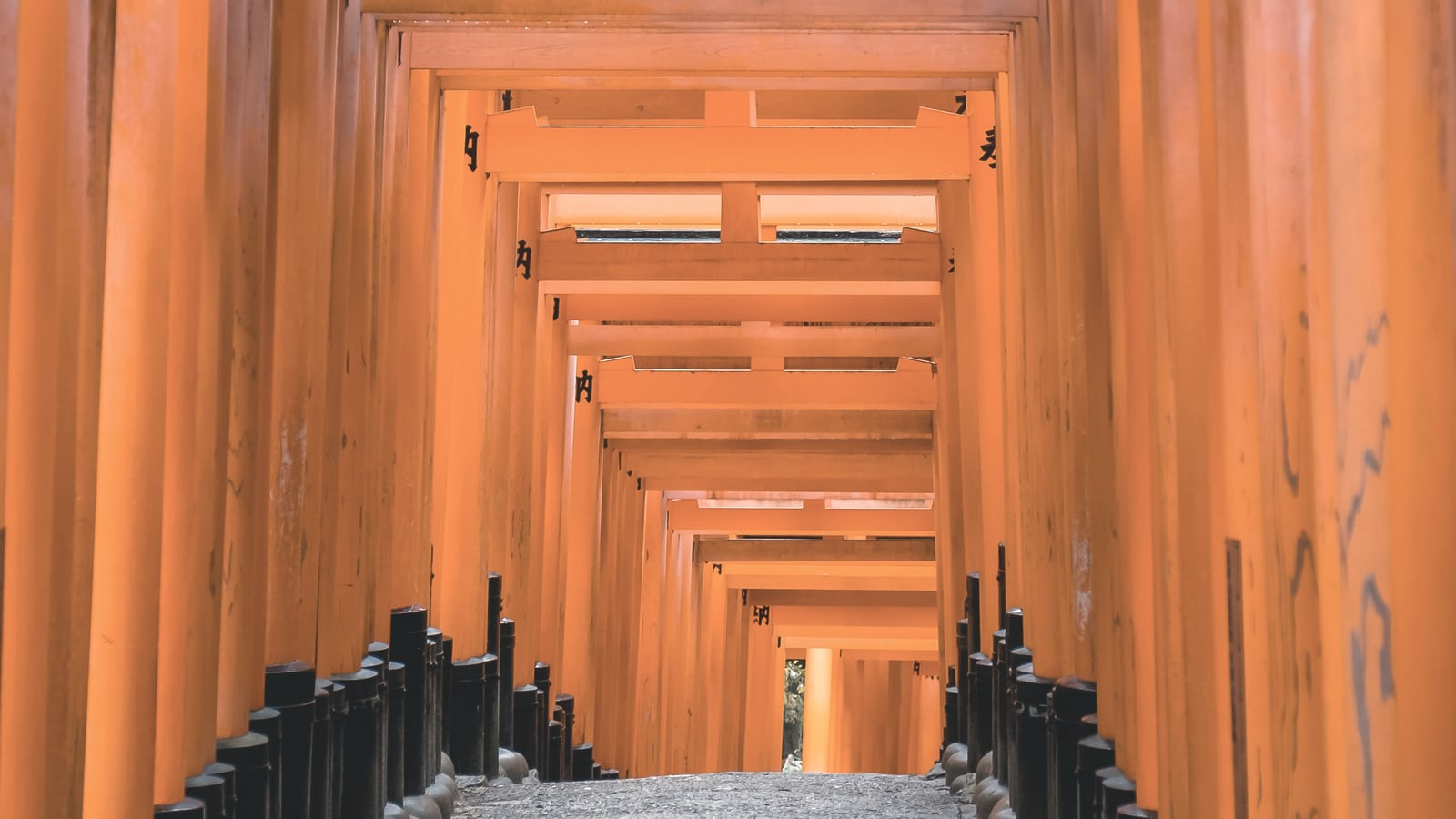
You have seen them in photographs before you ever visited Japan. Two vertical pillars, a horizontal beam, a curved crosspiece above it. Often red, sometimes stone, sometimes wood weathered gray. Often standing in water, or at the start of a forest path, or marking the approach to a building.
Torii gates are one of the most immediately recognizable images in Japanese visual culture. They are also genuinely misunderstood — not because they are complex, but because the explanation people reach for first (“it is a Japanese arch”) is almost completely wrong.
What a torii marks
A torii marks a threshold between the ordinary world and sacred space.
The area beyond a torii is kami territory — the domain of the sacred presence enshrined there. Walking through the gate is not just entering a building complex. It is crossing from the human world into a space where the ordinary rules are suspended and a different kind of attention is called for.
This is why torii appear where they do: at the approach to shrines, not as ornament, but as announcement. The gate says: you are about to enter a different kind of space.
Why multiple gates exist
At many shrines, you will walk through not one torii but several — sometimes dozens, sometimes hundreds. Fushimi Inari-taisha in Kyoto is famous for its tunnel of thousands of vermillion gates, stretching up a mountain.
Each gate was donated by a person or organization as a form of prayer or gratitude. The inscription on the side pillars usually names the donor and the date. What looks like an architectural spectacle is actually a record of thousands of individual acts of devotion, accumulated over centuries.
More gates do not make the space more sacred in a simple arithmetic sense. But they do make visible the depth of the relationship between the kami enshrined there and the community that approaches it. A shrine covered in donated torii is a shrine where people have been asking for things for a very long time.
The middle of the path
At a traditional shrine approach, the path through the torii — the sandō — has a center strip and two sides.
The center, in many traditions, is left for the kami. Visitors walk to the side.
Not every shrine enforces this, and many modern visitors do not know it. But the convention reflects the same logic as the torii itself: this is not simply a walkway, it is a space where the divine and the human share the same path, and the arrangement of that sharing matters.
What to do when you pass through
There is no strict requirement, but the usual gesture is a slight bow before stepping through the gate. This acknowledges the threshold — that you are entering, and you know it.
You do not need to bow deeply. You do not need to say anything. The bow is simply a physical marker of awareness: I know where I am going.
After visiting the shrine, the same bow on the way out — facing back toward the inner space, toward the kami’s residence — closes the exchange. You entered, you were present, you are leaving.
Torii outside of shrines
You will sometimes see torii in places that are not formally shrine grounds — at the edge of a field, at the base of a staircase in an old neighborhood, built into a wall with barely enough room to pass through. These are remnants, or markers of smaller sacred sites that have been reduced or moved over time.
They are still thresholds. Whatever lies beyond them was once considered, and in some cases still is considered, to be under the care of a kami. The absence of a grand shrine behind them does not erase what they mark.
The simplest version
A torii is not a gate to a building. It is a gate between worlds.
Passing through one is a gesture of recognition — that you are entering a space where something more than architecture is happening. That recognition is the point.
You do not need to share the belief to understand the meaning. And understanding the meaning changes how you walk through.