Some of Japan’s most famous spiritual beings are known everywhere: kitsune, oni, tengu, kappa. You will find them in anime, games, and tourist shops across the country.
But a large part of the Japanese folk tradition works differently. Many of its spirits, kami, and yokai are deeply local — known only in a particular valley, a specific mountain district, a village that no longer exists. They have names that do not appear in national encyclopedias. Their stories are told by people who grew up near the place they inhabit.
This localism is not a gap in the tradition. It is the tradition working as it was designed to.
Why place matters in Shinto
The foundational concept of Japanese spiritual life is that kami inhabit specific places. Not the world in general, not the sky, not an abstract divine realm — but this mountain, this spring, this ancient tree at the edge of this particular field.
The kami of a mountain is not the same as the kami of another mountain nearby. They are distinct presences, tied to distinct locations, with distinct histories of relationship with the communities who live near them.
This means that spiritual knowledge in Japan is, at its deepest level, local knowledge. To know the kami of a place, you need to know the place — its geography, its history, the things that happened there. That knowledge cannot be fully extracted and made general without losing something essential.
Chinju no mori and the guardian forest
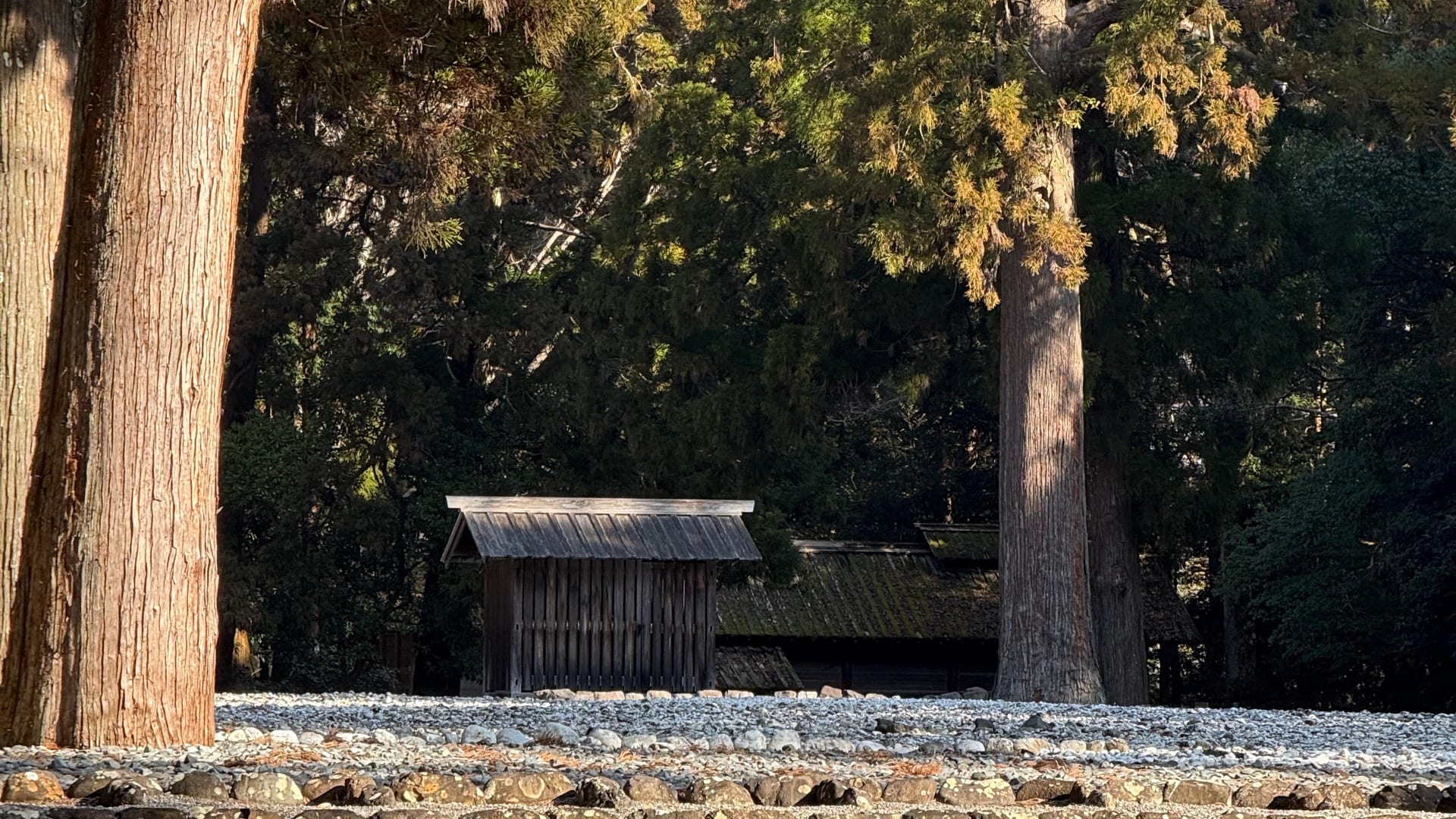
Many towns and villages in Japan have a chinju no mori — a small sacred grove attached to the local shrine, where the guardian kami of that place (chinju) resides. The grove is often the oldest continuously protected land in the area, predating the surrounding development by centuries.
The chinju is the spirit responsible for that specific community: watching over the harvests, the health of the residents, the safety of the local land. It is not a universal protector of Japan. It is the protector of this place.
When you walk past an old shrine surrounded by large, dense trees in the middle of a Japanese neighborhood, you are very likely looking at a chinju no mori — a remnant of a much older landscape that has been maintained because cutting it would mean losing something more than timber.
Local yokai as landscape memory
Regional yokai stories often encode specific knowledge about a place: where the water is dangerous, which mountain path becomes treacherous at night, what happened at a particular crossroads.
The kappa — the river creature associated with dragging children and adults underwater — appears across Japan, but its specific character varies by region. In some areas it is dangerous. In others it can be befriended, tricked, or appeased. Local kappa stories encode local knowledge about local water: which rivers flood, which pools are deep and still, which crossings are unreliable.
This is why dismissing yokai stories as “just mythology” misses their function. They were, among other things, a way of remembering and transmitting specific knowledge about specific places — what the land does in certain seasons, where the real dangers are, what to be careful of at night.
What gets lost when places empty out
Japan’s rural depopulation is, among other things, a spiritual problem in the literal sense of this tradition. When a village empties, the people who knew the local kami’s stories leave. The chinju no mori may still stand, but the priesthood may be absent, the festival may have been discontinued, the stories may no longer be told.
The kami does not disappear. The place does not become uninhabited in the deeper sense. But the relationship — the ongoing exchange between the kami and the human community that maintained it — may go dormant.
This is why some visitors to rural Japan find themselves in front of small, apparently abandoned shrines that still feel charged with something. The relationship has thinned, but the place is the same. The presence was there before the community and may remain after it.
Why this changes how you travel
If you are traveling in Japan with any interest in its spiritual landscape, the most interesting layer is not the famous national shrines. Those matter and are worth visiting. But the most alive and specific layer is often local: the particular shrine in a particular town, the mountain that a particular community has been approaching for centuries, the small grove that survived because everyone agreed, generation after generation, that it should.
That specificity is not available in general guides. It requires being in the place, slowing down, and asking — of the landscape itself, or of the people who still live near it — what is here, and what has this place been for?
The answer is different every time, because every place is different. That is the point.