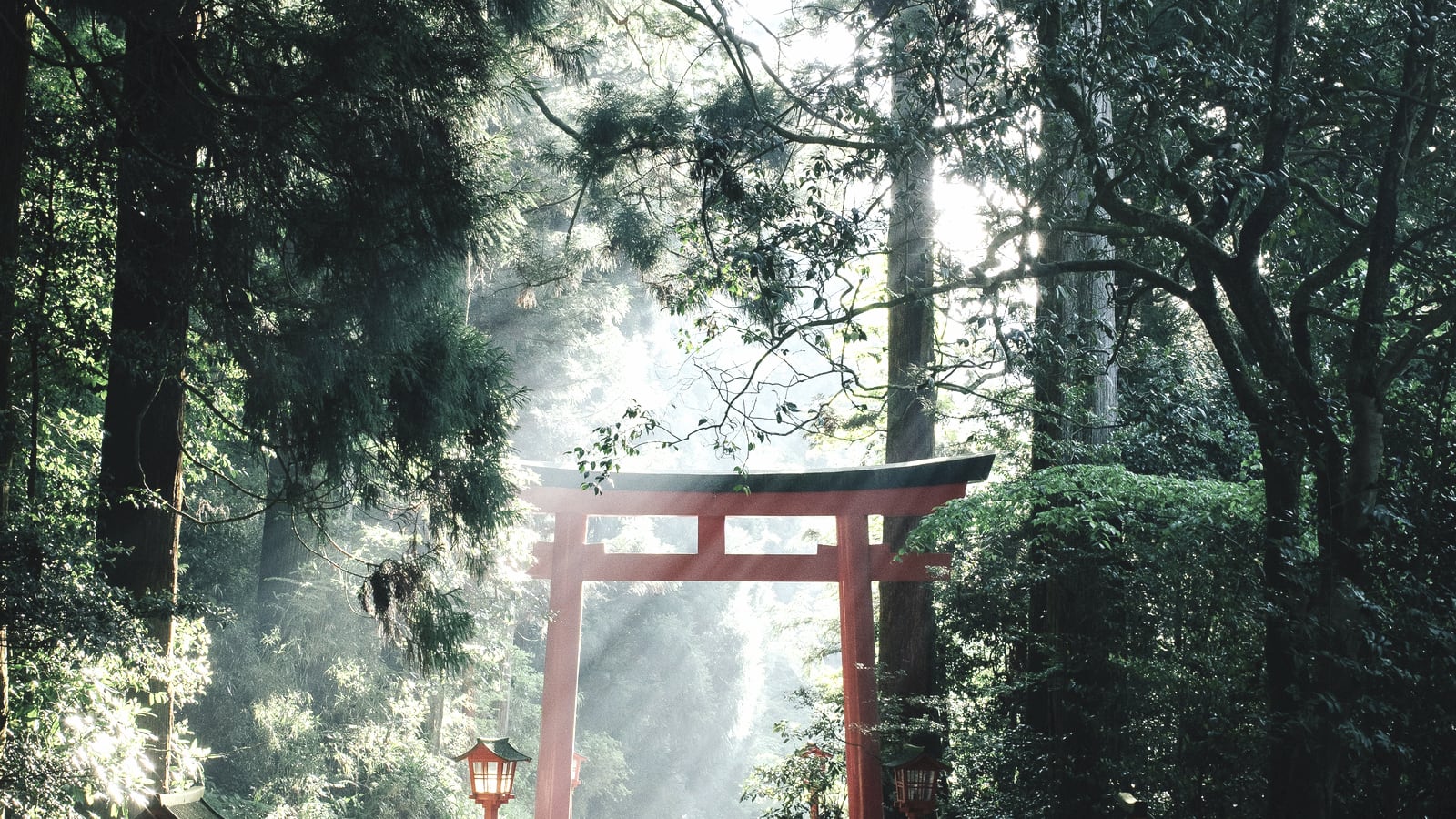
Two words come up constantly when people start exploring Japanese spirituality: kami and yokai. Most translations reach for “gods” and “monsters” — and while those are not completely wrong, they miss enough of the picture to be genuinely misleading.
Here is a cleaner way to think about them.
Kami: presences in things
Kami is the central concept in Shinto, Japan’s indigenous religious tradition. Kami are not gods in the sense of distant, all-powerful beings who created the world. They are more like sacred presences or forces that inhabit and animate specific things.
A mountain can be kami. A river can be kami. An ancestor with unusual virtue can become kami. A quality — craftsmanship, beauty, the force that makes rice grow — can be kami. Even objects, in the right circumstances, can carry kami.
What unites these is quality, not category. Kami are whatever has extraordinary quality, power, or sacred presence in it. The word itself is sometimes translated as “that which is above” or “that which is awe-inspiring.”
Shrines (jinja) are built to honor kami — to create a proper space for their presence, to maintain a relationship between the kami and the human community, and to make requests through that relationship. When you approach a shrine, you are approaching a kami’s space.
Yokai: strangeness at the edge
Yokai occupy a different part of the spiritual landscape. If kami are presences with sacred power — honored, approached with ritual, central to the Shinto order — yokai are the strange things at the margins.
Yokai are not honored in the same way. They are observed, feared, propitiated, sometimes tricked, sometimes befriended. They exist in the spaces where the ordinary world gets weird: old forests, abandoned houses, rivers at night, mountain passes after dark.
The key difference is not good vs. evil. It is sacred vs. strange. Kami are powerful presences that the human world has found a way to relate to through ritual and respect. Yokai are the presences that resist that kind of orderly relationship. They are outside the system.
Where it gets complicated
In practice, the line between kami and yokai is not always clean.
Some beings cross over. A revered fox at an Inari shrine is understood as a messenger of kami — zenko, a sacred fox operating within the divine order. The same fox in a folk tale, leading a traveler astray in a mountain forest, is a yokai — a nogitsune, outside and unpredictable.
Same animal, different frame, different category.
Others begin as yokai and are later elevated to kami through community recognition and shrine construction. Local spirits who protect a particular village, or figures who died in unusual circumstances and whose power needed to be managed, sometimes ended up with shrines of their own.
This flexibility is not a failure of the system. It reflects how Japanese spirituality actually works: categories are practical, not absolute. The question is not “what kind of being is this?” in some ontological sense — it is “what relationship does this community have with this presence, and how do we manage it?”
Why the distinction matters when you travel
When you visit a shrine, you are in kami space. The rituals there — the handwashing, the approach, the offering, the bow and clap — are a way of acknowledging that relationship. The presences honored there have been incorporated into a recognized, managed relationship with the human world.
When you hear a folk story about a strange creature in a specific place — a kappa by a certain river, a figure at a mountain pass — you are in yokai territory. Those stories encode a different kind of knowledge: warnings, explanations for misfortune, a way of naming what the community encountered and could not fully control.
Both are serious. Both are real in the sense that matters — they shaped and continue to shape how people relate to specific places.
The simplest version
Kami = sacred presences that have been brought into a recognized relationship with humans through ritual and respect.
Yokai = strange presences at the margins of ordinary life that resist that orderly relationship.
Not good vs. evil. Not gods vs. demons. Sacred and strange.
With that in mind, a lot of what you see in Japan — the shrine practices, the folk art, the regional stories, the visual vocabulary of both religious sites and ghost stories — starts to make more sense.