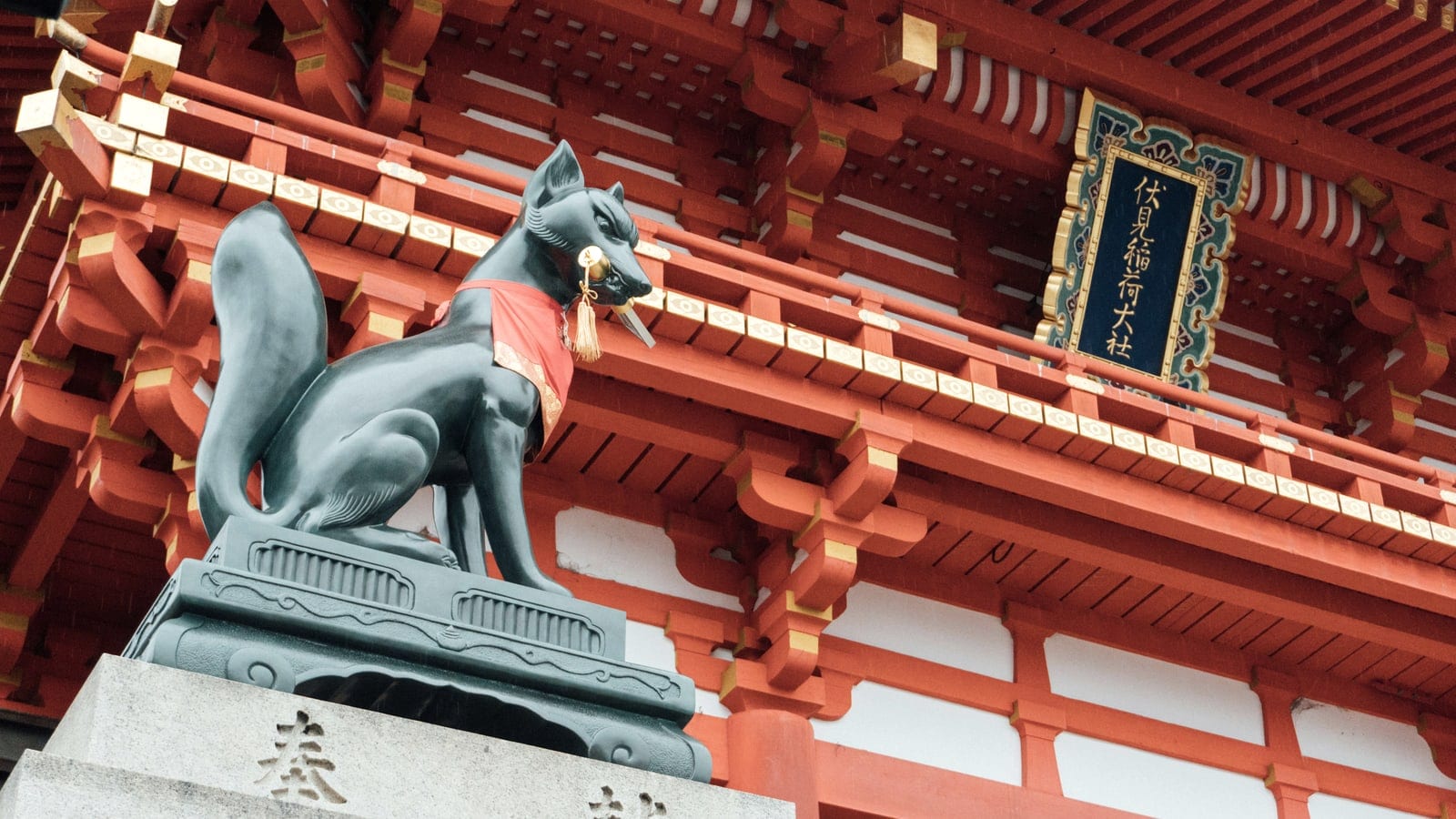
Watch: Why foxes guard Japanese shrines
You may notice them near the entrance of a shrine: two stone foxes facing each other, sometimes wearing red bibs or scarves. Some are large and formal. Others are small enough to miss if you are walking quickly.
Those foxes are not just a cute shrine detail. In many cases, they are kitsune connected to Inari, one of the most widespread forms of shrine worship in Japan.
Inari is not a fox
This is the thing most people get backwards.
Inari is a kami — a divine force or spirit in the Shinto tradition — associated with rice, food, harvest, prosperity, and transformation. Inari is not a fox. Foxes are Inari’s messengers.
The distinction matters because it explains the relationship. The fox statues at a shrine are not the deity. They are the intermediaries — the figures that carry prayers and intentions between the human world and the divine one.
This is why the foxes often hold something in their mouths: a key, a scroll, a sheaf of rice, a jewel. Each object represents something Inari governs — access, knowledge, abundance, spiritual power. The fox carries the message. The object shows what kind of message.
Why foxes?
Foxes appear in Japanese belief long before Inari became widespread. In older folk traditions, foxes were animals of the boundary — creatures that moved between cultivated fields and wild mountains, between the human world and whatever lay beyond it.
That liminality made them logical messengers. They were already understood as existing at the edge of things.
Over time, the connection between foxes and Inari deepened, partly through religious synthesis and partly through cultural repetition. By the time Inari worship became one of the most common forms of shrine practice in Japan, the fox had become inseparable from the imagery.
Today, Inari shrines are the most numerous shrine type in Japan — an estimated 30,000 or more, from the grand Fushimi Inari-taisha in Kyoto to small neighborhood shrines tucked behind convenience stores.
The red bibs
If the fox statues at a shrine are wearing red bibs or red scarves, those are offerings from worshippers — usually parents praying for the health and safety of children, or people asking for protection.
Red is a color associated with warding off misfortune in Japanese tradition. The bibs are a form of active prayer, not just decoration.
The foxes receiving these offerings are being treated as what they are: figures with access to something the worshipper cannot reach directly.
What this means when you visit
Nothing complicated is required. When you see fox statues at a shrine, you are at an Inari shrine. The foxes are messengers. What they hold gives you a clue about what the shrine is traditionally approached for.
If you want to understand the shrine more fully, look at what the foxes are carrying. Look for the main hall (honden) and what is written above the gate. Look for the color red — red torii, red decorations, red offerings.
The foxes are not there simply to block the entrance. They mark the point where a visitor moves from ordinary space into shrine space, which is why their position near gates and paths matters.
That is the simple version.