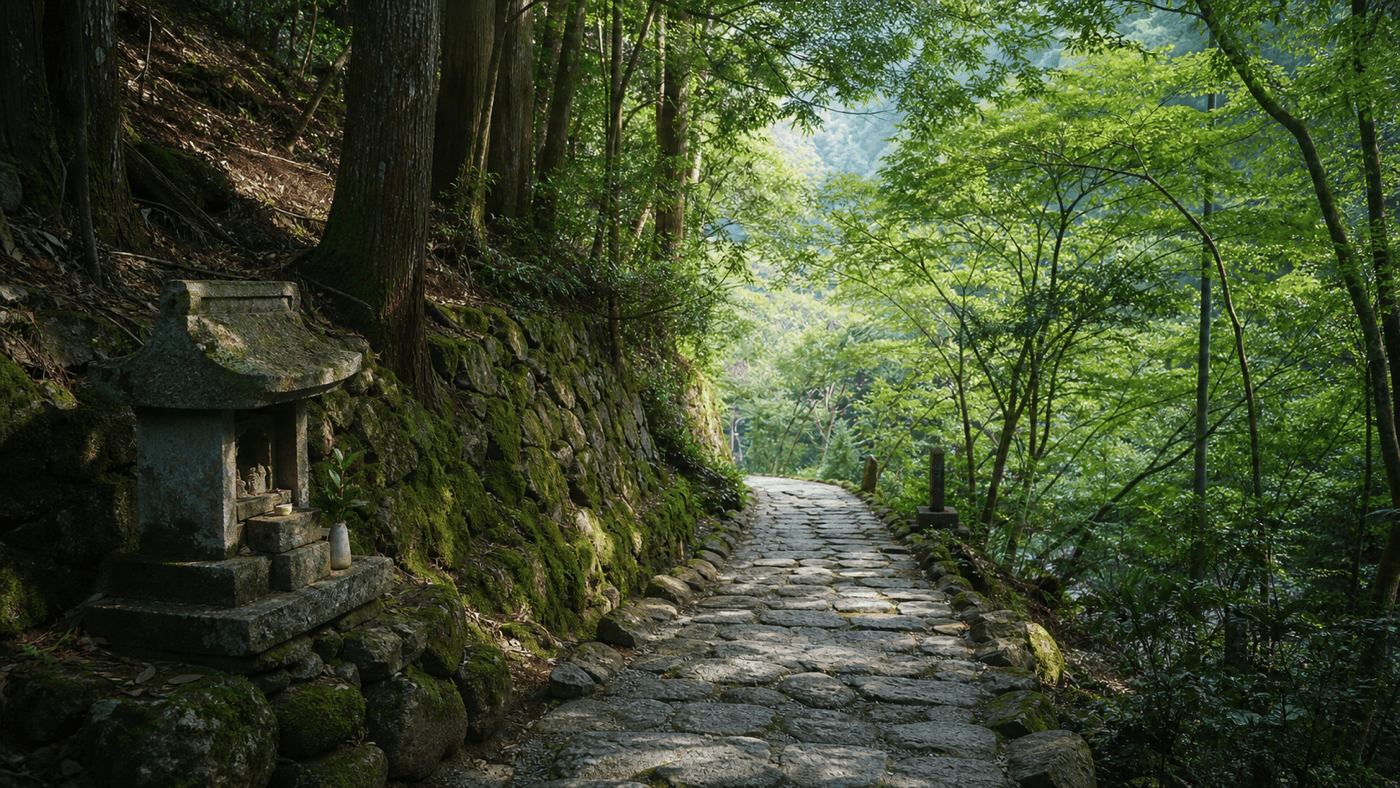
You will find them if you start looking: a small wooden box on a post at the side of a road, barely larger than a birdhouse. A miniature torii at the base of a wall, with just enough space to suggest a threshold. A stone figure in a corner of a parking lot, surrounded by a few coins and a wilting flower. A tiny structure tucked into a gap between buildings, with incense ash in front of it.
These are shrines. Small ones — sometimes called hokora or yashiro — and they are everywhere in Japan once you know to look for them.
Why they exist
The simple answer is that kami are understood to inhabit specific places, not just grand buildings. A particular rock formation, a tree that has stood for centuries, a spring, a crossroads, a place where something significant once happened — all of these can be the location of a kami’s presence.
A shrine is not what makes a place sacred. A shrine is what humans build to acknowledge that something sacred is already there.
The small ones mark exactly this: a presence noticed, acknowledged, and maintained. The size of the structure reflects the scale of the community involved, not the importance of what is being honored. A neighborhood shrine visited by forty families does not require the architecture of a national site.
The historical root
In the older layers of Japanese agricultural life, kami were understood as being everywhere — in the fields, at the water source, at the boundary between the village and the surrounding wilderness, at the crossroads between traveled paths.
Maintaining a relationship with these local presences was practical as much as devotional. The kami of the water source should be acknowledged. The kami of the crossroads deserved recognition, because crossroads are places where things can go wrong. The kami of the old tree at the edge of the field had been there longer than anyone could remember, and that longevity deserved respect.
Small shrines were the infrastructure for maintaining these relationships — low-cost, locally managed, embedded in daily movement through the landscape.
What hokora means
Hokora (祠) is the word for a small roadside or outdoor shrine, usually housing a kami that is not attended by a full priesthood. The character combines elements meaning “spirit” and “place” — literally, the place where the spirit resides.
Some hokora are affiliated with a larger shrine nearby. Others are independent, maintained informally by the local community or by individual families. Some are very old; the kami they honor have been in that location longer than the neighborhood that now surrounds them.
What happens when cities grow around them
Urban expansion in Japan often absorbed older sacred sites into city blocks — but the sites themselves were rarely simply removed.
You will find hokora in the middle of shopping districts, behind convenience stores, pressed against the walls of apartment buildings. The city grew up around them. In some cases the physical structure was relocated; in others it remained exactly where it had always been while everything else changed.
This creates one of the stranger visual textures of Japanese cities: the sacred and the commercial sitting side by side without obvious tension. A tiny shrine with fresh flowers and a stick of incense at the base of a modern office building. An ancient stone figure watching a busy intersection.
The juxtaposition is not ironic in Japan the way it might feel in other contexts. The presence was there before the building. The building happened to arrive around it.
The fresh offerings are the clue
If you want to know whether a small roadside shrine is still active, look for signs of recent attention: fresh flowers, incense ash from the same week, a new coin, a recently placed piece of salt or rice.
These indicate someone comes regularly. They feel a responsibility to the presence there — or gratitude to it, or a relationship with it — and they continue to show up.
The shrine may be tiny. The maintenance may take thirty seconds. But the continuity it represents is often very long.
What to do when you encounter one
Nothing is required. Slowing down to notice is enough.
If you want to acknowledge the presence, a brief pause and a slight bow is appropriate — the same minimal gesture you would offer at a larger shrine. You are acknowledging that you noticed, and that you know what you are looking at.
The small shrines reward the kind of attention that slows down enough to see what is actually there. Japan has built that attention into its landscape in tens of thousands of places. Most visitors walk past all of them.