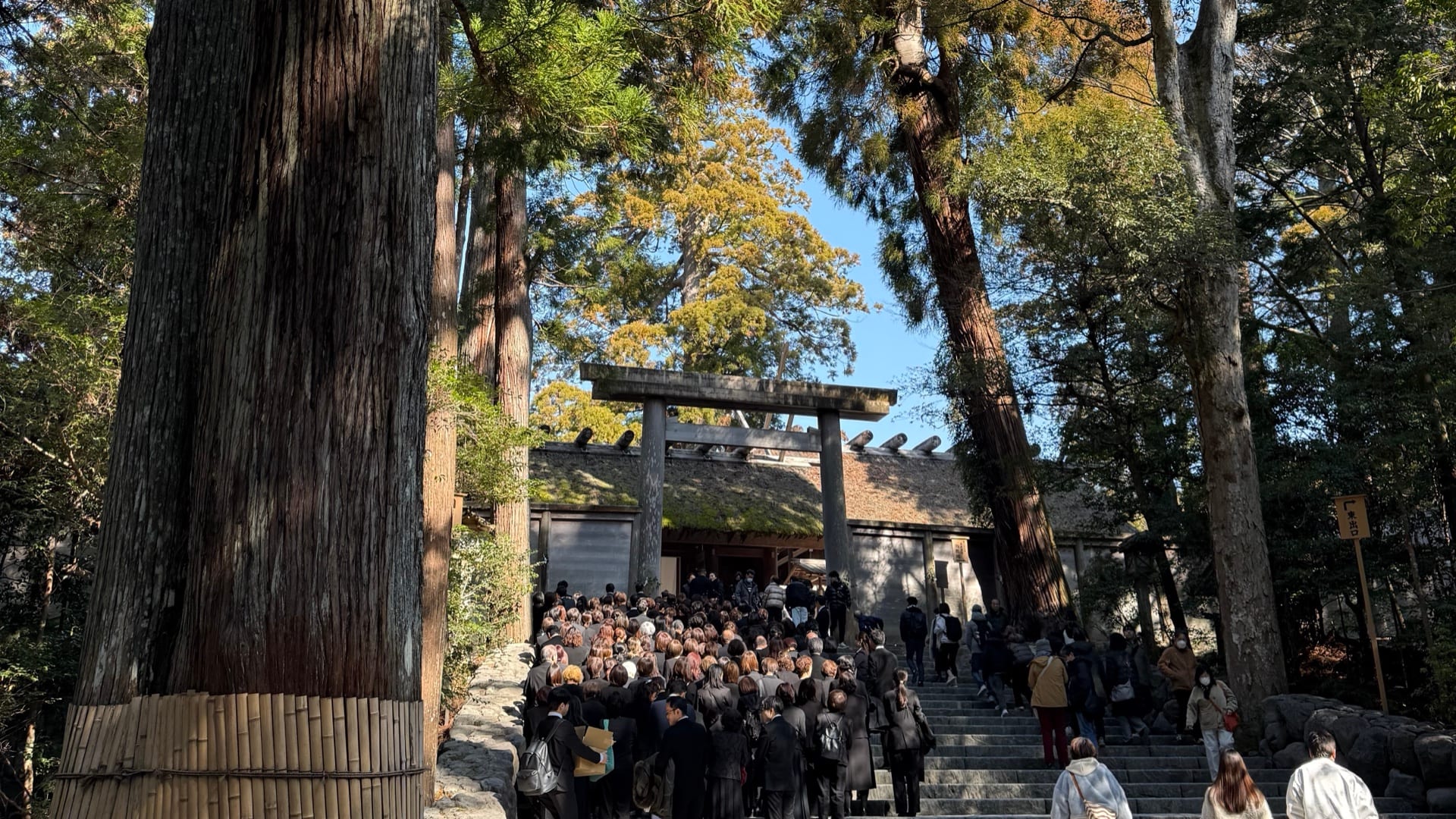
Watch: Why people clap at Japanese shrines
If you watch people approach a shrine, you will see a sequence: a bow, a coin tossed into the offering box, two deep bows, two sharp claps, another bow. The claps are distinct — hands held at chest height, brought together twice in quick succession with a clean, dry sound.
It looks specific, because it is specific. The gesture has a name, a history, and a logic.
What the gesture is called
The full sequence at the offering hall is called nirei nihakushu ichirei: two bows, two claps, one bow. It is the standard form of worship (sanpai) at most Shinto shrines.
Each element has a purpose:
- The first two deep bows (nirei) acknowledge the kami and signal respect
- The two claps (nihakushu) call the kami’s attention and mark the moment of contact
- The final bow (ichirei) closes the exchange
The claps are not applause and not a signal to anyone human. They are directed at the kami.
What the clapping is doing
The clap (hakushu, or in more formal usage kashiwade) is a way of creating a sound at the threshold between the human world and the kami’s presence — a gesture that marks the opening of communication.
Some interpretations emphasize purification: the sharp sound dispels impurities before the prayer. Others emphasize announcement: you are signaling that you are here, that you have come to speak. Both interpretations point toward the same underlying logic — the clap is a marker, a way of saying I am present, and I am making this moment distinct.
The sound has a particular quality that matters: it should be clear and sharp, not soft or muffled. The hands come slightly apart after the first clap so the second strike lands cleanly. The sound itself is the offering, in a sense.
Why two claps
The specific count varies slightly by shrine tradition — some require four claps, a few use a single clap. But two is the common standard, and the pairing matters.
In Japanese religious and ritual thinking, pairs carry meaning. The two bows at the beginning and the final bow create a frame around the whole gesture. The two claps are part of that symmetry — matching, balanced, complete.
The variation at Izumo
There is a notable exception. At Izumo Taisha in Shimane — one of the most historically significant shrines in Japan — the form is four claps, not two. This reflects the older tradition specific to that shrine, which predates the standardized form used elsewhere.
If you visit Izumo Taisha and observe people clapping four times, they are not doing something wrong. They are following the correct form for that place.
This is worth knowing because it illustrates something broader: Shinto practice is not uniform across Japan. Forms differ by region, by shrine lineage, by tradition. The standard form taught in general guides is common but not universal.
The handwashing that comes before
Before approaching the offering hall, most shrines have a temizuya — a stone basin with running water and wooden ladles. Washing hands and rinsing the mouth before approaching the kami is called misogi, a form of purification.
The sequence is: left hand, right hand, then water cupped in the left hand to rinse the mouth (or simply to rinse the hand again), then the ladle is tipped to run clean water down its handle before being returned.
The water does not have to be thorough. It is a ritual act, not a hygiene measure. The point is the gesture of preparation — marking the transition from everyday space to sacred space before you approach.
What this means when you visit
You do not need to perform the ritual to visit a shrine. Many visitors observe, photograph, and walk the grounds respectfully without worshipping. That is fine.
But if you do approach the offering hall and would like to participate in the form, the sequence is simple:
- Wash hands at the basin if there is one
- Toss a coin into the offering box
- Two deep bows
- Two sharp claps — hands aligned, clear sound
- Moment of attention (hold the prayer, or simply be present)
- One final bow
It takes about thirty seconds. What it asks of you is less about correctness than about attention — the willingness to mark this moment as distinct from the rest of the day.
That marking is the point.