The question comes up often enough that it deserves a direct answer: kitsune are not simply good, and they are not simply evil. They are something older and more interesting than either category.
Understanding why gets you somewhere useful — not just for understanding fox folklore, but for understanding how the Japanese folk tradition tends to handle powerful beings in general.
The short answer
Kitsune are morally ambiguous in the older traditions.
They can be divine messengers acting on behalf of Inari, carrying prayers and offering protection. They can also be tricksters who deceive humans, lead travelers astray, or possess people against their will. In some stories, the same fox does both in the same tale.
The moral character of a kitsune was understood to depend on several things: how old it was, which power it served, how it was treated by humans, and what the story needed it to do.
Older foxes, more power, more complexity
In Japanese folklore, foxes accumulated tails as they aged. A young fox might have one tail. A very old fox could have up to nine. The nine-tailed fox (kyūbi no kitsune) is one of the most powerful beings in the tradition — present in Japanese, Chinese, and Korean folklore alike.
But more power does not mean more goodness. A nine-tailed fox is not necessarily benevolent; it is simply too old and too capable to be easily categorized. Older foxes in folklore tend to operate on a scale that makes simple good-or-evil judgments feel inadequate.
What age does indicate is awareness. A young fox might trick a human out of mischief. An ancient fox with nine tails operates with purpose — and whether that purpose aligns with yours is a different question.
The two fox traditions
Japan has two distinct kitsune traditions that run in parallel, and this is where a lot of the confusion comes from.
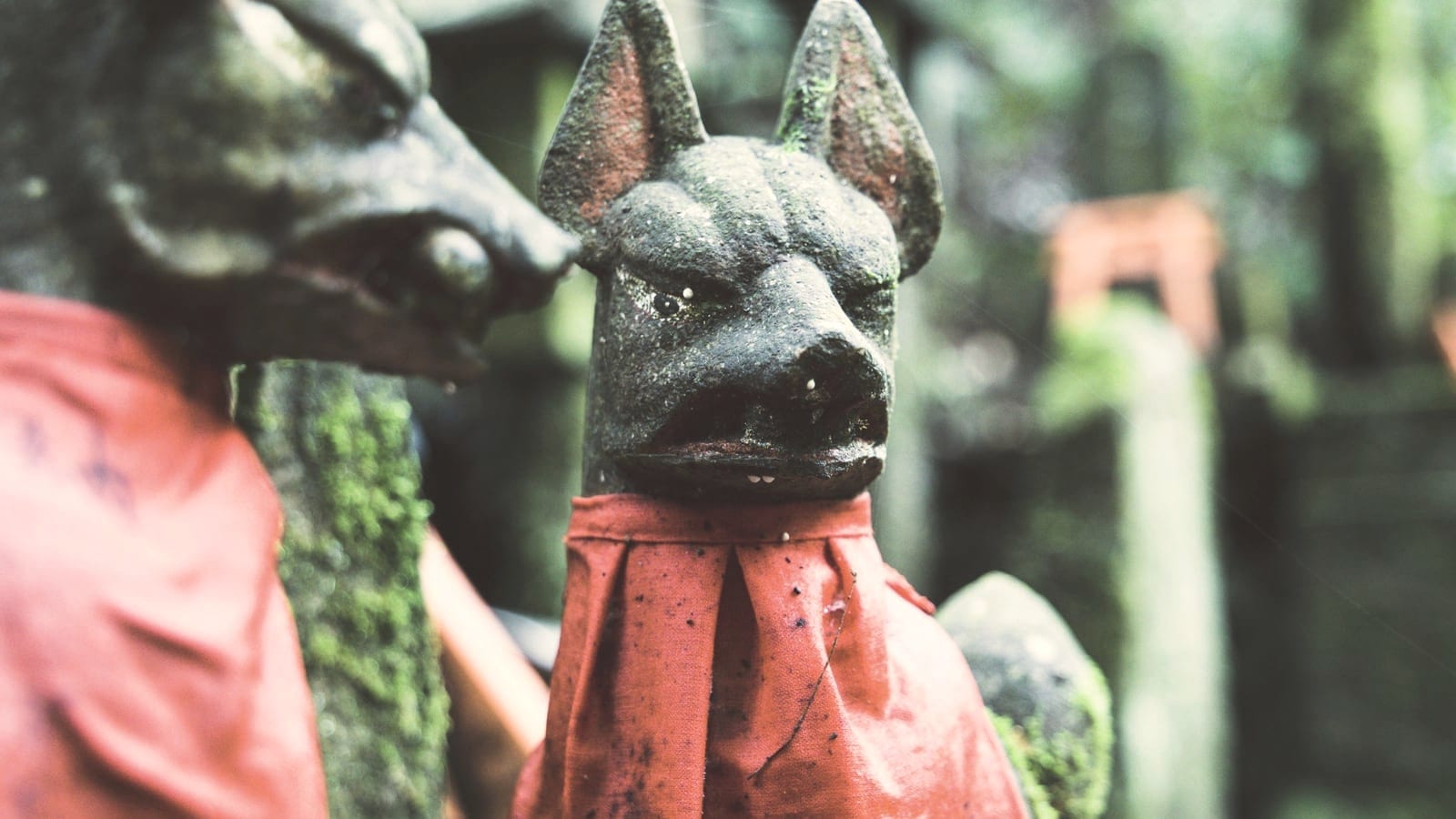
The first is the religious tradition — the fox as Inari’s messenger. These foxes are zenko, roughly translated as “good foxes” or “celestial foxes.” They operate within a divine framework, mediate between humans and the kami, and are approached with respect at shrines. They reward proper observance and sincerity.
The second is the folk tradition — the fox as shapeshifter, trickster, and spirit of the wild. These foxes are yako or nogitsune, field foxes or wild foxes. They are not evil exactly, but they are outside the divine order, unpredictable, and capable of causing real harm — possession, illness, delusion, misfortune.
The two traditions coexist in Japanese culture. A fox at a shrine is a zenko. A fox in a folk story about a man led off a mountain path at night is probably a yako.
The shapeshifting problem
Kitsune are famous for taking human form — usually beautiful women, in the most common version of the stories. This shapeshifting is neither good nor evil by itself; it is a power.
What gives the shape its moral weight is intent. Kitsune who take human form in folk stories sometimes live among humans as wives or companions for years — genuinely connected, genuinely caring. The tragedy in these stories is usually the moment of discovery: the fox is revealed, the disguise breaks, and the relationship dissolves.
These are not stories about evil disguising itself. They are stories about the difficulty of connection across worlds, about what is lost when the hidden thing is named.
Why the ambiguity is the point
Japan’s folk tradition is not built on a simple moral binary of good spirits and evil spirits. The more powerful a being, the more likely it is to exceed any simple category.
Kitsune sit at a threshold. They are animals, but they are not only animals. They are messengers, but not always obedient ones. They are present at sacred sites and in dark forests simultaneously.
The useful frame is not “are they good or evil?” but “what is this fox doing, for whom, and in what relationship?”
That ambiguity is not a gap in the tradition. It is the tradition.