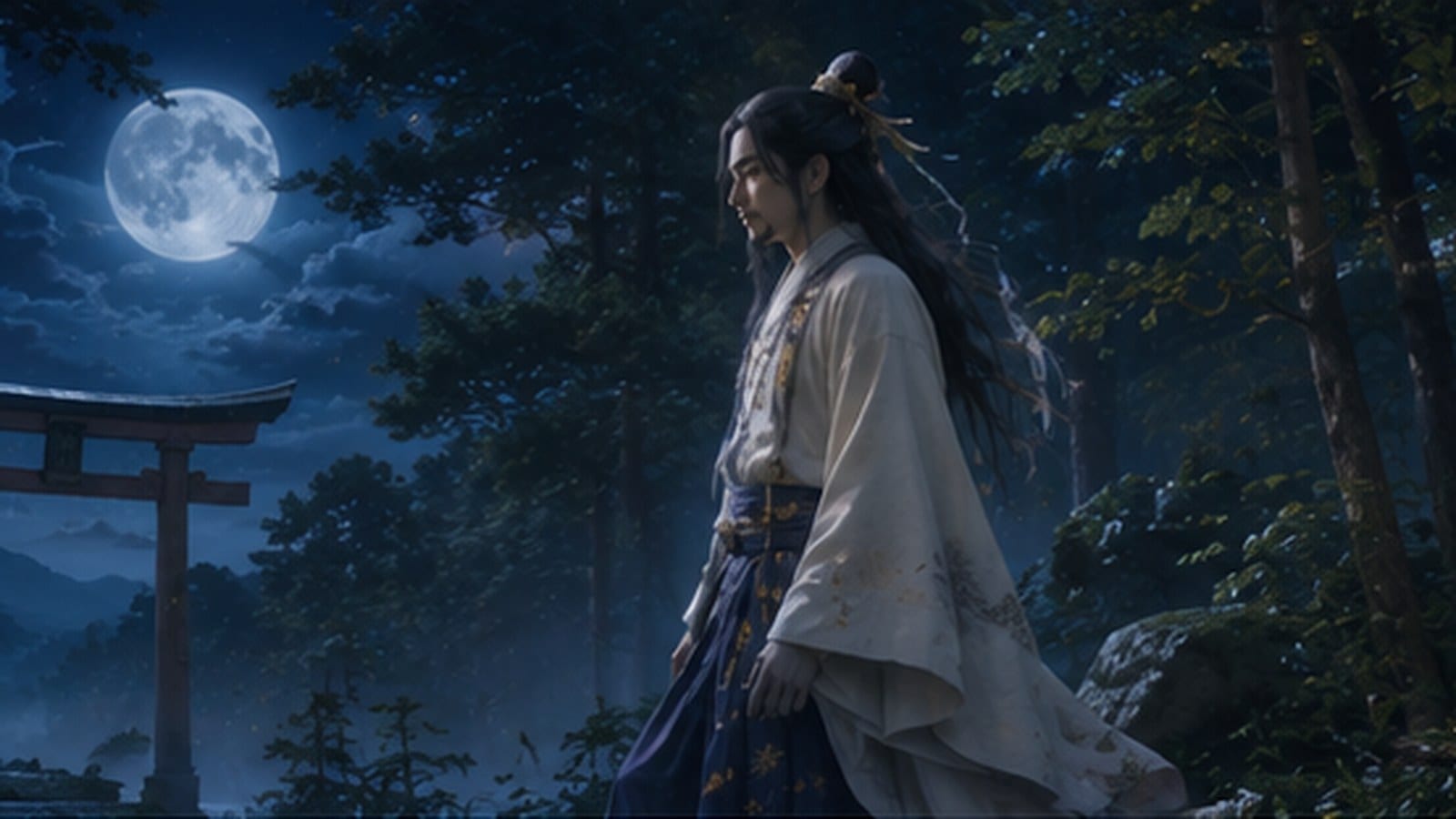
Amaterasu (sun), Susanoo (storm), and Tsukuyomi (moon). The Kojiki calls them the Three Noble Children — three siblings of special standing.
But while Amaterasu and Susanoo each carry rich myths, Tsukuyomi’s stories are almost entirely absent.
In this series, Tsukuyomi is the unusual case. The lack of stories is, in a way, what defines him.
Who he is
Tsukuyomi (月読命) is described as a male god in the Kojiki.
He is associated with the moon, the night, and the passage of time as measured by the moon’s phases. His name itself — Tsuki-yomi — means something like reading the moon, in the sense of reading time from its cycles.
The Kojiki’s division goes: Amaterasu rules the day, Tsukuyomi rules the night, Susanoo rules the sea.
That assignment is made — and the story essentially stops there.
The quietness in the Kojiki
There is almost no substantive narrative about Tsukuyomi in the Kojiki.
He appears at the moment of his birth from Izanagi, and at the moment of being assigned the night, and that’s nearly all. After that, his story dissolves into the background.
Was this loss in the transmission? Was he never a strongly storied kami to begin with? Scholars don’t agree on one answer.
The absence of stories is, in a real way, the shape of Tsukuyomi.
An alternate version in the Nihon Shoki
The Nihon Shoki preserves a little more — most notably an alternate version about Ukemochi, a food deity.
In this version, Amaterasu asks Tsukuyomi to visit Ukemochi on earth. Ukemochi hosts him by producing food from her mouth.
Tsukuyomi finds this defiling and kills her.
From her body, the Nihon Shoki says, rice, wheat, beans, and cattle and horses were born — making this one of the origin stories of food.
When Amaterasu hears what he did, she is so angry that, from that day on, sun and moon never share the sky.
This story is one of several alternates in the Nihon Shoki, and is not in the Kojiki. The Kojiki places a similar structural story with Susanoo as the actor instead. The same shape of myth landing on two different gods, depending on which book you read.
What we can read from the fragments
Personality is hard to draw from so little. But what’s preserved suggests:
- A quiet figure, rarely stepping forward
- A god given a role, but not one who pushes to define himself
- In the Nihon Shoki version, a sensitivity (or even rigidity) about cleanliness
He doesn’t have the brightness of Amaterasu or the volatility of Susanoo. But like the moon hanging silently in the sky, being unspoken-of is its own kind of presence.
Other gods around him
The Three Noble Children stand together as a unit:
- Amaterasu — sister, ruler of day
- Susanoo — brother, ruler of sea and storm
The three were born when their father Izanagi performed the cleansing after returning from the underworld — Amaterasu from his left eye, Tsukuyomi from his right eye, Susanoo from his nose. Born together, they are read together.
Where to meet him today
Tsukuyomi shrines are not numerous, but they exist in quiet corners across Japan:
- Tsukiyomi Jinja (Kyoto, an auxiliary shrine of Matsuo Taisha)
- Tsukuyomi-no-miya (Ise — an auxiliary shrine of the inner Ise complex)
- Gassan Jinja (Yamagata, one of the Dewa Sanzan — Three Mountains of Dewa)
- Local Tsukiyomi and Tsukuyomi Jinja here and there
If you visit Ise, you can extend the walk to Tsukuyomi-no-miya. The air there is noticeably quieter than the main shrines — more in keeping with the kami it enshrines.
For shrine etiquette in general, see How to Visit a Shrine.
A closing note
Tsukuyomi is a god whose silence is part of his identity.
The next time you look up at the moon, it might shift the feeling slightly to know that there’s a kami who lives there in the mythology — a quiet presence who has simply remained, without needing to say much.