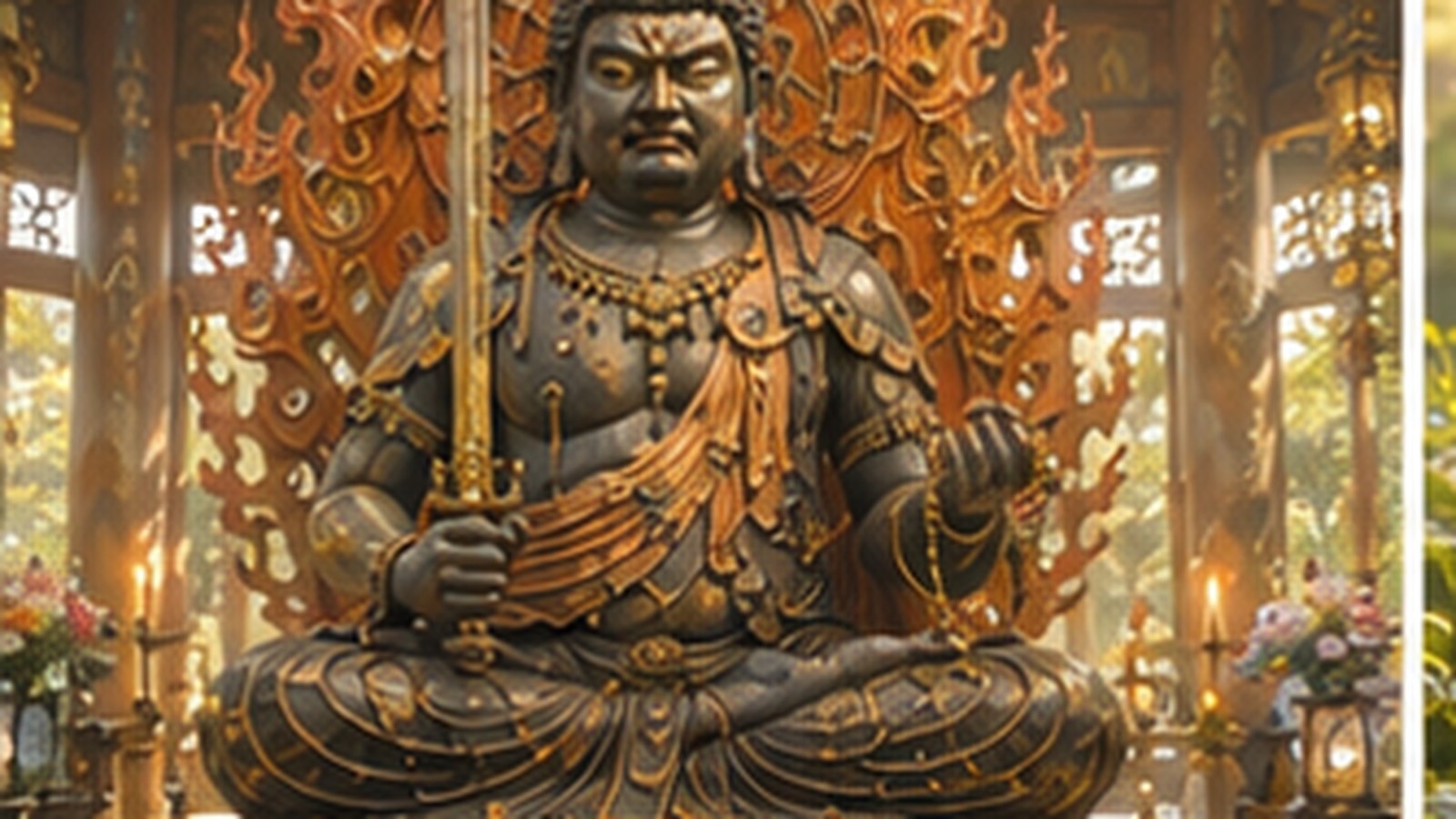
The Aizen Hall at Saidai-ji in Nara. Inside the dim hall.
A figure with red skin and six arms sits on a lotus throne, wearing a lion-headed crown. One hand draws a bow. The expression is wrathful — but not the same kind of fury as Fudō Myōō. Something hotter, more charged.
This is Aizen Myōō (愛染明王).
Among Buddhist figures, Aizen sits at a particularly unusual place: he takes the emotion that Buddhism has warned against most — desire — and turns it directly into awakening. A figure built on a paradox.
Who he is
Aizen belongs to the Myōō (Wisdom King) layer.
The Sanskrit name Rāgarāja means “the King of Passion / Desire.” Rāga refers to passionate desire as a defilement; rāja is “king.” So: King who rules over desire.
What Aizen is associated with:
- Transforming desire into awakening
- Marriage and matchmaking
- Family harmony
- The dyeing trades — by association with the character 染 (“to dye”) in his name
Where Fudō cuts delusion away, Aizen turns desire itself into the energy of awakening — a distinctly esoteric reversal.
”Turning desire into awakening”
Mainstream Buddhism has treated desire (kleshas) as something to be set aside. It blocks awakening.
Esoteric Buddhism (mikkyō) introduces a different angle:
Bonnō soku bodai (煩悩即菩提) — defilements themselves are awakening.
If you don’t avert your gaze from the deepest human emotions, what’s hidden inside them is the very energy of awakening. Aizen embodies this idea in one body.
He doesn’t deny passion. He grasps it — and turns it.
What his statue looks like
Aizen makes a strong impression:
- Red skin — the color of passion and desire
- Three eyes — a third eye on the forehead
- A lion-headed crown — the lion (king of beasts) as a symbol of wisdom
- Six arms, each holding a different object
- Seated on a lotus throne
The six arms typically hold:
- A bow and an arrow — for shooting the arrow of desire / striking defilements
- A vajra (五鈷杵) and a vajra bell — esoteric ritual implements
- A lotus
- One hand left to form a mudra
The most recognizable detail is the bow-drawing pose — Aizen with the arrow notched and the string pulled back.
”Love-tinted” and matchmaking
From the Heian period (794–1185 CE) through the medieval era, Aizen held an important place inside esoteric rituals. Over time, popular faith rotated the figure toward something more domestic: a matchmaking god.
Romance, marriage, family harmony — the figure that grasps the power that draws people together came to be associated with these everyday human bonds, rather than only the original sense of passion-as-defilement.
People still visit Aizen-centered temples to pray for relationships today.
Patron of the dyeing trades
The character 染 in his name means “to dye.” From that, Aizen also came to be venerated as a guardian of dyeing and textile workers.
This is a folk association built on a play of characters, but it’s been part of the textile and craft world — especially around Kyoto and Osaka — for many centuries. There are still places in Kyoto where dyers regularly visit Aizen.
Schools that center him
Aizen is most centered in:
- Shingon — the primary esoteric context
- Tendai — through its esoteric stream
- Shugendō — mountain ascetic tradition
He is often paired with Fudō Myōō as the “two great Myōō” of Esoteric Buddhism, and temples frequently enshrine both.
Where to meet him today
Major places:
- Saidai-ji Aizen-dō (Nara) — the central image is a Kamakura-period seated Aizen
- Jingo-ji (Kyoto, Takao) — Aizen sculpture
- Tō-ji (Kyoto) — within Kūkai’s three-dimensional mandala
- Kakuon-ji (Kamakura) — Aizen image
- Kume-dera (Nara) — old Shingon temple
The Aizen-dō at Saidai-ji draws steady streams of visitors during the Hatsu-Aizen festival in January and the Aizen festival in June.
Temple etiquette: bow with palms together, no clapping.
A closing note
Aizen Myōō is the figure that doesn’t disown the emotion Buddhism most warned against.
Red skin, six arms, the arrow drawn — each element of the iconography reads as an emotional intensity refusing to be repressed, and being aimed at awakening instead.
The pull people feel toward each other isn’t dismissed as obstacle. It’s read as a possible road in.
For someone praying for a relationship, someone surprised by their own feelings, someone trying to hold a strong emotion without turning away — standing in front of Aizen can be a meaningful gesture, even now.