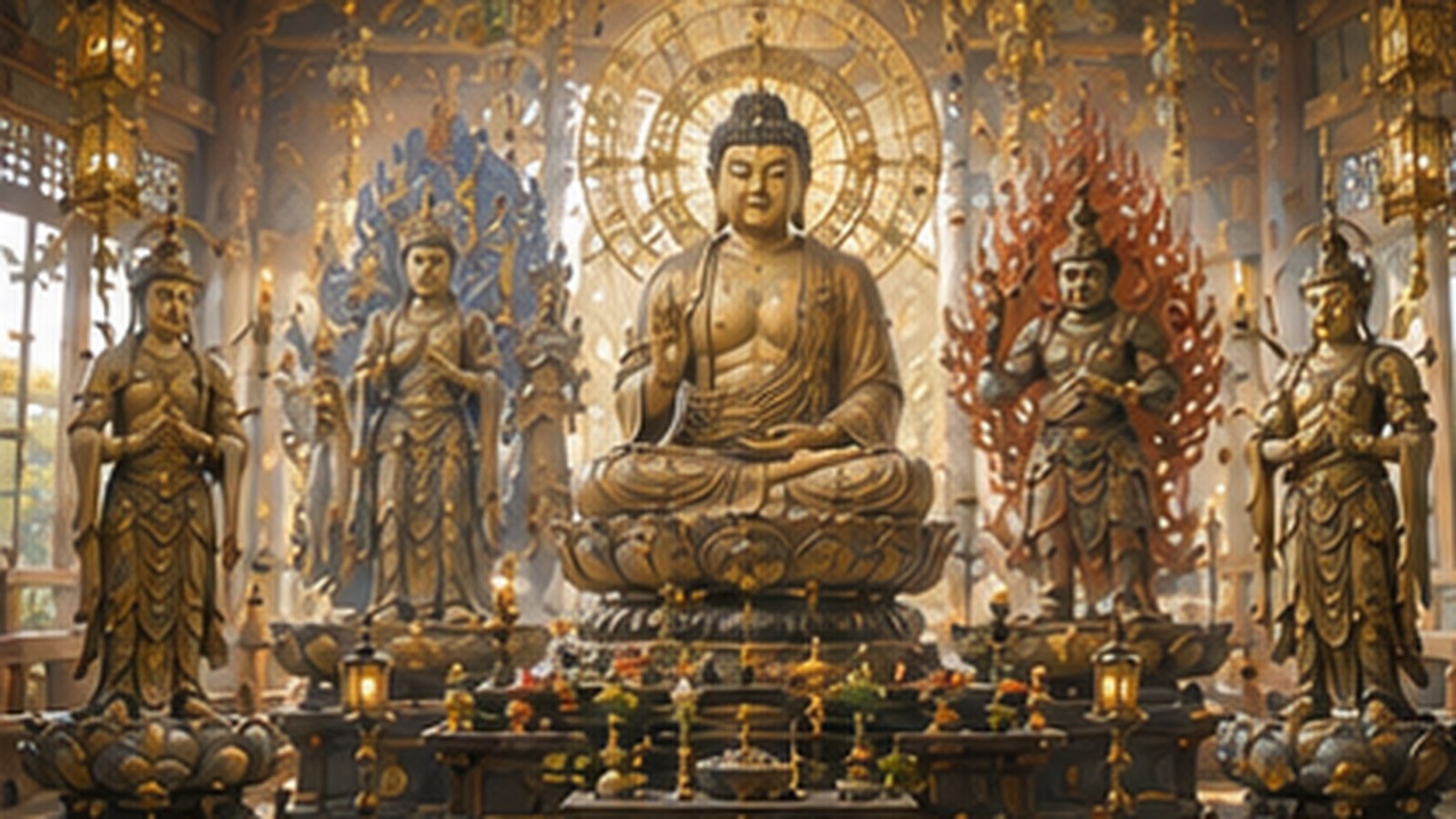
Step into the main hall of a Japanese Buddhist temple and you’ll often see a large figure seated deep in the dim back of the room.
Soft light around it, a serene expression, and a hand held in a posture that looks like it means something specific. Most people leave the temple still wondering: who exactly was that?
This page is the entry point to Buddhas you meet at Japanese temples. It’s not a textbook; it’s a map for anyone who wants a quiet sense of the world they’re stepping into.
Buddhas and kami are two different worlds
Because Buddhism and Shintō have lived side by side in Japan for over a thousand years, it’s easy to mix them up. The cleanest first cut is:
- Kami belong to Shintō and are enshrined in shrines (神社)
- Buddhas belong to Buddhism and are enshrined in temples (寺)
Shintō is a religion that grew in Japan, centered on natural presences and ancestors called kami. Buddhism originated in India, traveled through China and Korea, and reached Japan in the 6th century, organized around the idea of awakening (enlightenment).
This series introduces the figures you meet on the Buddhist side, one by one.
Buddhism has a soft hierarchy of figures
A “Buddha figure” can mean many things. Traditionally, Japanese Buddhism organizes them into four broad layers. We’re not treating these as strict doctrine — they’re a way to read a temple.
1. Nyorai (如来) — Fully Awakened Ones
Beings who have completed awakening. These sit at the center.
Most common Nyorai:
- Shakyamuni (the historical Buddha, founder of Buddhism)
- Amida (Amitābha — Buddha of the Pure Land)
- Dainichi (Mahāvairocana — the cosmic Buddha)
- Yakushi (Bhaiṣajyaguru — the Medicine Buddha)
Statue features: plain, unadorned. The post-awakening figure has set aside princely robes. Each Buddha holds its hands in a specific mudra (印相) that carries meaning.
2. Bosatsu (菩薩) — Bodhisattvas
Beings on the way to awakening, working to help others. Often described as one step before becoming a Nyorai — but in practice they’re the figures closest to everyday life.
Common Bosatsu:
- Kannon (Avalokiteśvara)
- Jizō (Kṣitigarbha)
- Miroku (Maitreya)
- Monju (Mañjuśrī)
- Fugen (Samantabhadra)
Statue features: ornate. Crowns, jeweled necklaces, flowing robes — the look of a prince who hasn’t renounced everything yet. The exception is Jizō, who appears as a simple monk — that’s part of why Jizō feels so close to ordinary life.
3. Myōō (明王) — Wisdom Kings
Wrathful figures who cut through delusion. They look angry, but the anger is a means — the fierce face is, in Buddhist tradition, compassion turned outward to remove obstacles.
Common Myōō:
- Fudō Myōō (Acala)
- Aizen Myōō (Rāgarāja)
- Kujaku Myōō (Mahāmāyūrī)
Statue features: flames behind them, weapons in hand, fierce expression. Most often found in Esoteric Buddhist temples (Shingon and Tendai schools).
4. Tenbu (天部) — Devas
Gods who guard the Buddhist law. Originally Hindu deities absorbed into Buddhism as it spread. They handle worldly matters — battle, music, commerce, prosperity.
Common Tenbu:
- Bishamonten (Vaiśravaṇa)
- Benzaiten (Sarasvatī)
- Daikokuten (Mahākāla)
- Taishakuten (Indra)
- Bonten (Brahmā)
Many of the Seven Lucky Gods belong to this layer. In Japan, the line between Tenbu and Shintō kami can blur considerably.
Figures who don’t fit the layers
Some figures sit outside or across these four layers:
- Bodhidharma (Daruma) — the patriarch of Zen. A historical monk who became an object of devotion
- Enma (King of Hell) — closely tied to Jizō Bodhisattva
- Kūkai (Kōbō Daishi) — a historical Japanese monk venerated as something close to a Buddha
Buddhism has spent centuries blending with local folk traditions across East Asia. Many of the figures you meet at a temple sit in this in-between space.
The twelve figures in this series
In Buddhas you meet at Japanese temples, we’ll introduce twelve figures one by one.
- Shakyamuni Nyorai (the historical Buddha, enshrined at Zen head temples like Sōji-ji)
- Amida Nyorai (the Pure Land Buddha — Byōdō-in)
- Dainichi Nyorai (the cosmic Buddha — Kōya-san)
- Yakushi Nyorai (the Medicine Buddha — Yakushi-ji)
- Kannon Bosatsu (Kiyomizu-dera, Sensō-ji)
- Jizō Bosatsu (roadside stones, Adashino Nenbutsu-ji)
- Miroku Bosatsu (the future Buddha — Kōryū-ji)
- Monju Bosatsu (wisdom on a lion)
- Fudō Myōō (Narita-san Shinshō-ji)
- Aizen Myōō (Saidai-ji)
- Bishamonten (Kurama-dera, Shigi-san)
- Daruma Daishi (the patriarch of Zen, the red round doll)
Each figure has its own role and its own iconography. Once you can read what’s in a Buddha’s hands, or who’s behind the flames, or why a monk’s statue holds a staff, the back of the hall starts to feel a little closer.
Before you visit a temple
You don’t need to know any of this to visit a temple. Knowledge isn’t a prerequisite for joining your hands together.
But knowing a little — what the hand position means, what the object is, whose role this is — makes the figure in front of you start to feel like a specific presence rather than a generic statue.
For practical guidance, our How to Visit a Shrine article covers shrine etiquette; temples differ slightly (no clapping at a temple — only quiet bowing with hands together).
This series exists for that small shift — when the dim back of a temple hall starts to feel a little more legible than before.