The Phoenix Hall at Byōdō-in in Uji. A vermillion building whose wings seem to spread across a reflecting pond.
At the center sits a great gold figure, quiet, very large. That’s Amida Nyorai (阿弥陀如来).
Amida is also probably the most commonly enshrined Buddha on Japanese household altars. He is, in a real sense, the Buddha closest to Japanese deaths and funerals.
Who he is
Amida is a Nyorai — a fully awakened Buddha.
“Amida” is a Japanese rendering of the Sanskrit “Amita” (immeasurable), “Amitābha” (infinite light), or “Amitāyus” (infinite life). He is understood as a Buddha of infinite light and infinite life.
What he is associated with:
- Salvation after death
- Rebirth in the Pure Land (Sukhāvatī, the Western paradise)
- Deep compassion
In Buddhism, the stream centered on Amida is called Pure Land (Jōdo), and it has been one of the largest pillars of Japanese Buddhism for centuries.
The forty-eight vows
Unlike Shakyamuni, Amida’s story isn’t told as a human life. It’s a more symbolic narrative.
According to the Larger Sukhāvatī-vyūha Sūtra, long ago there was a monk named Dharmākara (法蔵, Hōzō).
Wishing to save all beings, Dharmākara made forty-eight vows — each shaped as “if this is not fulfilled, I shall not become a Buddha.” For example:
- The 18th vow: anyone who calls my name with sincere heart shall be reborn in the Pure Land
- The 32nd vow: my land shall be filled with jewels and light, free of suffering
After long practice, every vow was fulfilled, and Dharmākara became Amida Buddha.
This structure — vowed to become a Buddha, fulfilled the vow — is what makes Amida distinctive. He is understood as a Buddha who will come to meet anyone who sincerely calls his name.
The image of the descending Buddha
When Amida is invoked, one image returns again and again: the raigōzu (来迎図), the picture of the descent.
In these paintings, Amida descends on clouds with Kannon and Seishi attending him, coming to meet someone who is dying. Countless versions of this scene were painted from the Heian period (794–1185 CE) onward.
Death isn’t pictured as something only sorrowful — it’s reframed as the moment of being met.
What his statue looks like
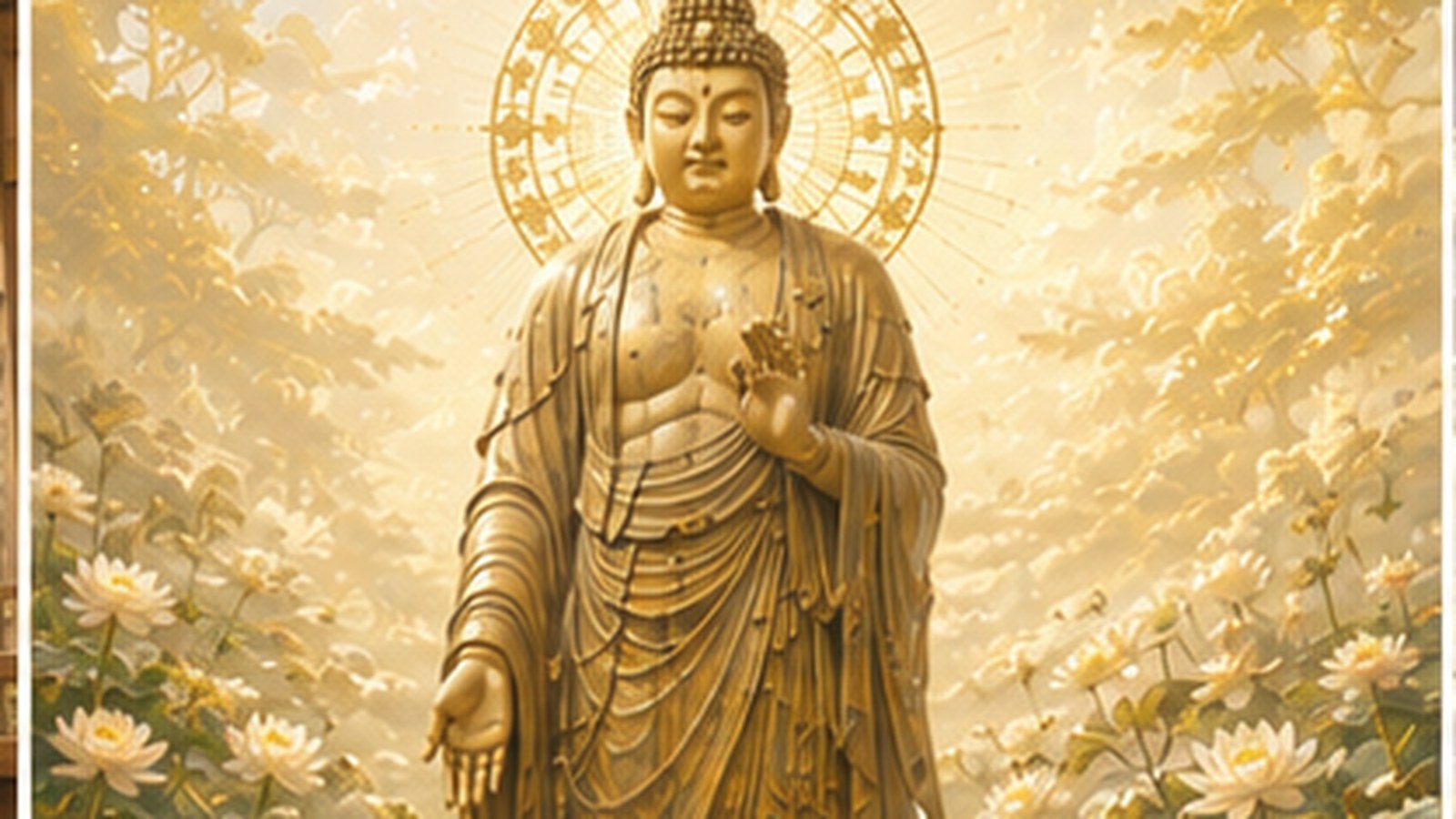
Amida is rendered in several standard mudras:
- Meditation mudra — hands in the lap, seated. The Byōdō-in figure is in this form
- Descent mudra (来迎印) — standing, with the hands forming circles as he descends
- Teaching mudra — preaching
One particularly striking form: at Eikan-dō in Kyoto, the Mikaeri Amida (“Looking-Back Amida”) shows him pausing mid-step to turn back — a gesture explained as “waiting for the ones who fall behind.”
The robes are plain, like every Nyorai: no princely ornament.
Schools centered on Amida
Schools that take Amida as their principal Buddha:
- Jōdo-shū (founded by Hōnen, 1175 onward)
- Jōdo Shinshū (founded by Shinran, 1224 onward)
- Ji-shū (founded by Ippen, 1276 onward)
These Pure Land schools are one of the great currents of Japanese Buddhism. From the Kamakura period (1185–1333) onward they spread broadly among warriors and commoners alike. The recitation “Namu Amida Butsu” (南無阿弥陀仏) has been one of the closest forms of prayer in everyday Japanese life for many centuries.
Tendai and Shingon also enshrine Amida as an important figure.
Where to meet him today
Major places associated with Amida:
- Byōdō-in Phoenix Hall (Kyoto, Uji) — built by Fujiwara no Yorimichi in 1053. The building on the 10-yen coin
- Chion-in (Kyoto) — head temple of Jōdo-shū
- Higashi Hongan-ji and Nishi Hongan-ji (Kyoto) — centers of Jōdo Shinshū
- Eikan-dō (Kyoto) — the famous “Looking-Back Amida”
- Kamakura Daibutsu (Kanagawa) — a colossal seated Amida at Kōtoku-in
- Taima-dera (Nara) — tied to the descent imagery
The Amida at Byōdō-in, attributed to the sculptor Jōchō, is considered one of the high points of Japanese Buddhist sculpture.
In homes, if a household follows a Pure Land school, the central image on the family altar is most often Amida.
Temple etiquette: bow with palms together, no clapping.
A closing note
Amida is the Buddha who has stayed closest to Japanese deaths and farewells — the figure of being met, no matter what.
Standing in front of the pond at Byōdō-in, the golden figure inside has received the silent prayers of nearly a thousand years. Carrying that thought with you can change how the water at the edge of the temple feels.