“Three heads together make Monju’s wisdom” — Sannin yoreba Monju no chie.
It’s one of those Japanese sayings everyone knows. The figure inside that saying — Monju Bosatsu (文殊菩薩) — is the bodhisattva who handles wisdom.
When students pray for academic success, when someone feels stuck on a hard problem, when a decision needs clarity — Monju is the figure people have turned to for centuries.
Who Monju is
Monju belongs to the Bosatsu (Bodhisattva) layer.
The name translates Sanskrit Mañjuśrī (妙吉祥) — “wonderful auspiciousness.”
What Monju is associated with:
- Wisdom — seeing into the nature of things
- Learning — the deepening of knowledge
- Speech — careful thought, careful words
- Guidance on the bodhisattva path
Alongside Amida’s compassion, Yakushi’s healing, and Kannon’s listening, Monju’s wisdom is one of the pillars of the bodhisattva ideal.
Shakyamuni’s attendant
Monju takes an important place in the Shaka Triad — Shakyamuni Buddha flanked by two bodhisattvas:
- Center: Shakyamuni Nyorai
- Left (right from the viewer): Monju Bosatsu — wisdom
- Right (left from the viewer): Fugen Bosatsu — practice
Thinking (Monju) and doing (Fugen), framing Shakyamuni’s teaching.
When you see a Shaka triad, look for the one on a lion — that’s Monju.
On the back of a lion
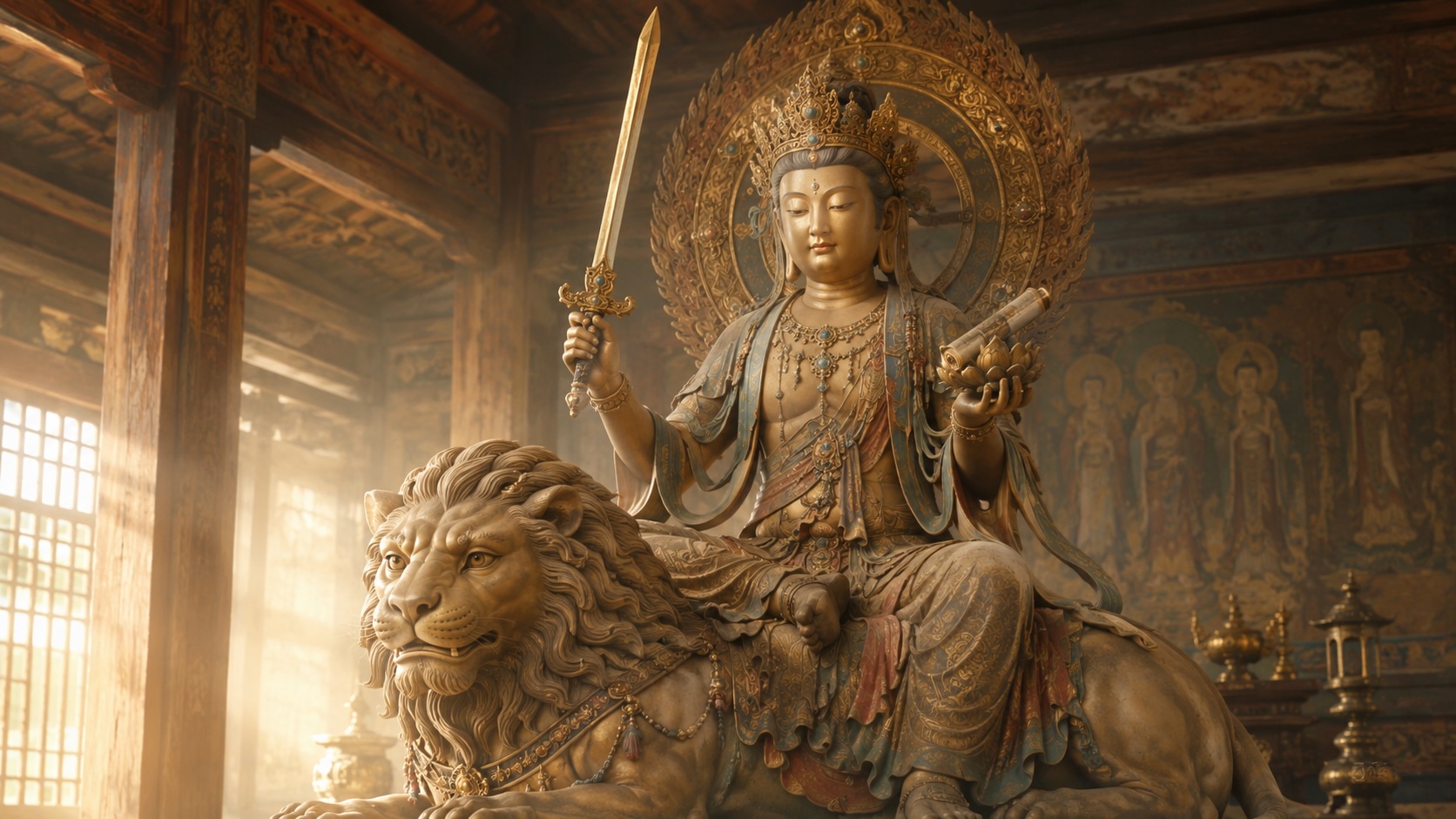
The clearest distinguishing feature of Monju: he rides a lion.
The lion — king of beasts — symbolizes the strength of wisdom. Not soft wisdom: wisdom sharp enough to cut through delusion.
Visual features:
- Mounted on a lion (or seated on a lotus throne placed on a lion’s back)
- Holds a sword in the right hand — to cut through delusion
- Holds a sūtra scroll or a lotus in the left hand
- Bodhisattva-style princely ornament (crown, jewelry)
A note: holding a sword isn’t only the wrathful Wisdom Kings’ visual. Monju has one too. The difference: where Fudō Myōō’s sword burns away delusion, Monju’s sword cuts cleanly between things — discernment as wisdom.
”Three heads make Monju”
The proverb means: even ordinary people, when three of them think together, can reach something like Monju’s wisdom. The phrase reaches back into Edo-period (1603–1868) folk usage and reflects how thoroughly the bodhisattva of wisdom had settled into ordinary Japanese speech.
A nuance: Monju’s wisdom isn’t “lots of opinions in one room.” It’s wisdom that sees through to the essence. The proverb says that this depth isn’t only reserved for the lone genius — that it can also gather inside a group.
Eight-character and five-character Monju
In Esoteric Buddhism (Shingon, Tendai), Monju is classified by numbers tied to his mantras:
- One-character Monju
- Five-character Monju — the most common, tied to the syllables A-Ra-Pa-Cha-Na
- Eight-character Monju
- Six-character Monju
Each variant has its own ritual context. Temples enshrining a specific form will name it.
Schools and traditions
Monju is venerated across many schools:
- Hossō (Kōfuku-ji, Yakushi-ji)
- Tendai and Shingon — important in esoteric ritual
- Zen — Monju is often placed at the center of the meditation hall (sōdō) or the dining hall (jikidō)
The Zen choice is meaningful: practice itself is the polishing of wisdom — Monju at the center of a meditation hall expresses that view.
Prayers before exams
The most familiar contemporary use of Monju is exam-season pilgrimage. Students and parents visit Monju-centered temples to pray for academic success and hang ema prayer plaques requesting it.
The proverb is still alive in everyday speech. The role of “the bodhisattva of wisdom” hasn’t changed.
Where to meet him today
Major places:
- Chion-ji (Kyoto, Amanohashidate) — famous Monju hall; one of Japan’s “Three Great Monju”
- Abe Monju-in (Nara, Sakurai) — another of the Three Great Monju; lion-mounted Monju statue
- Daishō-ji (Yamagata, Kameoka) — the third of the Three Great Monju
- Kōfuku-ji (Nara) — a Kamakura-period Monju paired with the layman Vimalakīrti (Yuima)
- Tōdai-ji (Nara) — Monju images in the Hokke-dō and other halls
- Zen monastery dining and meditation halls across the country
The Three Great Monju are the historical pilgrimage centers.
A closing note
Monju is the bodhisattva of thinking, discerning, cutting between things — wisdom itself, given a face.
The lion, the sword, the scroll — every element of the iconography speaks to a sharper kind of clarity, the kind that cuts through what wouldn’t otherwise come apart.
When you’re stuck — on a question, a decision, an exam — visiting a Monju temple isn’t a strange thing to do, even now. The bodhisattva is open not only to students, but to anyone short of an answer.