Tucked into a residential corner of Tsurumi in Yokohama, a vast temple precinct opens up — long corridors, deep groves of trees, and the constant quiet movement of monks.
This is Sōji-ji (總持寺), one of the two head temples of Sōtō Zen.
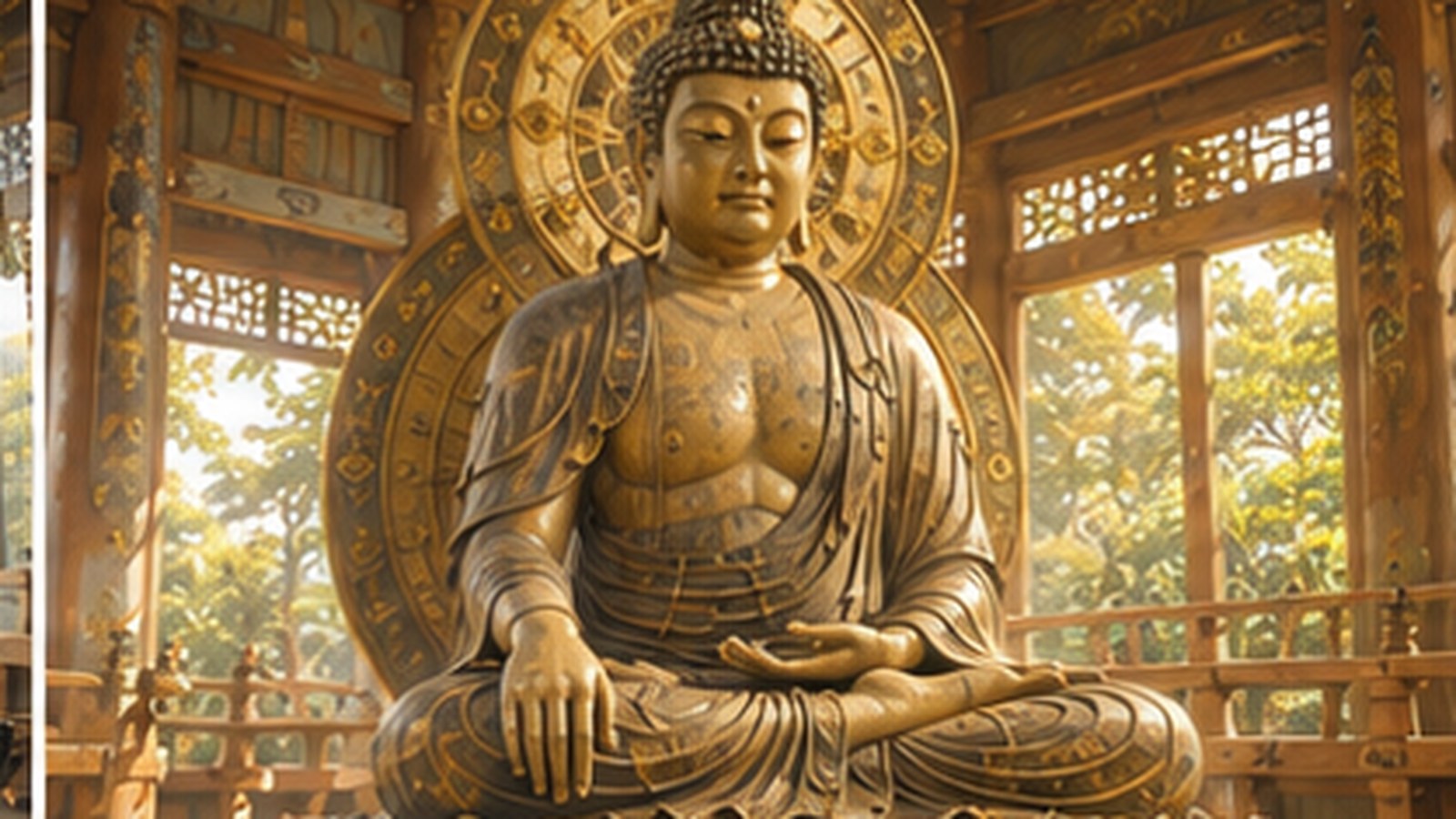
In the center of the main hall, in soft light, sits a wooden seated figure: Shakyamuni Nyorai (釈迦牟尼如来).
He is the Buddha at the beginning of everything in Buddhism — and in Zen temples, he sits at the literal center of the world. He’s probably the most commonly enshrined Buddha across Japan as the honzon (principal image).
Who he is
Shakyamuni belongs to the Nyorai layer — the fully awakened Buddhas.
“Shakyamuni” refers to Gautama Siddhārtha, a historical figure who lived in northern India around the 5th or 6th century BCE. Born a prince of the Shakya clan, he renounced his royal life at 29 and reached awakening at 35, after which he was called “Buddha” — the Awakened One.
The name Shakyamuni is a Sanskrit term meaning “Sage of the Shakya clan,” transliterated into Japanese as 釈迦牟尼. In everyday Japanese he is often simply called Oshaka-sama (お釈迦様). When you see “Shaka Nyorai” written, that’s the same Buddha.
The starting point of every Buddhist story
All of Buddhist tradition begins with Shakyamuni.
The classical account: born under the trees of Lumbini, raised in a sheltered palace, he was deeply shaken when he encountered an old man, a sick man, a corpse, and a wandering ascetic on a walk through the streets. With the question can humans escape this suffering? lodged in him, he left his family and his throne and became a wandering seeker.
After years of severe austerity, he sat under a Bodhi tree, entered deep meditation, and reached awakening.
He spent the next 45 years teaching across northern India and died at 80. This is the broad arc traditionally told.
What his statue looks like
Shakyamuni is shown in several standard forms:
- Seated — the meditation pose, most common in Zen temples
- Standing — teaching, or moving toward final nirvana
- Newborn Buddha (誕生仏) — a small standing image of the infant Shakyamuni pointing one hand to the sky and one to the earth
The general look: plain, simple robes, no princely jewelry. After awakening, he set aside royal ornament. His hands form one of several mudras with specific meanings:
- Meditation mudra (禅定印) — both hands resting in the lap
- Teaching mudra (説法印) — fingers forming a circle
- Fearlessness and granting mudra (施無畏印 / 与願印) — right hand up, left hand down
- Earth-touching mudra (降魔印) — right hand pointing down to the earth, witnessing his awakening
The principal image at Sōji-ji is the seated meditation form — Zen tradition embodied in posture.
Buddhist schools that center him
Schools that take Shakyamuni as their principal Buddha:
- Zen (Sōtō and Rinzai) — returning to Shakyamuni’s own seated meditation as the core practice
- Nichiren-shū — reading the Lotus Sūtra as Shakyamuni’s deepest teaching
- Risshū (Vinaya school) — centered on monastic discipline
Beyond these, every Buddhist school in Japan honors Shakyamuni as the founder. He’s the principal image of countless temples regardless of sect.
For comparison: Pure Land schools place Amida at the center, Shingon places Dainichi, and so on. Knowing which Buddha is principal at a given temple changes how you read what you’re seeing.
Where to meet him today
Major places associated with Shakyamuni:
- Sōji-ji (Kanagawa, Yokohama) — head temple of Sōtō Zen. The wooden seated figure sits quietly in the main hall
- Eihei-ji (Fukui) — the other Sōtō head temple, deep in the mountains
- Kenchō-ji and Engaku-ji (Kamakura) — major Rinzai Zen temples
- Kamakura Daibutsu (Kōtoku-in) — often identified as Amida, but some traditions identify him as Shaka
- Hōryū-ji (Nara) — the Shaka triad (Asuka period)
- Kōryū-ji (Kyoto) — best known for Miroku, but also enshrines Shaka
Sōji-ji is especially worth noting: about 30 minutes by train from central Tokyo, much less touristy than the famous Kyoto/Nara temples, and one of the calmest ways to sit with Shakyamuni in Japan.
Temple etiquette differs slightly from shrine etiquette: at a temple, do not clap. Bow with palms together. For the broader picture, see How to Visit a Shrine.
A closing note
Shakyamuni is the figure at the beginning of all of Buddhism.
No bright ornament, no special object in hand, simply seated — and in that simplicity, awakening itself is said to be present.
Standing in front of the seated figure at Sōji-ji, the stillness in front of you is, in a sense, continuous with what is said to have happened thousands of years ago under a Bodhi tree in northern India. Carrying that thread with you can change how the back of the hall looks.