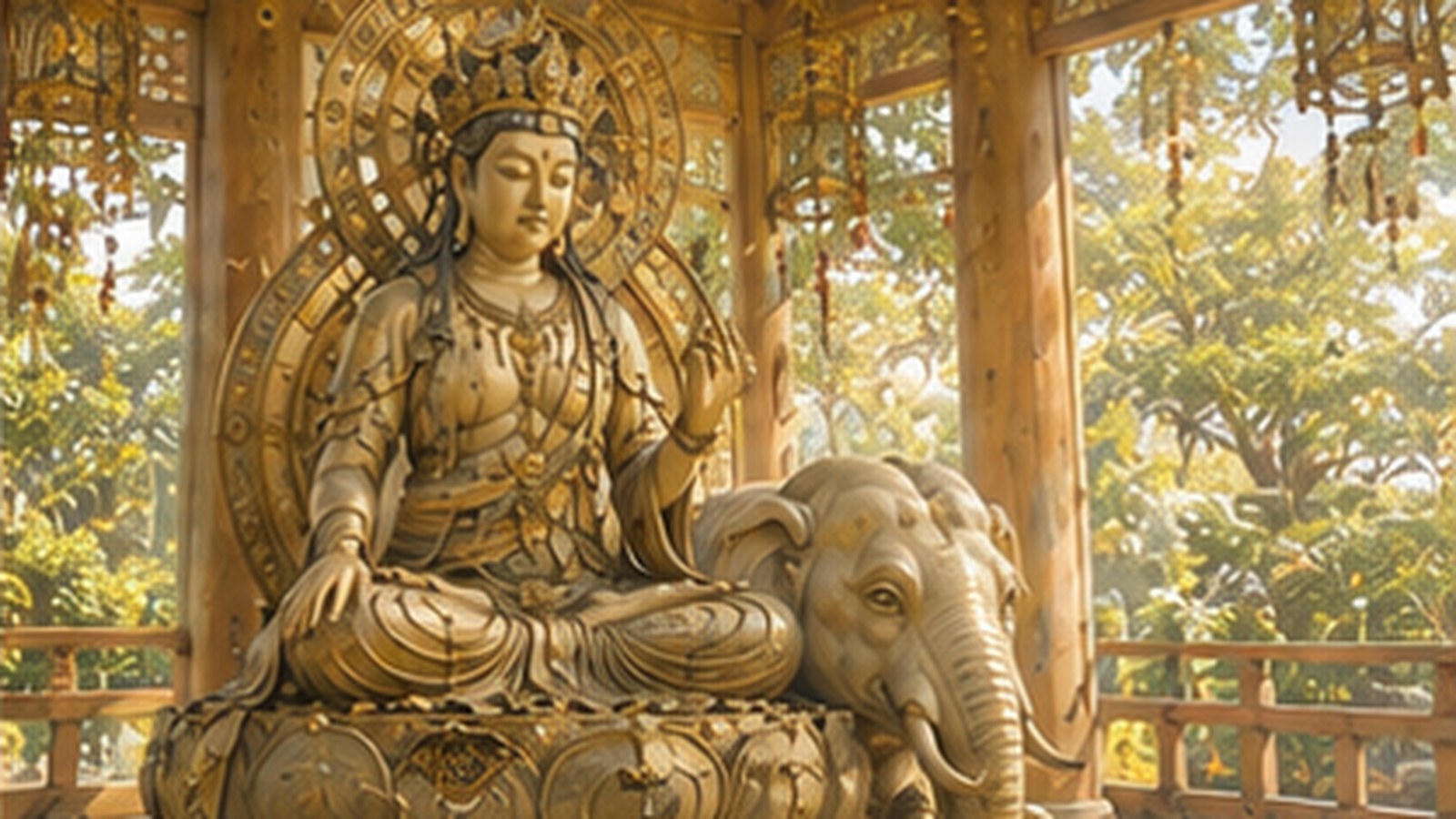
Kōryū-ji in Uzumasa, Kyoto. The dimly lit treasure hall.
In the half-shadow, a wooden figure sits with one leg crossed and a fingertip resting against the cheek, lost in thought.
This is the Miroku Bosatsu Hanka Shiyui-zō — the Half-Seated Contemplative Miroku (弥勒菩薩半跏思惟像).
Made in the Asuka period (592–710 CE), it’s often counted among the most beautiful Buddhist sculptures ever carved anywhere in the world.
What is he thinking about? Why is he seated in contemplation in the back of this room? The answer lies in Miroku’s unusual role.
Who Miroku is
Miroku belongs to the Bosatsu (Bodhisattva) layer.
The name comes from the Sanskrit Maitreya — “the loving one.” Miroku is the next Buddha — the one who will appear on earth long after Shakyamuni’s time and save the beings of that future world.
Right now, in Buddhist tradition, Miroku has not yet become a Nyorai. He’s a Bodhisattva still — waiting for his time.
This in-between status is what makes Miroku distinct.
Waiting in the Tuṣita heaven
Where is Miroku right now, in tradition? The classical answer: in Tuṣita (兜率天, Tosotsu-ten), a heaven within the realm of desire.
There, Miroku is said to be contemplating and teaching, preparing for the moment of descent into this world.
That’s why the famous half-seated thinking figure at Kōryū-ji is shaped as it is. It captures Miroku in Tuṣita, mid-contemplation — endlessly considering how to save beings when his time comes.
The thinking pose is a kind of moment frozen mid-thought: thought itself, made visible.
The “5.67 billion years” number
Tradition says Miroku will descend to earth 5,670,000,000 years after Shakyamuni’s death.
This is less a precise calendar number than a way of saying “an unimaginably long time.” Buddhist time scales — kalpas, asaṃkhyeya kalpas — are built to be larger than any human grasp of duration.
The shape of the idea is what matters: salvation will come, but you must wait beyond all reasonable waiting. That structure has carried both hope and patience for many generations of believers.
The half-seated thinking pose
The most famous form of Miroku is the Hanka Shiyui (半跏思惟) — half-seated contemplative pose:
- Seated on a stool-like base
- Right leg crossed up onto the left knee
- Right hand raised, fingertips lightly resting against the cheek
- A soft expression — somewhere between smile and concentration
This pose existed earlier in Indian and Chinese Buddhist sculpture and reached Japan via the Korean peninsula in the Asuka period.
The Kōryū-ji and Chūgū-ji thinking Mirokus are the canonical Japanese examples.
Standing and seated forms
Miroku also appears in ordinary standing or seated forms, less iconographically distinctive:
- In the Hossō school, Miroku takes a special place because Xuanzang (Genjō Sanzō) brought Miroku images back from Central Asia
- Kōfuku-ji has a Kamakura-period Miroku rendered already as a Nyorai — a forward-looking choice that depicts the future Buddha as if he had already attained Buddhahood
A note on East Asian folk tradition: a laughing, big-bellied figure called Hotei is sometimes identified as an incarnation of Miroku. Japan’s Seven Lucky Gods Hotei comes from that same identification.
Schools and traditions
Miroku is venerated across many schools, but is especially significant in Hossō (Yogācāra) lineages.
- Hossō (Kōfuku-ji, Yakushi-ji)
- Tendai and Shingon
- Local Miroku-dō halls in many places
From late Heian (794–1185) into the Kamakura period (1185–1333), mappō thinking (末法思想) — the idea that the world is descending into a degenerate age — spread widely. The longing for Miroku’s eventual arrival grew alongside it.
Where to meet him today
Major places:
- Kōryū-ji (Kyoto, Uzumasa) — the famous “Treasure One” Miroku, the first item ever designated National Treasure #1
- Chūgū-ji (Nara, Ikaruga) — another Asuka-period contemplative Miroku
- Kōfuku-ji (Nara) — a Kamakura-period Miroku Nyorai
- Murō-ji (Nara) — Miroku hall
- Taima-dera (Nara) — Miroku Buddha statue (Hakuhō period)
The Kōryū-ji and Chūgū-ji figures receive visitors quietly. The Kōryū-ji statue, in particular, has spent more than a thousand years sitting in the dim hall — and that long stillness is part of what you feel standing in front of it.
A closing note
Miroku is the Buddha who has not yet arrived.
While we live our lives, Miroku — somewhere in tradition — is still in Tuṣita, still in contemplation. Standing in front of the half-seated figure at Kōryū-ji, those fingertips against the cheek aren’t a frozen pose; they’re a moment captured from a thinking that has continued, and will continue, far beyond the span we can imagine.
The scale of the time is unlike a human lifetime. And yet — across so many generations — people have continued to believe that the salvation will come, eventually. The figure sits inside that long faith.