Mount Kurama, Kyoto. Thirty minutes by train from the city, then a steep approach climbing through deep cedar forest, and you arrive at Kurama-dera — a mountain temple wrapped in a quiet that the city never reaches.
At the center of its main hall, among the three figures enshrined, stands Bishamonten (毘沙門天).
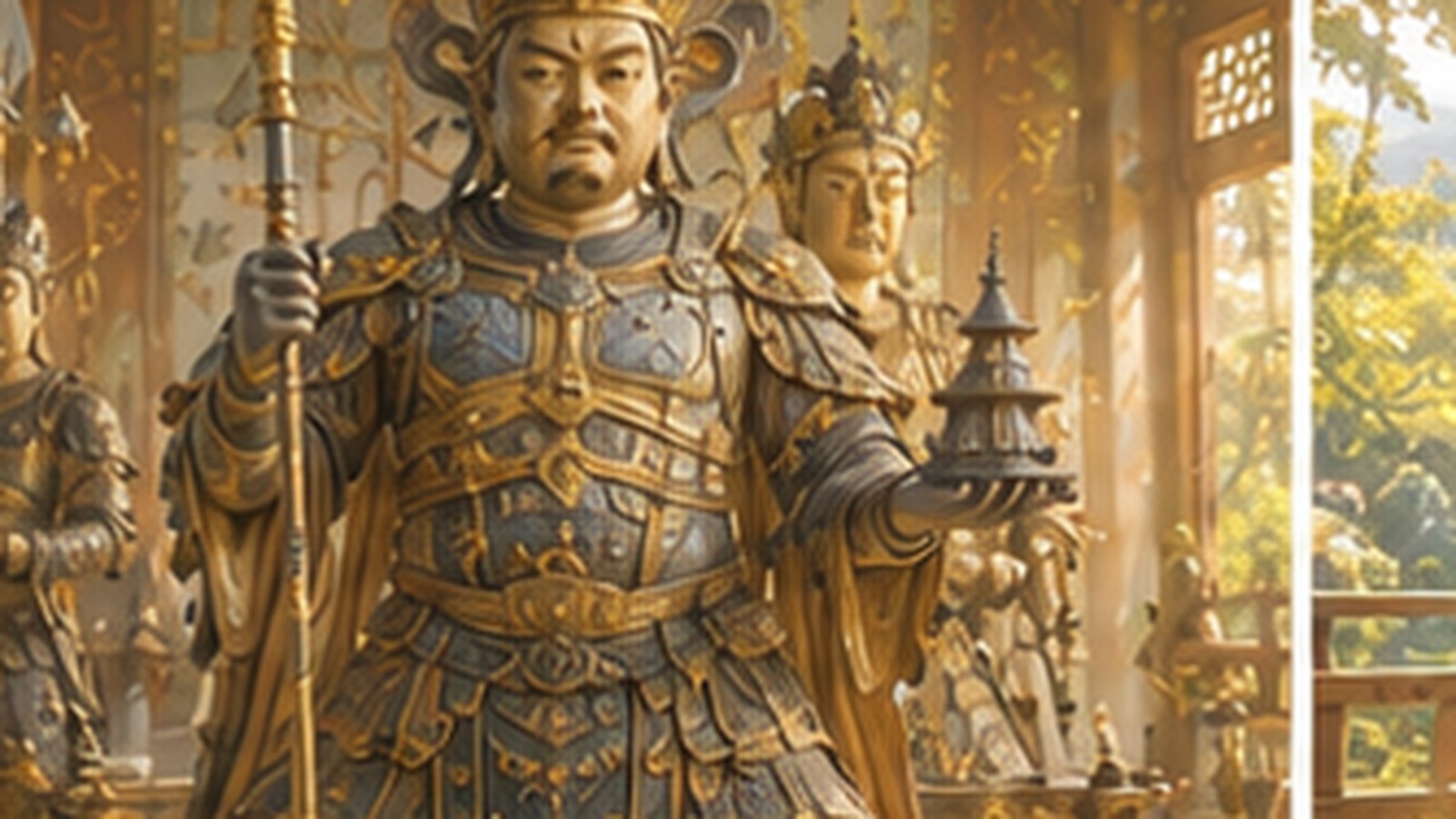
Not the calm presence of a Nyorai or Bosatsu, but an armored warrior. A jeweled pagoda in one hand, a spear in the other, a small demon trodden beneath the feet — among all Buddhist figures, Bishamonten wears the most clearly martial form.
Who he is
Bishamonten belongs to the Tenbu (deva) layer.
The name comes from the Sanskrit Vaiśravaṇa, transliterated into Japanese as Bishamon. He is also called Tamonten (多聞天) — “the one who hears much” — said to have listened carefully and often to the Buddha’s teaching.
What he is associated with:
- Guarding the Buddhist Law (Dharma)
- Martial protection
- Defense of the realm
- Wealth and fortune
The Tenbu layer originates in Hindu deities absorbed into Buddhism as protectors of the Dharma. Bishamonten is one of them — known in India as Kubera, a god of wealth.
Two faces — Four Heavenly Kings and Seven Lucky Gods
Bishamonten carries two distinct identities.
One: the north of the Four Heavenly Kings
In Buddhist cosmology, the four directions of Mount Sumeru — the sacred mountain at the center of the world — are guarded by four armored deities:
- East: Jikokuten (持国天)
- South: Zōchōten (増長天)
- West: Kōmokuten (広目天)
- North: Tamonten (Bishamonten)
These are the Four Heavenly Kings (四天王). You’ll see them standing at the four corners of a temple hall or around a Nyorai — four armored figures, each turned outward. Bishamonten is the one guarding the north.
In this context he is called Tamonten, and is often regarded as the leader among the four.
Two: one of the Seven Lucky Gods
In folk belief, Bishamonten is one of the Seven Lucky Gods (七福神):
- Ebisu
- Daikokuten
- Bishamonten
- Benzaiten
- Fukurokuju
- Jurōjin
- Hotei
In this setting, he is approached less as a warrior and more as a bringer of fortune and prosperity.
What his statue looks like
Bishamonten is easy to recognize:
- Fully armored — wearing both armor and helmet
- A jeweled pagoda in the left hand — a small treasure-tower
- A spear or vajra in the right hand
- A demon trampled underfoot — a small jaki symbolizing defilements and evil
- A dignified, wrathful expression
The detail most particular to him is the pagoda lifted in one hand. The tower is said to contain relics of the Buddha (shari), making it a literal embodiment of “guarding the Dharma.”
The other three Heavenly Kings are also armored and similar in posture, but only Bishamonten carries the pagoda.
Uesugi Kenshin and Bishamonten
In the Sengoku period (c. 1467–1615 CE), one warlord became famous for his deep devotion to Bishamonten: Uesugi Kenshin (上杉謙信).
Kenshin believed himself to be an incarnation of Bishamonten and is said to have prayed at length before the figure’s image before going into battle. His banner bore the single character 毘 (“Bi”) — for Bishamon.
Through figures like Kenshin, Bishamonten became, for medieval warriors, a deeply personal object of devotion.
Sect context
Bishamonten is not the preserve of any one school. He is venerated across many:
- Tendai (Mt. Hiei / Enryaku-ji)
- Shingon (Tō-ji / Mt. Kōya)
- Nara Buddhism (Tōdai-ji / Kōfuku-ji)
- Shugendō
The Tendai temple Kurama-dera and the Shingon-related Shigi-san are both major centers of Bishamonten devotion.
Where to meet him today
Places to encounter Bishamonten:
- Kurama-dera (Kyoto) — mountain temple known for Kurama-tengu; one of the three central figures enshrined
- Shigi-san Chōgosonshi-ji (Nara) — historical center of Bishamonten faith
- Tōdai-ji Kaidan-in (Nara) — National Treasure Four Heavenly Kings
- Kōfuku-ji (Nara) — National Treasure Four Heavenly Kings
- Zenkō-ji (Nagano) — Four Heavenly Kings at the Niō gate
- Tō-ji (Kyoto) — Four Heavenly Kings within Kūkai’s three-dimensional mandala
- Nishinomiya-jinja (Hyōgo) — as one of the Seven Lucky Gods
The Four Heavenly Kings at Tōdai-ji’s Kaidan-in and at Kōfuku-ji are among the finest sculptural works of the Nara and Kamakura periods — and they convey the warrior aspect of Bishamonten more powerfully than almost any other images.
A closing note
Bishamonten is the figure that carries a clearly defined role: to guard the Dharma with martial force.
Guardian of the north in the Four Heavenly Kings; bringer of fortune among the Seven Lucky Gods; tutelary figure of Sengoku warlords; today, often prayed to for prosperity — he holds several faces at once.
Armored, lifting his pagoda, standing on a defeated demon, he has watched over Nyorai and Bosatsu from the corners of temple halls for many centuries. Standing in front of Kurama-dera’s main hall, one can sense — behind the warrior’s stance — the guarding force that has held the mountain in place for so long.