New Year. A round red doll bought from a shop, set on a shelf or near the household altar.
Both eyes are still white. With a brush, you fill in one eye, and make a wish. When the wish comes true, you fill in the other.
That is the Daruma. Anyone who has spent a winter in Japan has seen one.
The doll takes its name and form from Daruma Daishi (達磨大師) — the figure transmitted as the founder of Zen.
Who he is
Unlike the Nyorai, Bosatsu, Myōō, and Tenbu we’ve covered so far, Daruma Daishi is remembered as a historical monk — a real person, not a cosmic figure.
The name is the Japanese transliteration of the Sanskrit Bodhidharma. He is said to have been born into Indian royalty in the 5th–6th century and to have crossed to China carrying the teaching that would later be called Zen.
What he is associated with:
- The spirit of Zen — seated meditation and direct awakening
- Unbroken resolve — a will that doesn’t bend
- Folk fortune — through the doll, a symbol of luck and wish-making
Unlike Nyorai or Bosatsu, Daruma Daishi sits in a particular position: a human being, and at the same time a focus of devotion.
From India to China
Tradition says that Daruma was born as a third prince in India, became a monk in his youth, and trained for many years.
Later he crossed the sea to China, arriving in the southern kingdom of Liang around 520 CE.
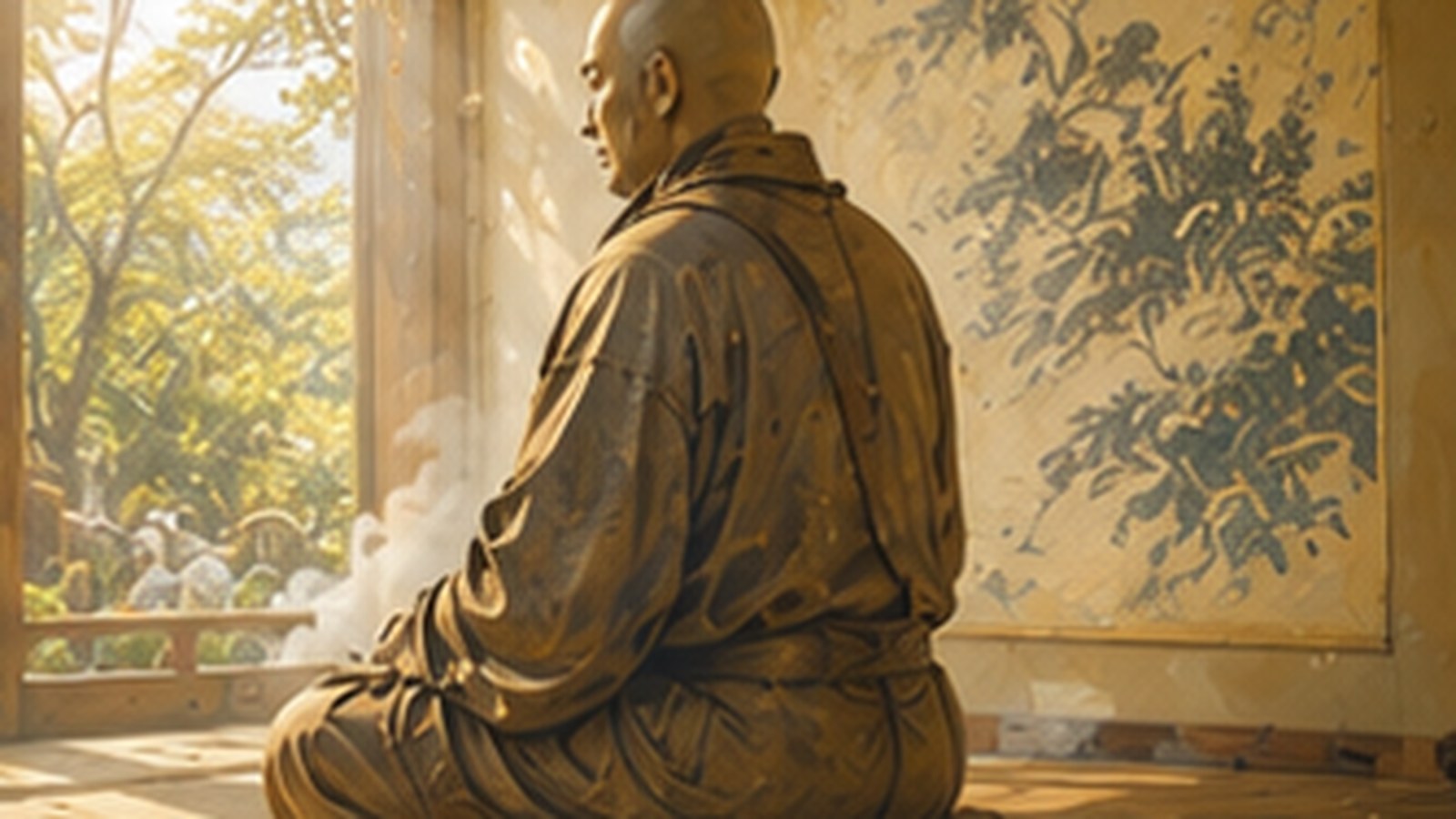
He then moved north from Liang into the kingdom of Wei, where, at Shaolin-ji on Mount Song, he carried out the famous nine years facing the wall — sitting in zazen, turned toward a stone wall, for nine straight years.
He eventually transmitted his teaching to a disciple named Huike (慧可), and from that transmission grew the entire lineage of Zen across China and East Asia.
The story of nine years at the wall
The story that comes up most often when speaking of Daruma is the nine-year wall-facing.
In a cave at Shaolin, Daruma sat facing the wall and barely moved. After nine years, according to one strand of legend, his legs withered and fell away.
This is the reason given for the round, limbless shape of the Japanese Daruma doll.
It is, of course, a legend rather than a historical record — best read as a story that carries the figure’s unbroken resolve, not a literal biography.
What the Daruma doll means
From the Edo period (1603–1868 CE) onward, the Daruma doll — modeled on Daruma Daishi — spread widely through Japan.
Features:
- Round body — the spirit of nana-korobi ya-oki, “fall seven times, get up eight”
- Red color — originally Daruma’s red robe, later associated with warding off evil
- White eyes — fill in the left eye (the doll’s left, on your right) when making a wish; fill in the right eye when it comes true
- Heavy brows and beard — the dignified face of Daruma
The structure itself — fall, and rise again — is read as Daruma’s resolve made physical. Exams, business, elections, household wishes: the Daruma has been a fixture of Japanese life for centuries.
What his temple image looks like
Apart from the folk doll, temples enshrine sculpted and painted images of Daruma Daishi:
- Monk’s form — shaven head, robe
- Heavy brows and beard — markers of a monk who came from the west
- Large, intense eyes — a strong will
- Seated facing a wall in a cave — known as Menpeki Daruma, “wall-facing Daruma”
In Zen temples, Daruma is placed at the very head of the founders’ lineage and is often enshrined as a figure in his own right.
Sect context
Schools that hold Daruma as their founder:
- Zen — Sōtō, Rinzai, Ōbaku
Chinese Zen was transmitted to Japan in the Kamakura period (1185–1333 CE): Eisai brought Rinzai; Dōgen brought Sōtō. Japanese Zen took shape from there.
In every Zen school, Daruma is positioned as the founding ancestor (soshi), with the lineage running “Daruma → Huike → … → Eisai / Dōgen.”
Daruma-ki
Each year on the fifth of October (lunar calendar), Zen temples hold Daruma-ki (達磨忌) — a memorial service on the traditional anniversary of Daruma’s death, honoring the founder. Some temples open the ceremony to lay visitors.
Where to meet him today
Places to encounter Daruma Daishi:
- Sōji-ji (Yokohama, Kanagawa) — head temple of Sōtō Zen; Daruma figures within the founders’ lineage
- Eihei-ji (Fukui) — the other head temple of Sōtō Zen
- Kenchō-ji / Engaku-ji (Kamakura) — major Rinzai temples
- Shōrin-zan Daruma-ji (Takasaki, Gunma) — origin of the famous Takasaki Daruma
- Katsuō-ji (Osaka) — known for the katsu-daruma, “winning Daruma”
- Shirakawa Daruma Market (Fukushima) — Daruma as living folk culture
Shōrin-zan Daruma-ji in particular is named after Daruma Daishi himself; its Daruma Market in early January draws very large crowds.
A closing note
Daruma Daishi occupies an unusual position — outside the layered hierarchy of Buddhas, yet firmly held as a focus of devotion.
Not a transcendent figure like a Nyorai or Bosatsu, but a single monk who lived through history — whose unbroken stance has continued to live, in Japanese everyday scenery, in the form of a small round red doll.
The next time someone fills in the eye of a New Year Daruma, it may help to remember that behind that small red doll sits the story of a monk who is said to have spent nine years facing a wall. With that in mind, the doll looks a little different.