Mount Kōya. Deep in the mountains of Wakayama, at an altitude of about 900 meters, surrounded by ancient cedar groves.
Walking through the central temple complex — Kongōbu-ji and the Danjō Garan — you come to a great vermillion building, the Konpon Daitō (Great Stupa).
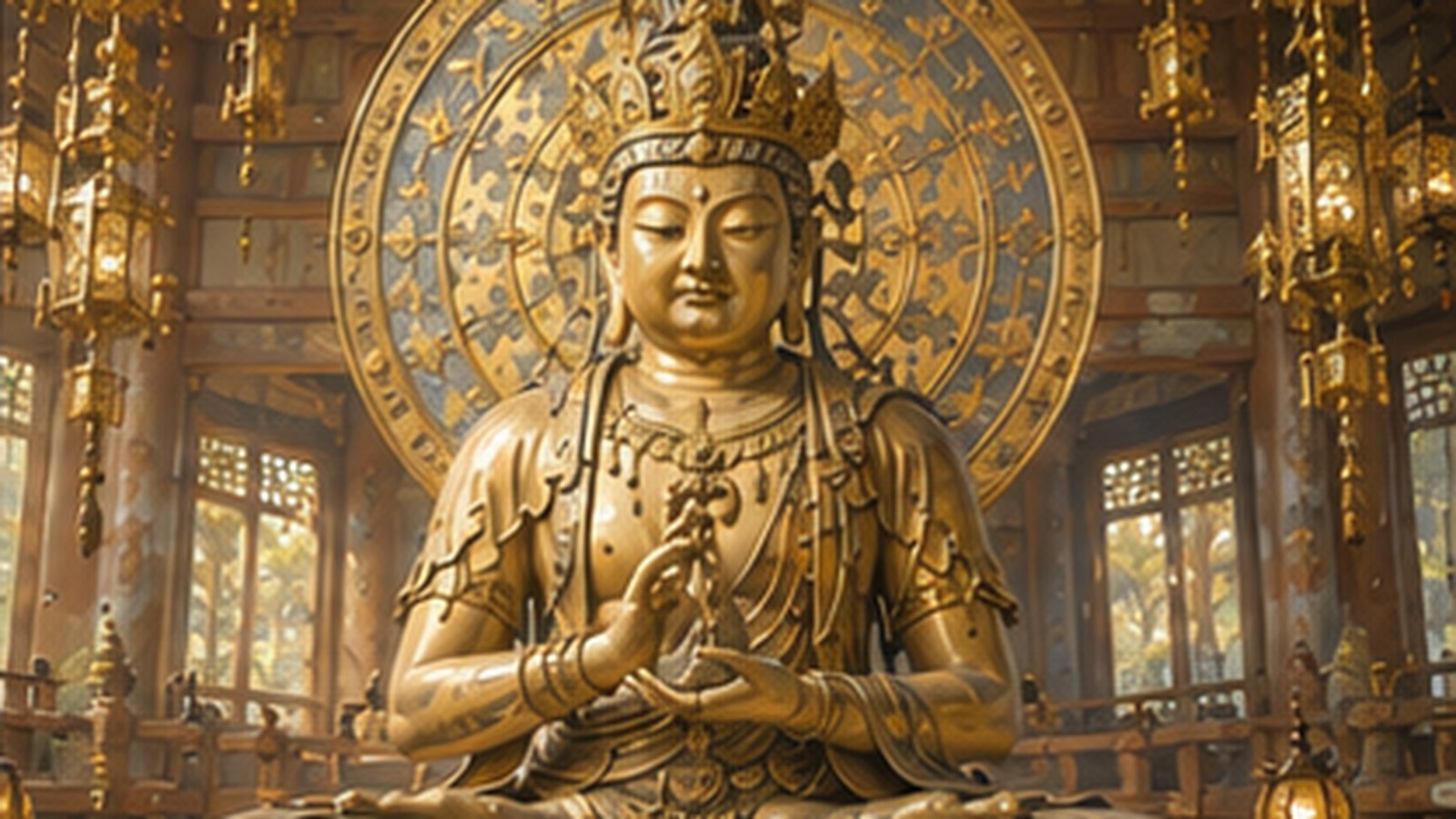
At the heart of its inner chamber sits Dainichi Nyorai (大日如来).
Unlike other Buddhas, he wears a crown and ornament. The sheer presence of the figure tells you immediately that this is the center of the Shingon world.
Who he is
Dainichi belongs to the Nyorai layer, but he sits in a distinct position among the Buddhas.
“Dainichi” translates Sanskrit Mahāvairocana — the “Great Illuminator.” He is understood as the universe itself, the cosmic ground from which all other Buddhas arise. Where Shakyamuni, Amida, and Yakushi each handle particular functions, Dainichi includes them all.
This is the heart of mikkyō — Esoteric Buddhism — the tradition founded in Japan by Kūkai as the Shingon school.
The two mandalas
To understand Dainichi, you need to see the two great mandalas (曼荼羅) hung in every Shingon temple:
- Kongōkai Mandala (金剛界曼荼羅) — the world of Buddha’s wisdom
- Taizōkai Mandala (胎蔵界曼荼羅) — the world of Buddha’s compassion
In both, Dainichi sits at the center, surrounded by hundreds or even a thousand other Buddhas arranged in geometric patterns.
The structure says: every Buddha in the universe arises from the central Dainichi. It’s a picture of the cosmos as Buddha.
What his statue looks like
Dainichi looks different from every other Nyorai:
- Wears a crown — golden, often with a small Buddha figure on it
- Wears princely jewelry (necklaces, armlets)
- Robes are elaborate rather than simple
This is not the post-awakening simplicity of Shakyamuni; this is awakening itself, in the form of cosmic sovereignty.
The hand position changes between the two mandalas:
- Kongōkai Dainichi: Chiken-in (智拳印) — left index finger raised, right fist gripping it
- Taizōkai Dainichi: Hokkai jō-in (法界定印) — hands in the lap, thumbs touching
If you’ve seen a Buddha statue with the Chiken-in gesture and wondered what it meant, you’ve already met Dainichi.
Schools centered on him
Schools that center Dainichi:
- Shingon (founded by Kūkai, 816 CE) — Mount Kōya is the head
- Tendai also gives him a central position within its esoteric stream
After Kūkai returned from Tang China having studied esoteric Buddhism, he founded Mount Kōya in 816, and Dainichi has been at the center of that world ever since.
The Shingon idea of sokushin jōbutsu (即身成仏) — “becoming a Buddha in this very body, this very life” — is bound up with the Dainichi worldview.
Where to meet him today
Major places associated with Dainichi:
- Mount Kōya, Kongōbu-ji and the Danjō Garan (Wakayama) — head of Shingon. The principal image of the Konpon Daitō
- Tō-ji (Kyōō-gokoku-ji) (Kyoto) — entrusted to Kūkai by Emperor Saga, the Shingon center in the capital
- Enjō-ji (Nara) — known for an early Dainichi by the sculptor Unkei
- Murō-ji (Nara) — an early Heian-era esoteric temple
Mount Kōya is accessible from Tokyo or Osaka and feels like a single mountain-wide temple. Walking the Oku-no-in (the great cemetery and Kūkai’s mausoleum), the Danjō Garan, and Kongōbu-ji is one of the cleanest ways to experience the Dainichi-centered worldview.
If you stay overnight at a shukubō (temple lodging), you can attend the morning service and hear shōmyō — the chanted prayers of Esoteric Buddhism.
A closing note
Dainichi expresses one of Buddhism’s largest gestures: the universe itself is Buddha.
Standing in front of the crowned figure inside the Konpon Daitō, you feel the shift — this isn’t Shakyamuni’s serene simplicity or Amida’s promise of the Pure Land. It’s a wholly different way of seeing the cosmos.
Knowing that this kind of view exists, and that it sits behind so much of Shingon’s imagery, can quietly change how every other Buddhist statue you see in Japan begins to read.