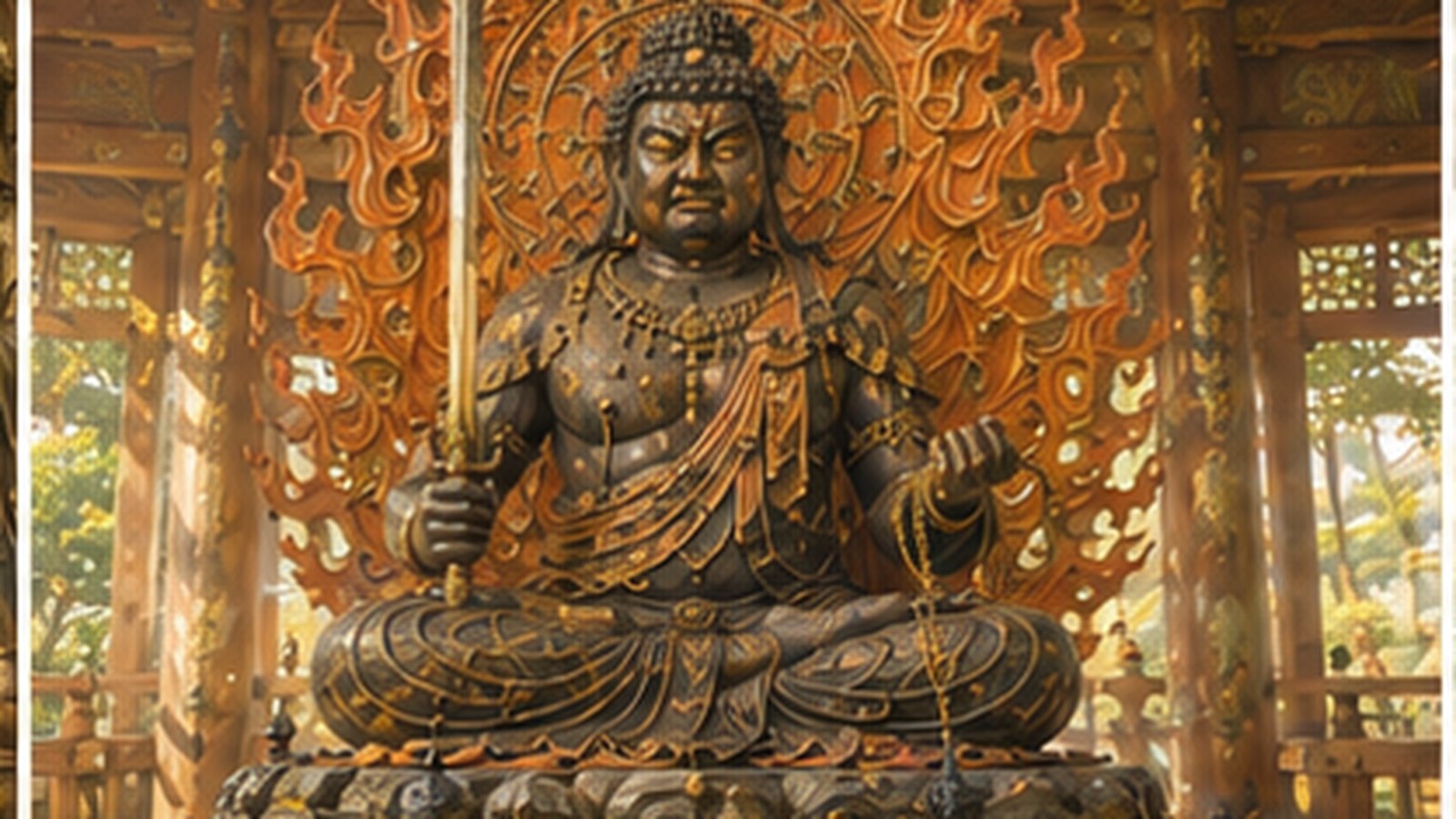
Narita-san Shinshō-ji in Chiba, the main hall. The deep, slow beat of a heavy drum. Sutras chanted in front of a real fire.
Behind the flames of the goma fire ritual, a great figure stands — dark-skinned, eyes wide, sword gripped in one hand.
This is Fudō Myōō (不動明王).
Unlike the serene expressions of the Buddhas and Bodhisattvas, Fudō is wrathful. And among the Wisdom Kings, he’s the one most widely venerated in Japan — known affectionately as “O-Fudō-sama.”
Who he is
Fudō belongs to the Myōō (Wisdom King) layer.
The Sanskrit name Acala means “the immovable one.” The Japanese name Fudō (不動) carries the same idea — an unshakable resolve.
What Fudō is associated with:
- Cutting through delusion
- Burning away defilements (kleshas)
- Protecting practitioners
- Removing obstacles and calamities
If Amida handles the afterlife and Yakushi handles bodily illness, Fudō handles the fierce work of cutting through the mind’s confusions.
A form of Dainichi
Fudō isn’t read as an independent being. He is understood as a transformation body (henge-shin) of Dainichi Nyorai — the cosmic Buddha at the center of Shingon.
Dainichi, in order to reach those who need a forceful intervention, takes the wrathful form of Fudō.
This is essential to reading the figure: the surface is fury, but inside is Dainichi’s compassion. It’s been described as “compassion that looks like anger.”
The Esoteric Buddhist worldview uses this idea — henge-shin — to explain why a single Buddha might appear in radically different forms.
What his statue looks like
Fudō makes a strong impression:
- Dark skin — typically deep blue-black
- Eyes wide open (or one wide, one narrowed — the Tenchi-gan, “Heaven-and-Earth eyes”)
- Teeth biting opposite lips (geji-geshū) — upper tooth on lower lip, lower tooth on upper lip
- Sword in the right hand — the Kurikara sword, cutting away defilements
- Rope in the left hand — to bind and lead beings away from confusion
- Flames at his back — Karura-en, fierce wings of fire
- Standing on a rock pedestal — the immovable stone base
In some images the sword is wrapped by a dragon (the Kurikara dragon-sword) — another symbol of burning through defilement.
His clothing is simple — not princely. He stands on the side of practitioners.
The two boy attendants
Fudō is often accompanied by child attendants (童子, dōji):
- Kongara Dōji — gentle, palms together
- Seitaka Dōji — wild, holding a staff
In some traditions the count expands to eight child attendants (Hachidai Dōji) around the central figure. They appear together in temple sculpture.
The fire ritual (goma)
You can’t talk about Fudō without goma (護摩).
In a goma ritual, a fire is lit in front of Fudō’s image, and thin wooden sticks (goma-ki) inscribed with prayers are fed into it while mantras are chanted. The fire is said to burn away defilements and obstacles. It’s one of the signature rituals of Esoteric Buddhism.
At Narita-san, goma is performed multiple times every day, and anyone can attend. The drum, the chant, the firelight — that combined atmosphere is one of the most direct ways to feel Fudō’s world.
Schools and traditions
Fudō is central to:
- Shingon — Kūkai’s Esoteric school. The most central context for Fudō
- Tendai — through its esoteric stream (Taimitsu)
- Shugendō — mountain ascetic tradition, where Fudō is the central figure
From the Heian period (794–1185 CE) onward, as Esoteric Buddhism took root in Japan, Fudō spread broadly. In Shugendō, yamabushi ascetics walking the sacred mountains have carried Fudō as their primary protector — a tradition still alive today.
Where to meet him today
Major places:
- Narita-san Shinshō-ji (Chiba) — Shingon Chizan-ha head temple; famous for goma
- Meguro Fudō Ryūsen-ji (Tokyo) — one of Edo’s “Five-Color Fudō”
- Mejiro / Meaka / Meao / Mei Fudō (Tokyo) — the Five-Color Fudō guarding Edo’s directions
- Takahata Fudō-son Kongō-ji (Tokyo, Hino) — one of Kantō’s three great Fudō
- Ōyama-dera (Kanagawa, Isehara) — mountain ascetic Fudō
- Tō-ji (Kyoto) — Kūkai’s three-dimensional mandala in the lecture hall (Kōdō)
- Sacred mountains of Shugendō — Dewa Sanzan, the Ōmine range, Hiko-san
Narita-san stands out: the goma ritual runs on a strict daily schedule, making it one of the most accessible ways to encounter the world Fudō belongs to — less as sightseeing, more as a real ceremony.
Temple etiquette: bow with palms together, no clapping.
A closing note
Fudō Myōō is the Buddha who protects people by looking angry.
The anger on the surface is the inside-out of compassion. Standing in front of a figure standing in flames, sword in hand, you might feel the fierce expression as a mirror to the parts of your own mind that need cutting through.
The drum and the fire at Narita-san. The quiet of Meguro Fudō inside the city. The deep silence of Ōyama in the mountains — the same Fudō has held space in each of these for a very long time.