Kiyomizu-dera in Kyoto. Standing on the famous wooden stage, looking out over the city. The view almost everyone remembers.
The principal image inside the main hall is a Thousand-Armed Eleven-Headed Kannon — one of Kannon’s many forms.
Sensō-ji in Tokyo. Through the Kaminari-mon and down Nakamise-dōri, the main hall — also Kannon.
The Bodhisattva most familiar to Japan, called affectionately “Kannon-sama” by ordinary people, is Kannon Bosatsu (観音菩薩).
Who Kannon is
Kannon belongs to the Bosatsu (Bodhisattva) layer.
The full name is Kanzeon Bosatsu (観世音菩薩), translating Sanskrit Avalokiteśvara — understood in East Asian tradition as “the one who observes the sounds of the world.”
What Kannon is associated with:
- Compassion — hearing the cries of suffering beings and answering
In many Buddhist traditions, Kannon stands as an attendant to Amida Buddha, carrying Amida’s compassion into the world.
The bodhisattva of many forms
The defining trait of Kannon is changing form.
The Universal Gateway chapter of the Lotus Sūtra (Kanzeon Bosatsu Fumon-pon) says that Kannon takes whatever form a being needs in order to be saved:
- A king
- A child
- An elder
- A merchant
- A wandering ascetic
The classical count is thirty-three forms — and that’s the origin of Japan’s famous thirty-three-temple Kannon pilgrimage routes: Saigoku-sanjūsansho, Bandō-sanjūsansho, Chichibu-sanjūyonsho. Together they are the “Hundred Kannon Pilgrimage” with a centuries-long history.
Seven canonical forms
Although the texts say thirty-three, statues mostly take seven recurring forms:
- Shō-Kannon (聖観音) — the standard form, one face, two arms
- Jūichimen Kannon (十一面観音) — eleven small heads atop the main head
- Senju Kannon (千手観音) — a thousand arms (in practice usually represented as forty-two)
- Batō Kannon (馬頭観音) — wrathful, with a horse’s head in the crown
- Nyoirin Kannon (如意輪観音) — holding a wish-fulfilling jewel and a dharma wheel
- Juntei Kannon (准胝観音) — many arms
- Fukūkenjaku Kannon (不空羂索観音) — holding a rope to “catch” beings in compassion
Each form expresses a different facet of what Kannon does.
On gender
Kannon was originally depicted in India in male form. As the figure passed through China, more feminine renderings appeared, and by the time Kannon settled into Japanese visual culture, the bodhisattva was often shown with feminine features.
Doctrinally, Kannon transcends gender: male, female, child, elder — the capacity to change form is the point. In modern times, “Jibo Kannon” (慈母観音) — the “Compassionate Mother Kannon” — is a particularly common rendering.
What the statues look like
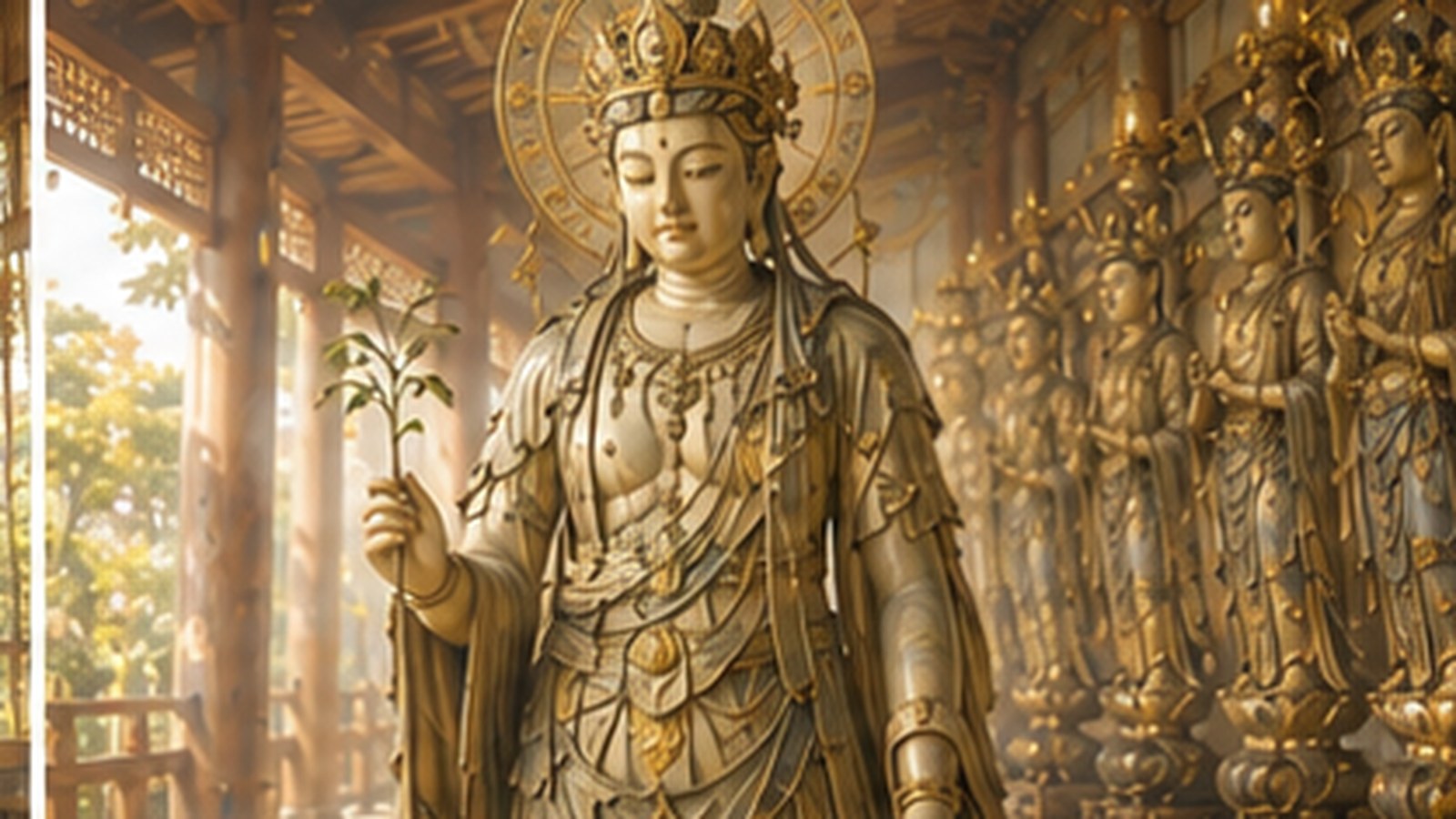
- Wears a crown (often with a small Amida figure on top — a sign that Kannon carries Amida’s compassion into the world)
- Wears flowing necklaces and jewelry (princely, like most Bodhisattvas)
- Heavenly scarves (tenne) drape from the shoulders
- Often holds a lotus or a water vessel (suibyō)
Schools where Kannon is central
Kannon is not exclusive to any single school — Kannon is enshrined across every major Japanese Buddhist tradition:
- Tendai, Shingon, Jōdo, Jōdo Shinshū, Zen, Nichiren — all of them have Kannon halls
- Often as part of the Amida triad (Amida, Kannon, Seishi)
- The thirty-three-temple pilgrimages cross sectarian boundaries
Few other figures are venerated across this many schools.
Where to meet Kannon today
Major places:
- Kiyomizu-dera (Kyoto) — Eleven-Headed Thousand-Armed Kannon; Saigoku pilgrimage #16
- Sensō-ji (Tokyo) — Shō-Kannon; Bandō pilgrimage #13
- Sanjūsangen-dō (Kyoto) — one thousand and one Thousand-Armed Kannon statues in a long hall
- Hase-dera (in both Nara and Kamakura) — colossal Eleven-Headed Kannon
- Hōryū-ji Kudara Kannon (Nara) — an elegant Asuka-period Kannon
- Ishiyama-dera (Shiga) — Nyoirin Kannon
- Roadside and town Kannon-dō halls — small shrines tucked into neighborhoods
The thirty-three-temple pilgrimage routes are, alongside the four-island Shikoku Henro for Kūkai, among the most famous ways to spend time with Kannon.
Temple etiquette: bow with palms together, no clapping.
A closing note
Kannon is the bodhisattva who listens and changes form to meet you where you are.
A thousand arms, eleven faces, a horse’s head, the gentle face of a mother — they’re all the same Kannon, doing the same work in different shapes.
The wooden stage of Kiyomizu, the busy approach to Sensō-ji, the small Kannon-dō on the edge of a village — wherever the figure appears, the gesture is the same: I hear you.