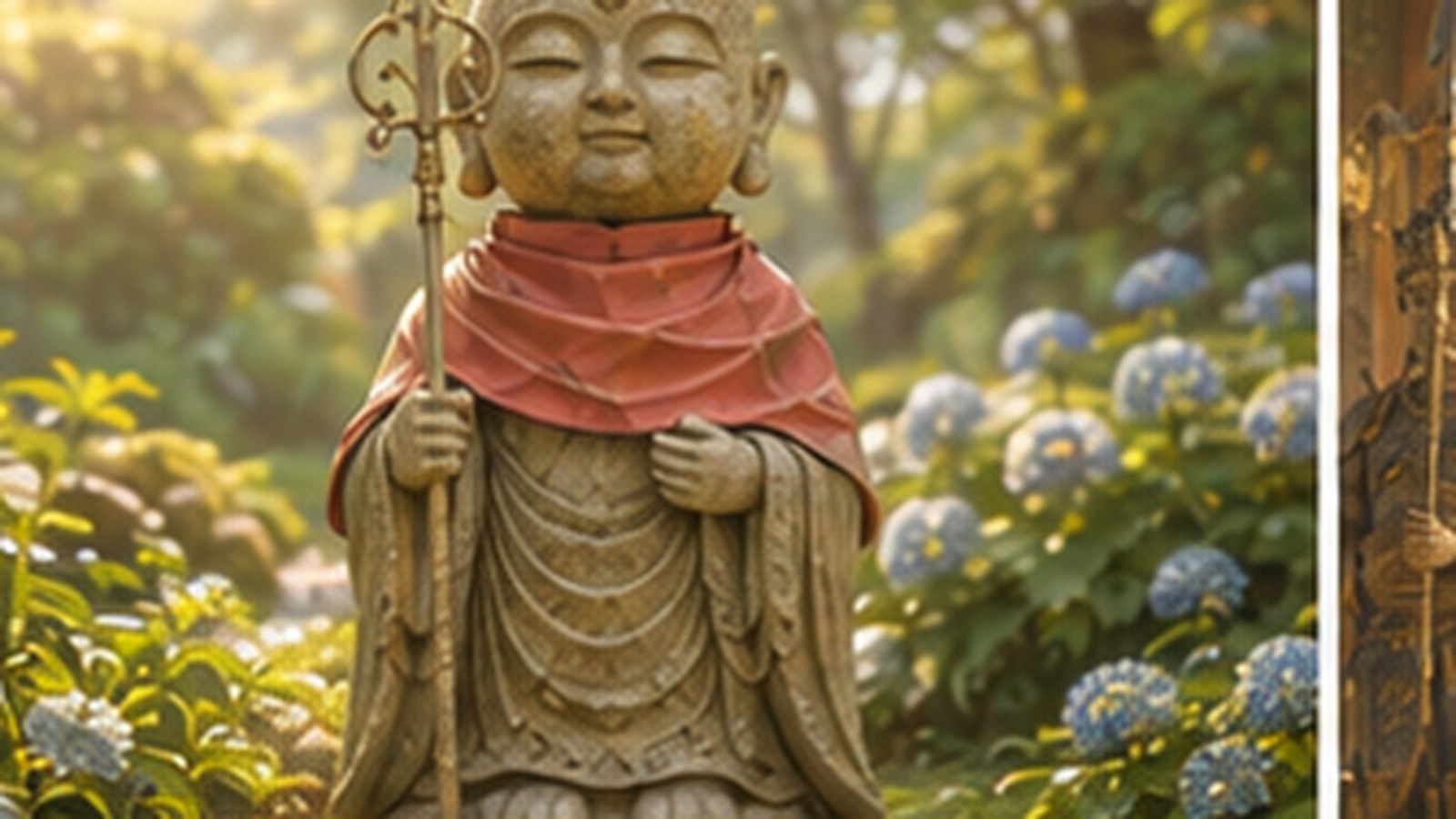
A field path. A village entrance. The midpoint of a mountain pass. The edge of a temple precinct. The path beside a cemetery.
You’ve seen them — small round-faced stone figures, sometimes a single one, sometimes lined up by the dozen, often wearing a red cloth bib.
Those are O-Jizō-sama — Jizō Bosatsu (地蔵菩薩).
Of all Buddhist figures in Japan, Jizō is the one that has dissolved most thoroughly into the everyday landscape. Not in the deep back of a temple hall — out on the road, beside a child’s grave, somewhere closer to ordinary life than any other.
Who Jizō is
Jizō belongs to the Bosatsu (Bodhisattva) layer.
“Jizō” translates Sanskrit Kṣitigarbha — “Earth Womb” or “Earth Store.” The image is of a presence that, like the earth, receives everything and holds everything.
What Jizō is associated with:
- Guiding the departed
- Protecting children
- Watching over travelers and those on the road
- Saving even those who have fallen into hell
Standing at the boundary between life and death, and at the same time among the figures closest to daily life — that’s the unusual position Jizō occupies.
The bodhisattva who goes into hell
The classical Buddhist worldview places beings on the wheel of six realms (rokudō): hell, hungry ghosts, animals, ashuras, humans, devas. Beings cycle through them in successive lives.
Jizō is said to appear in every one of the six realms, in whatever form is needed, to lead beings out of suffering.
Most distinctive of all: Jizō goes down to hell to rescue those who’ve ended up there. Few other figures in Buddhism are described doing this so directly.
The strong association with protecting children grows out of this. The folk tradition that Jizō especially watches over children who died young — guiding their souls — has rooted itself across Japan.
The bodhisattva who looks like a monk
Jizō is unique among the major bodhisattvas: instead of the princely look (crowns, jewelry, flowing scarves), Jizō appears in monk’s robes.
This visual choice signals where Jizō works: as close to ordinary humans as possible, walking the same paths.
The statues:
- A shaved head
- Simple monk’s robes
- Right hand holding a shakujō — a ringed staff that monks shake to warn small creatures away as they walk
- Left hand holding a wish-fulfilling jewel
Usually standing. Seated Jizō figures exist but are less common.
Why the red bibs
The roadside Jizō figures are often dressed in red bibs and small red caps.
The custom comes from grieving parents — placing red children’s clothing on a Jizō as a prayer for a deceased child. The hope is that the child, in Jizō’s care, is held in peace.
This isn’t formal Buddhist ritual. It grew up as a folk practice, and it’s now one of the most recognizable parts of the Japanese landscape.
Don’t confuse them with dōsojin
Other stone figures stand by Japanese roads too:
- Dōsojin (道祖神) — Shintō figures protecting village boundaries and roads
- Kōshin-tō (庚申塔) — towers from the Kōshin folk tradition
- Sarutahiko stones — the road-guiding kami
These can look similar at a glance. The way to tell Jizō apart: the monk’s appearance, holding the staff and the jewel.
For the Sarutahiko / Dōsojin side, see Who Is Sarutahiko? in our Gods series.
Schools and traditions
Jizō isn’t tied to any single Buddhist school — Jizō is a folk-rooted presence.
- Found in Shingon, Tendai, Pure Land, and Zen temples alike
- Most roadside Jizō figures have no specific sectarian affiliation
- Close to private prayers for the loss of a child
Jizō Bon (地蔵盆) — a community festival held around August 24 each year, especially in Kansai — gathers neighborhood children for a day at the local Jizō stones. It’s one of the surviving summer rhythms of Japanese town life.
Where to meet Jizō today
Some prominent places:
- Adashino Nenbutsu-ji (Kyoto, Sagano) — about eight thousand stone Buddhist figures, mostly Jizō
- Rokuhara Mitsu-ji (Kyoto) — strong ties to the six realms tradition
- Kyoto Six-Jizō Pilgrimage — six Jizō statues set at the historical entrances to Kyoto
- Sugamo Togenuki Jizō (Tokyo) — the Jizō who is said to draw out pain and illness
- Sen-bon Enma-dō (Kyoto) — Jizō tied to Ono no Takamura’s legendary journeys to hell
But the most likely place you’ll meet Jizō isn’t a temple. It’s the side of a road. A field path. A pass. The edge of a graveyard. Anywhere people walk, in fact.
A closing note
Jizō is the bodhisattva who lives closer to the road than to the back of the hall.
The pile of small stones placed by a grieving parent. The flowers someone left on a daily walk. The red bib that changes with the seasons — Jizō figures rarely stand alone for long; some private prayer is always nearby.
If you notice a small stone figure on a road in Japan and pause for a moment to put your hands together, what you’re doing has been done thousands of times before, by people walking the same path with their own quiet reasons.