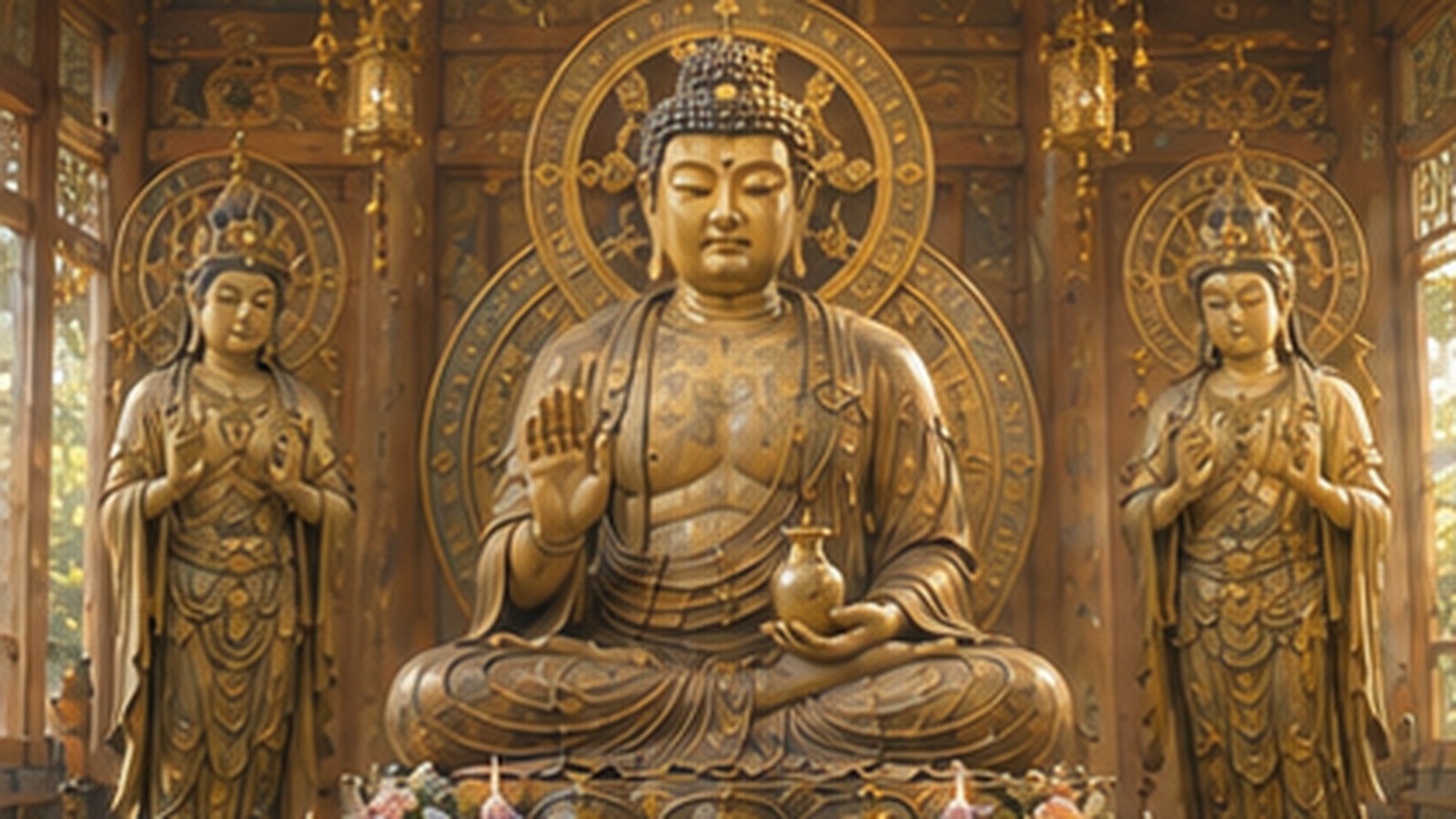
A short walk from Nishi-no-kyō station in Nara. Across a wide garden, two pagodas — one white-walled with red columns — stand alongside an old main hall.
This is Yakushi-ji. The principal image inside the main hall is Yakushi Nyorai (薬師如来), the Medicine Buddha.
Yakushi may not have the name recognition of Amida or Shakyamuni in international Buddhist literature. But if you’ve ever noticed a Buddha statue holding a small jar, that’s him.
Who he is
Yakushi is a Nyorai — a fully awakened Buddha.
His full name is Yakushi Rurikō Nyorai (薬師瑠璃光如来), translating Sanskrit Bhaiṣajyaguru — the Master of Medicine.
What he is associated with:
- Healing illness
- Removing physical suffering
- Comfort in this life
Where Amida promises the world after death, Yakushi addresses the suffering of this very life, this body, right now. That’s been the heart of his devotional appeal for centuries.
The twelve vows
Like Amida, Yakushi is said to have made vows in his time as a bodhisattva. There are twelve of them. For example:
- Make every body whole and healthy
- Remove hunger and thirst
- Clothe the unclothed
- Free those who are imprisoned
His concerns aren’t only physical illness — they extend to poverty, hunger, captivity. The full sweep of bodily suffering.
What his statue looks like
Yakushi shares many features with other Nyorai, but with one unmistakable detail:
- He holds a small medicine jar in his left hand.
This is the single clearest way to recognize him. If you see a Nyorai with a small bowl-like object resting in his upturned left palm, it’s almost certainly Yakushi.
The right hand usually forms the fearlessness mudra (right hand raised) or the granting mudra.
The robes are plain — no princely ornament, like other Nyorai.
A historical note: some early Yakushi statues, especially from the Nara period (710–794 CE), don’t yet have the jar. The Hōryū-ji Yakushi is in that older style.
The triad: Yakushi, Nikkō, Gakkō
Yakushi is often enshrined as a triad with two attendant bodhisattvas:
- Center: Yakushi Nyorai
- Left: Nikkō Bosatsu (Sun Bodhisattva)
- Right: Gakkō Bosatsu (Moon Bodhisattva)
Nikkō handles daytime healing; Gakkō, nighttime. Together they form a continuous, around-the-clock care.
In some temples (Yakushi-ji, Shin-Yakushi-ji), the triad is accompanied by the Twelve Heavenly Generals (十二神将, Jūni Shinshō) — armored warrior figures matched to the twelve directions and twelve hours of the day, standing guard around Yakushi.
Schools centered on him
Yakushi is not the exclusive Buddha of any single sect — he’s been widely enshrined across many traditions:
- Hossō-shū (Yakushi-ji, Kōfuku-ji)
- Tendai
- Shingon
- the broader Nara-period Buddhism (Nanto-rokushū)
From the Nara period onward, prayers for the recovery of the imperial family and aristocracy were directed to Yakushi. Later, he became part of everyday neighborhood faith as well.
Where to meet him today
Major places associated with Yakushi:
- Yakushi-ji (Nara) — head temple of the Hossō school. The Yakushi triad (Hakuhō period, 7th–8th c.) is a National Treasure
- Hōryū-ji (Nara) — older Yakushi figure in the Western precinct, Asuka style
- Shin-Yakushi-ji (Nara) — famous for its Twelve Heavenly Generals
- Daigo-ji (Kyoto) — five-storied pagoda and many Yakushi figures
- Enryaku-ji, Konpon-chūdō (Shiga, Mount Hiei) — the Yakushi here is said to have been carved by Saichō himself
- Countless local Yakushi-dō (Yakushi halls) — small shrines throughout neighborhoods and villages
The Yakushi triad at Yakushi-ji is considered one of the masterpieces of East Asian sculpture, and the patterns on the pedestal show clear traces of Indian Gupta influence, transmitted along the Silk Road.
Temple etiquette: bow with palms together, no clapping.
A closing note
Yakushi is the Buddha of this life, this body, this pain right now.
If Amida holds the world after death, Yakushi holds the world before it. He is the Buddha that ordinary people have prayed to for an aching tooth, for a fever in the family, for an illness too large to manage alone — for over a thousand years.
When you see a Nyorai holding a small jar, you’re standing at the end of a very long line of those prayers. That can change how the jar looks in his palm.