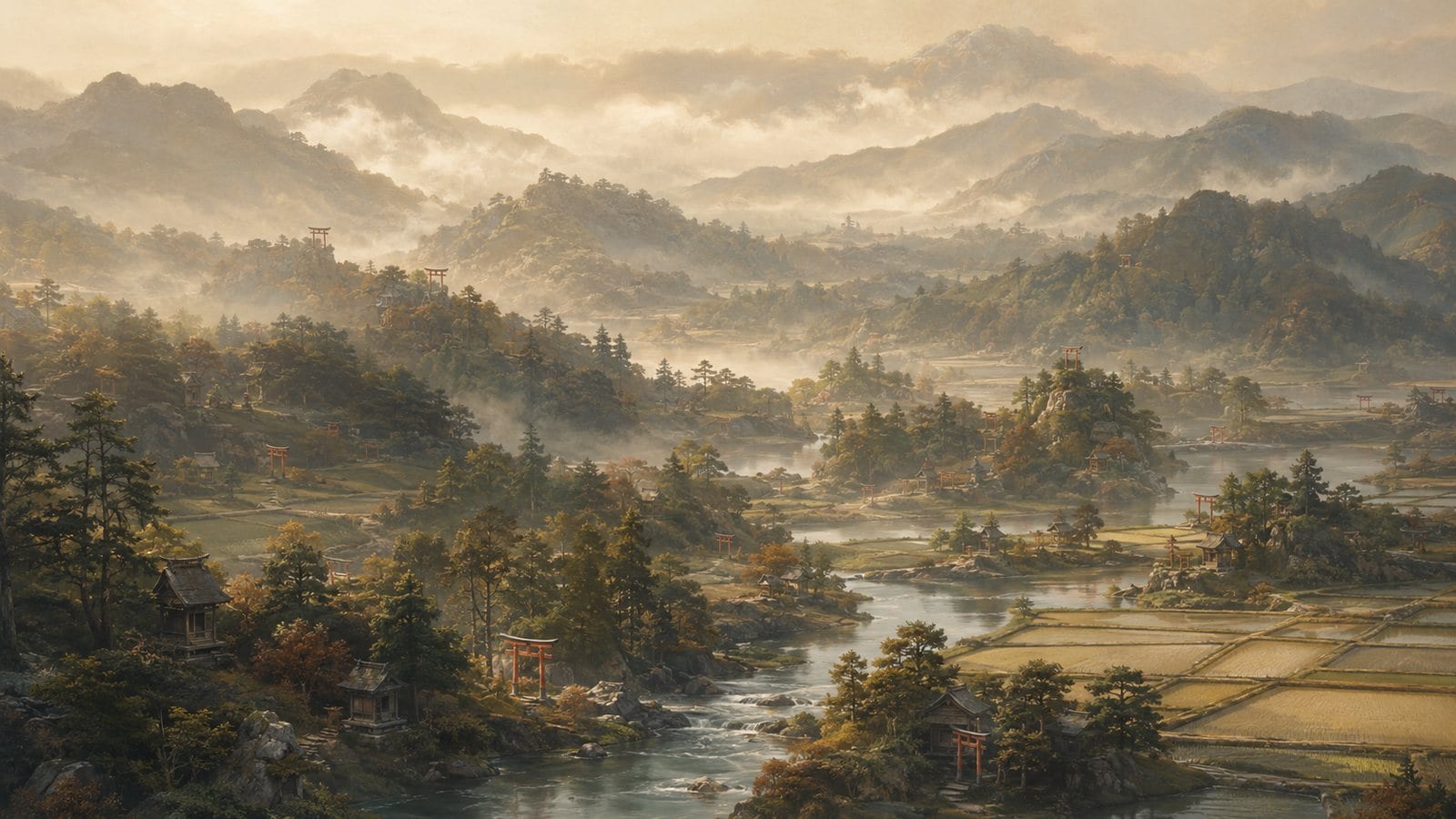
You may have heard, somewhere, that Japan has eight million gods.
It’s a striking number. But the number tends to arrive without much context — and the actual questions behind it, like who are they? or where are they? or what kind of beings are we talking about?, are usually left unanswered.
This page is a quiet entry point, written before the individual articles in this series. It’s not an attempt to classify or rank the gods. It’s a small map for anyone who wants a sense of the world they’re stepping into when they walk through a torii gate.
Eight million is not a literal number
Yaoyorozu (八百万) translates literally as “eight million.” But the number isn’t meant to be counted.
In older Japanese, the character for “eight” (八) was often used to mean “an uncountable many” — the same way English might say countless or innumerable. You see this same “eight” in words like yae (many layers), yakumo (many clouds), yamata (many branches). None of these are precise numbers.
Eight million gods doesn’t mean Japan keeps a registry of 8,000,000 deities. It means there are so many that no one is counting — that gods, in this tradition, are not rare or central but widespread, woven into the landscape.
There isn’t a single supreme being at the center of this world. There are many, in many places.
Where the gods are
The clearest way to feel yaoyorozu is probably not at a famous shrine. It’s in daily life.
In the old stories and in lived practice, gods (kami) are said to be:
- in mountains
- in rivers and waterfalls
- in the sea
- in large trees and stones
- in rice paddies
- at crossroads
- in the hearth of a kitchen
- even in toilets
The toilet one is not a joke. The premise of this world is that there are watchful presences in every part of daily life — not only in grand places.
The famous gods enshrined at famous shrines are not the only gods.
Two old books
The earliest written record of these gods comes from two books:
- Kojiki (古事記, completed 712 CE)
- Nihon Shoki (日本書紀, completed 720 CE)
Both were compiled at the imperial court to preserve much older oral traditions. The same gods appear in both books — but often in slightly different versions.
Differences you’ll see:
- Names are written differently
- The order of events shifts
- The Nihon Shoki sometimes records multiple alternate versions side by side
This series will not treat either book as the “correct” one. Two traditions exist, side by side, and we’ll respect that.
A soft sense of where they live
There’s a loose sense of where different gods live — not a rigid taxonomy, more like neighborhoods in a story.
- Takamagahara (the high heavens) — the realm of gods like Amaterasu and Tsukuyomi, associated with sky and light.
- Ashihara no Nakatsukuni (the land between) — the human earth. Gods like Ōkuninushi belong here, working on the land itself.
- Nature itself — specific mountains, rivers, stones, trees. Some named, many known only locally.
This isn’t a system. It’s the stage on which the stories play out.
The gods this series will meet
In Gods You Meet at Shrines, we’ll introduce twelve gods who appear most often in the shrines visitors encounter in Japan.
- Amaterasu — sun goddess, enshrined at Ise
- Susanoo — her younger brother, defeater of the eight-headed serpent
- Ōkuninushi — Izumo, en-musubi (the binding of relationships), kindness
- Inari (Ukanomitama) — and the foxes who serve as messengers
- Hachiman — protector of shrines, families, and the country
- Konohanasakuya-hime — Mount Fuji, cherry blossoms
- Tsukuyomi — moon god, the quiet one
- Ebisu — fishing rod, sea bream, prosperity
- Izanagi and Izanami — the husband-and-wife pair who made the islands
- Ninigi — Amaterasu’s grandson, descended to earth
- Sarutahiko — guide of paths, met at crossroads
- Benzaiten — goddess of water, music, and eloquence
Each god has a personality. None of them are portrayed as perfect. They fail, they sulk, they get jealous, they apologize. That’s part of why these stories have stayed around.
This article is the map you can keep open while reading the individual ones.
Before you visit a shrine
You don’t need to know the names of any gods to visit a shrine. Knowledge isn’t a prerequisite for putting your hands together.
But knowing a little — who is enshrined where, what kind of presence they’re said to be — makes the things in front of you (the name of the building, the offerings, the stone foxes, the path) start to mean something.
For practical guidance on shrine etiquette and the smaller shrines you might pass on the way, see How to Visit a Shrine, Why Some Shrines Are Tiny, and What Inari Really Means.
This series exists for that small shift in perception — when a stone fox or a quiet torii starts to feel a bit closer than before.