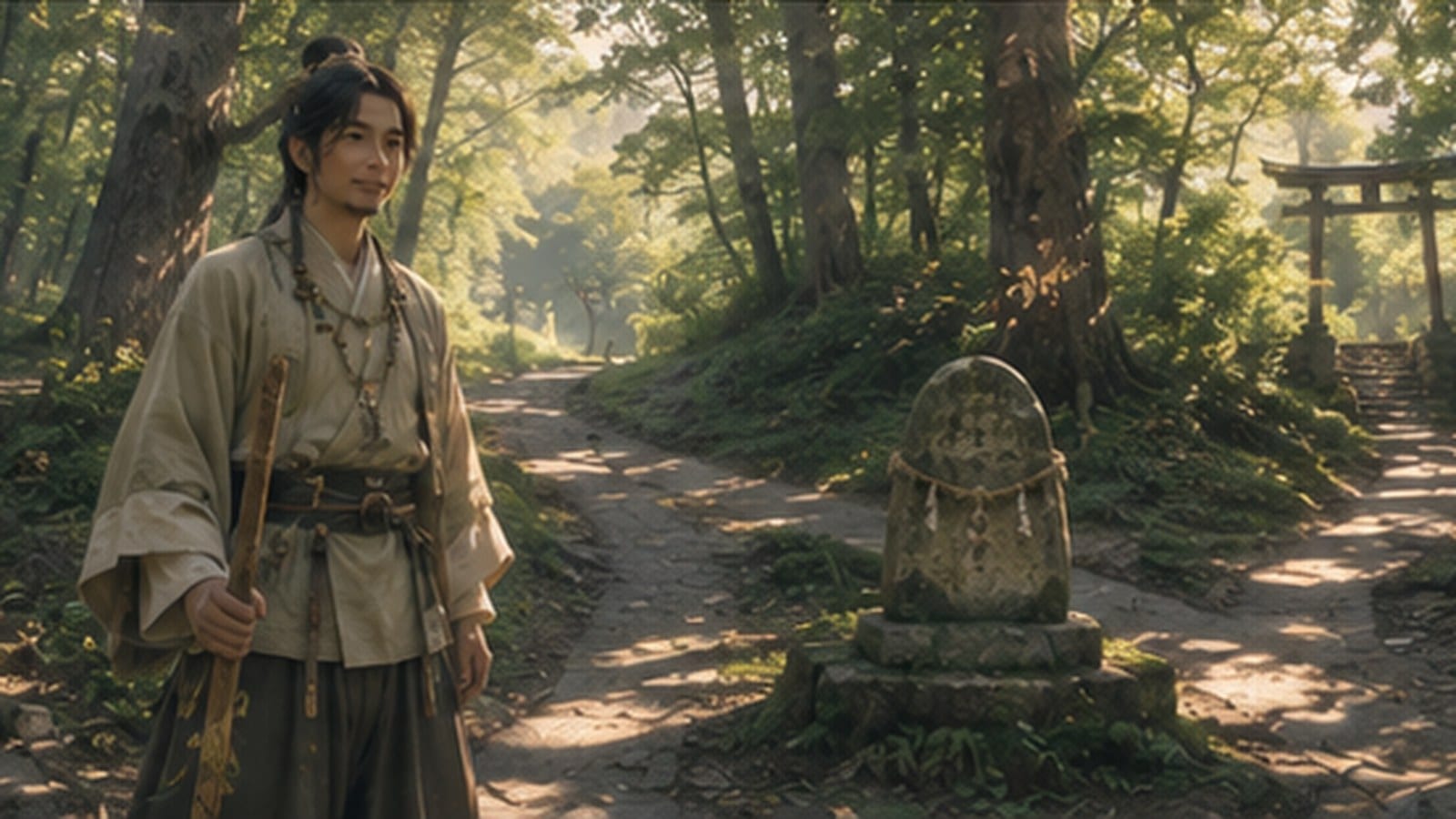
An old stone at a crossroads. A shrine that travelers pass on the way to somewhere new. The kind of small place you instinctively pause near before heading out.
Often, the kami in the background of those places is Sarutahiko (猿田彦命).
He is known as the god who guides paths. In the Kojiki, he appears as the figure who met Ninigi’s party at the moment they descended to earth.
His appearance is described as unusual — eyes that glow red, a long nose, a powerfully built form. But the stories never use that strangeness against him. He is, throughout, a god who guides.
Who he is
Sarutahiko is a male god.
He is associated with road-guiding, safe travel, new beginnings, and standing at boundaries. He’s enshrined where people cross — at the middle of paths, at the entrances to villages, at the foot of bridges.
He belongs to the kunitsukami — the gods of the earthly side — and his role was to meet the heavenly arrivals.
In the Kojiki
When Ninigi’s party began their descent from the heavens, they found a strange, very large god standing in the middle of the path.
The Kojiki describes him: huge in body, with light coming from his mouth and from his back, eyes glowing red, a long nose.
Ninigi’s party was startled and hesitated.
Ame-no-Uzume — the goddess who had danced in front of Amaterasu’s cave — stepped forward, opened her chest plainly, and asked: who are you?
Sarutahiko answered: I heard that the child of the heavenly gods would be descending, and I have come here to guide you.
He had not been blocking the way. He had been waiting to meet them.
With his guidance, Ninigi’s party reached Takachiho.
Sarutahiko and Ame-no-Uzume
The story has one more chapter.
After completing his role as guide, Sarutahiko returns toward his home, in the Ise region. Ame-no-Uzume is assigned the task of escorting him back.
And after that, the two are said to have become partners.
A goddess known for the bright, public moment of dancing Amaterasu out of the cave. A god known for standing patiently in the middle of a path. The pairing of two very different temperaments is one of the gentler moments in the Kojiki.
The Nihon Shoki preserves an alternate version of Sarutahiko’s later fate — he is said to have died after his hand was caught by a shellfish while fishing. This appears only in the Nihon Shoki, not in the Kojiki. The two books carry two different shapes for this god.
What the stories say about him
The Sarutahiko of the stories shows:
- An unusual outward form — but his role is to welcome, not to frighten
- A reticence about announcing himself, which means he can be misread at first
- A diligence about his task, and a quiet return after it’s finished
- A capacity to live with another deity (Ame-no-Uzume) of very different temperament
Looks unusual on the outside, kind on the inside — this is the recurring shape of his presence. Don’t judge by appearance.
In later folk traditions, Sarutahiko became tied to Kōshin belief and Dōsojin — the protective stone deities of village edges and crossroads. Many of the old roadside stones across Japan carry his influence in their backgrounds.
Other gods around him
- Ame-no-Uzume (his partner) — the goddess of the cave-mouth dance
- Ninigi — the figure he guided
These two relationships form the core of his story. Through the Dōsojin connection, Sarutahiko is also kin to many small roadside protective figures across the country.
Where to meet him today
Major shrines:
- Sarutahiko Jinja (Mie, Ise) — the center of his worship, just outside Ise Jingū
- Tsubaki Ōkami Yashiro (Mie, Suzuka) — claims status as the head shrine of all Sarutahiko shrines
- Shirahige Jinja (Shiga) — known for a torii standing in Lake Biwa
- Local Sarutahiko Jinja, Dōsojin stones, Kōshin-zuka mounds
When you visit Ise, you can walk over to Sarutahiko Jinja from the Inner Shrine. It’s a smaller, calmer precinct, different in feel from the great forest of Ise itself.
For shrine etiquette in general, see How to Visit a Shrine.
A closing note
Sarutahiko looks at first like a figure standing in the middle of the path. He’s actually the one pointing the way forward.
Whenever you’re starting a journey or stepping into a new place, and you notice a small Dōsojin stone or a torii of a Sarutahiko shrine, pausing for a moment is, in its own way, the most natural way to greet this kami.