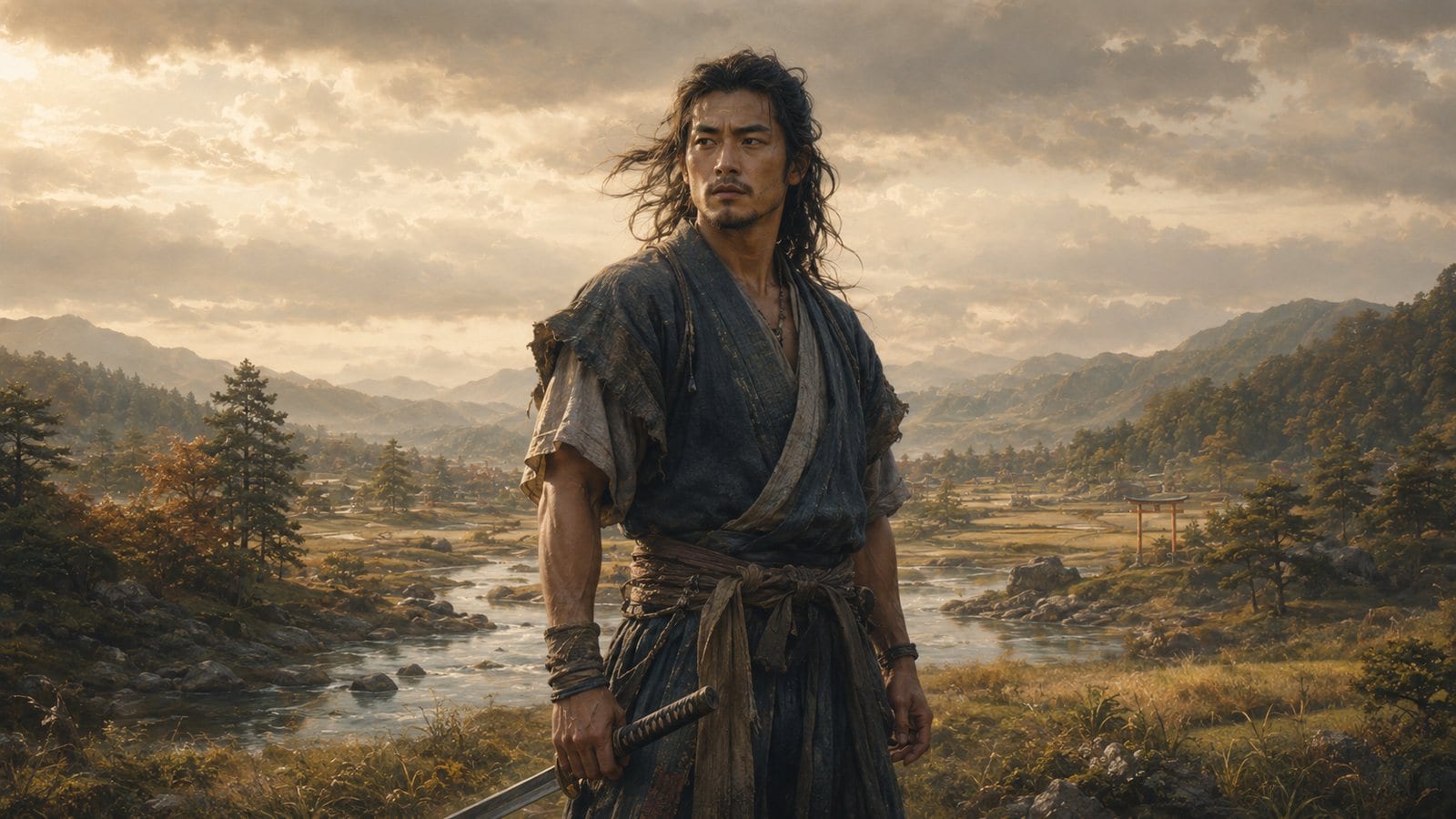
The summer festival of Gion in Kyoto, the mythology of Izumo, the long tradition of Hikawa and Tsushima shrines across the country — they all share a single kami in their background.
Susanoo (須佐之男命 / 素戔嗚尊).
He shows up first as the brother who hurt his sister Amaterasu. But once he reaches earth, he becomes a hero. The size of that swing is what makes him interesting.
Who he is
Susanoo is a male god — a brother to Amaterasu and Tsukuyomi, one of the three siblings the Kojiki calls the Three Noble Children.
He is associated with the sea, storms, raw strength, and — after his earthly chapter — the warding off of disease and disaster. Kyoto’s Gion Matsuri, still held every summer, has roots in prayers to Susanoo as a kami who calms epidemics.
He is not a single-note figure. Violence and kindness both live in him.
In the Kojiki
The Susanoo of the Kojiki begins as someone who cannot stop crying.
His father, Izanagi, told him to rule the sea. But Susanoo wanted his mother (Izanami), who had died, and he wept so long that mountains went bare and rivers dried up. Izanagi exiled him from his realm.
On his way out, he went up to the high heavens to say goodbye to his sister Amaterasu. There, his famous violence began: destroying rice paddies, defiling sacred spaces, and ultimately throwing a flayed horse into Amaterasu’s weaving hall. The result was Amaterasu hiding in the cave (the story is told in her article).
Then he was banished to earth. And in Izumo, his story changes completely.
The eight-headed serpent
In Izumo, Susanoo found an elderly couple weeping beside a river, with a single daughter — Kushinada-hime — left to them.
They had eight daughters. Every year, a great eight-headed serpent, Yamata no Orochi, came to devour one. Kushinada-hime was the last.
Susanoo offered to help. His one condition: that Kushinada-hime become his wife.
His plan was patient. He had eight large vessels of strong sake prepared. The serpent drank from all eight, fell into a heavy sleep, and Susanoo cut it down. In its tail, the Kojiki says, he found a great sword.
The same god who had wounded his sister in the heavens now saved a family, killed a monster, and made a home on earth. Two halves of one figure.
The Nihon Shoki preserves several alternate versions of how he reached Izumo and how the serpent was defeated. Neither book is the singular “correct” telling — they are two records of stories that had been retold across many generations.
What the stories say about him
Susanoo doesn’t fit into a single description.
- A grieving figure who can’t stop crying for his mother
- A brother whose anger spills into violence he can’t control
- A hero on earth who saves a family and slays a monster
- A husband who settles down in Izumo with Kushinada-hime
He’s neither just the “bad brother” nor just the “hero.” He fails, is exiled, and finds a different life on different ground.
Other gods around him
Susanoo’s web of connections is wide.
- Amaterasu — his sister, the heavenly conflict (covered in her article)
- Kushinada-hime — his wife, found by the river in Izumo
- Ōkuninushi — a later descendant of his line, central to the Izumo mythology
His story is the entry point to the Izumo cycle of myths — a whole region of the Kojiki that lives in his shadow.
Where to meet him today
Major shrines that enshrine Susanoo include:
- Yasaka Shrine (Kyoto, Gion) — the center of the Gion Matsuri
- Hikawa Shrines — common throughout the Kantō region
- Tsushima Shrine (Aichi) — known locally as the “Tennō-sama” shrine
- The Kumano Nachi Taisha and other Kumano-system shrines
- Many ancient shrines across the Izumo region
If your local summer festival has names like Tennō, Gion, or Hikawa attached to it, there’s a good chance Susanoo is in the background.
Shrine etiquette doesn’t change — see How to Visit a Shrine for the basics.
A closing note
Susanoo wounded his sister in the heavens and saved a family on earth. Failure and heroism both stay in the same god.
Whether you’re hearing the noise of a summer Gion festival or standing in front of a quiet Izumo shrine, the kami in the background is the same one — capable of both halves.