If you ask which shrine in Japan is associated with relationships and connections, most people will name Izumo Taisha.
The kami enshrined there is Ōkuninushi (大国主大神).
En-musubi — the binding of relationships — sounds romantic at first. But the Ōkuninushi the Kojiki describes is someone who was repeatedly betrayed, repeatedly hurt, and never lost his kindness toward others. When you know that, the word en-musubi starts to feel different, and so does the air around Izumo.
Who he is
Ōkuninushi is a male god. He is a descendant of Susanoo and stands as the representative figure of the kunitsukami — the gods of the earthly land.
He is associated with nation-building, the binding of relationships, medicine, and agriculture. Whatever has to do with cultivating the land and making life possible there tends to fall in his domain.
He has many names. Ōkuninushi, Ōnamuji, Yachihoko, Utsushikunitama — the Kojiki presents each name as belonging to a different chapter of his life. A single god with many faces, narrated as a long journey.
The white rabbit of Inaba
The clearest window into his character is the story of the white rabbit of Inaba.
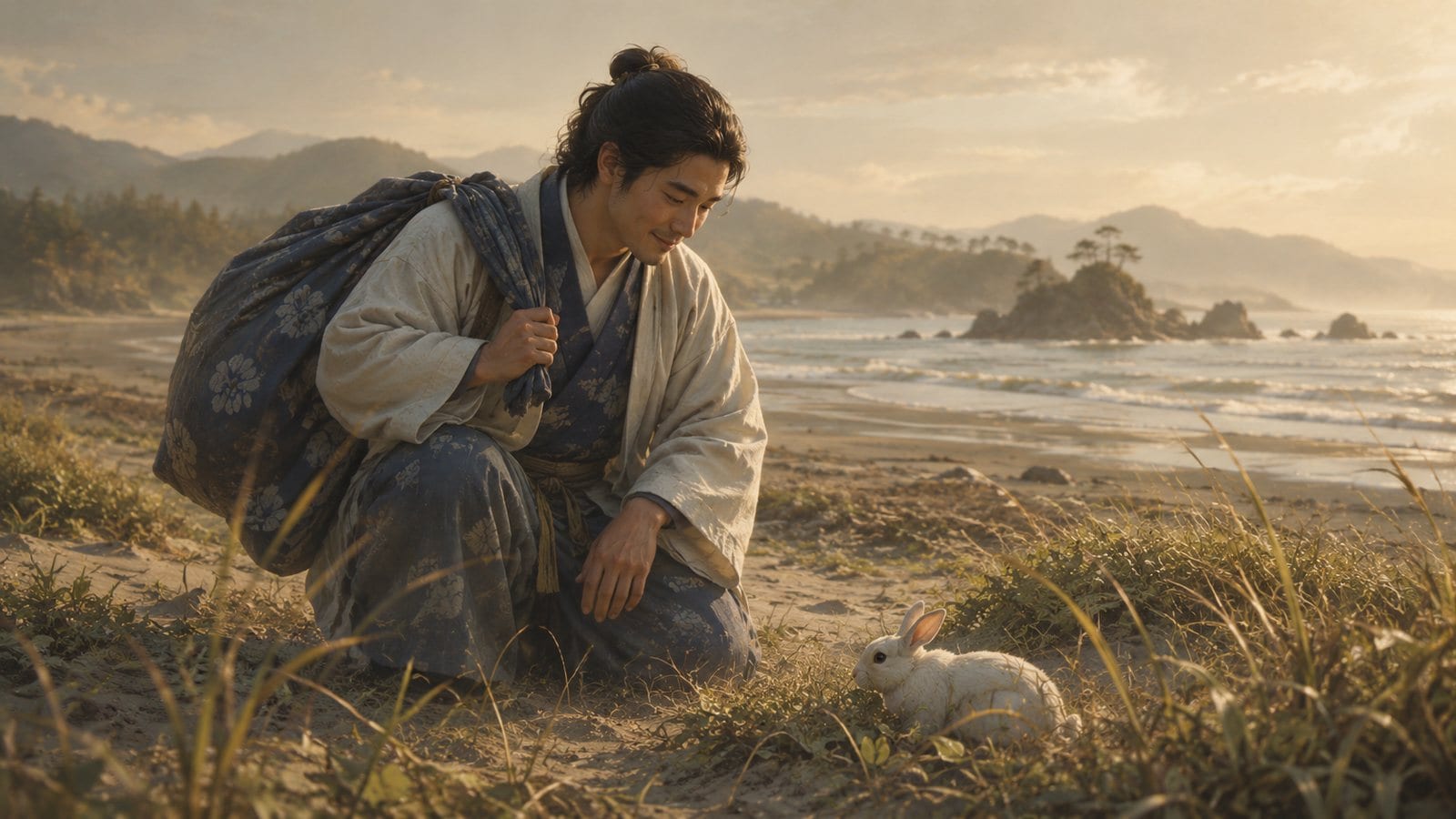
Ōkuninushi’s many older brothers (the Yasogami) were traveling to court a beautiful princess named Yagami-hime. As the youngest, Ōkuninushi was made to carry their luggage, walking far behind.
On the way, he came across a small white rabbit, hairless and in pain. The rabbit had tried to cross the sea by tricking sharks into lining up as a bridge, and the trick had ended badly — the sharks had stripped its fur.
The older brothers, who had passed earlier, had played a cruel joke: they told the rabbit to bathe in salt water. The rabbit obeyed and was in worse pain than before.
Ōkuninushi gave it the real cure — wash in fresh water, rest on the pollen of cattail flowers. The rabbit’s fur returned.
And the rabbit told him: it is you, not your brothers, who will be chosen by Yagami-hime.
Killed and resurrected
The kindness brought consequences. His brothers grew jealous and tried to kill him.
- Rolling a burning rock down at him, telling him it was a red boar
- Crushing him inside a split tree
He died, in the literal sense, more than once. Each time, his mother or other goddesses revived him.
Eventually he fled to the underworld — the Ne no Kuni — where Susanoo himself ruled.
There he met Susanoo’s daughter, Suseri-bime, and fell in love. Susanoo gave him a series of harsh trials: a room of snakes, a room of centipedes and bees, an arrow to retrieve from a burning field. He passed each one. In the end, Susanoo himself acknowledged him, gave him sword, bow, and koto, and let him return to the surface with Suseri-bime.
From that point, Ōkuninushi began the real work of kunizukuri — building the land.
Note: the Nihon Shoki tells far less of Ōkuninushi’s story than the Kojiki. The white rabbit and the trials in the underworld are mainly preserved in the Kojiki. The difference in coverage between the two books is itself a window into how oral traditions are recorded.
What the stories say about him
The thread that runs through Ōkuninushi’s stories is kindness.
- The kindness that healed a rabbit
- A refusal to retaliate, even after being killed by his own brothers
- Endurance through trial after trial, without resentment
- Welcoming Sukunabikona — a tiny god from across the sea — to build the country together
He is not portrayed as a saint, though. He had many wives, and the Kojiki preserves jealousy stories around him as well. He is a god who kept walking forward, kindly, through a lot of pain.
The reason he came to be known as the kami of en-musubi — the binding of relationships — has been read as growing out of this very journey. He bound relationships with everything and everyone as he built the country. The word isn’t only about romance.
Other gods around him
The gods closest to Ōkuninushi:
- Suseri-bime — his wife, daughter of Susanoo. They were bound through trial
- Sukunabikona — a small-bodied god who came from across the sea and built the country with him. Their pairing carries strongly into traditions of medicine and healing.
Where to meet him today
Major shrines:
- Izumo Taisha (Shimane) — the center of Ōkuninushi worship
- Ōmiwa Jinja (Nara) — one of Japan’s oldest shrines, where Mount Miwa itself is the deity
- Keta Taisha (Ishikawa)
- Many shrines called Ōkunitama or Ōkuninushi across the country
Izumo Taisha has its own particular etiquette — two bows, four claps, one bow — which differs slightly from most shrines. Check the form before you go and you’ll have an easier visit.
For general shrine etiquette, How to Visit a Shrine is the place to start.
A closing note
Ōkuninushi is the god who was hurt many times and remained kind.
When you stand in front of Izumo Taisha with that in mind, the word en-musubi sits differently. It isn’t a slogan. It’s the shape of one god’s long walk.