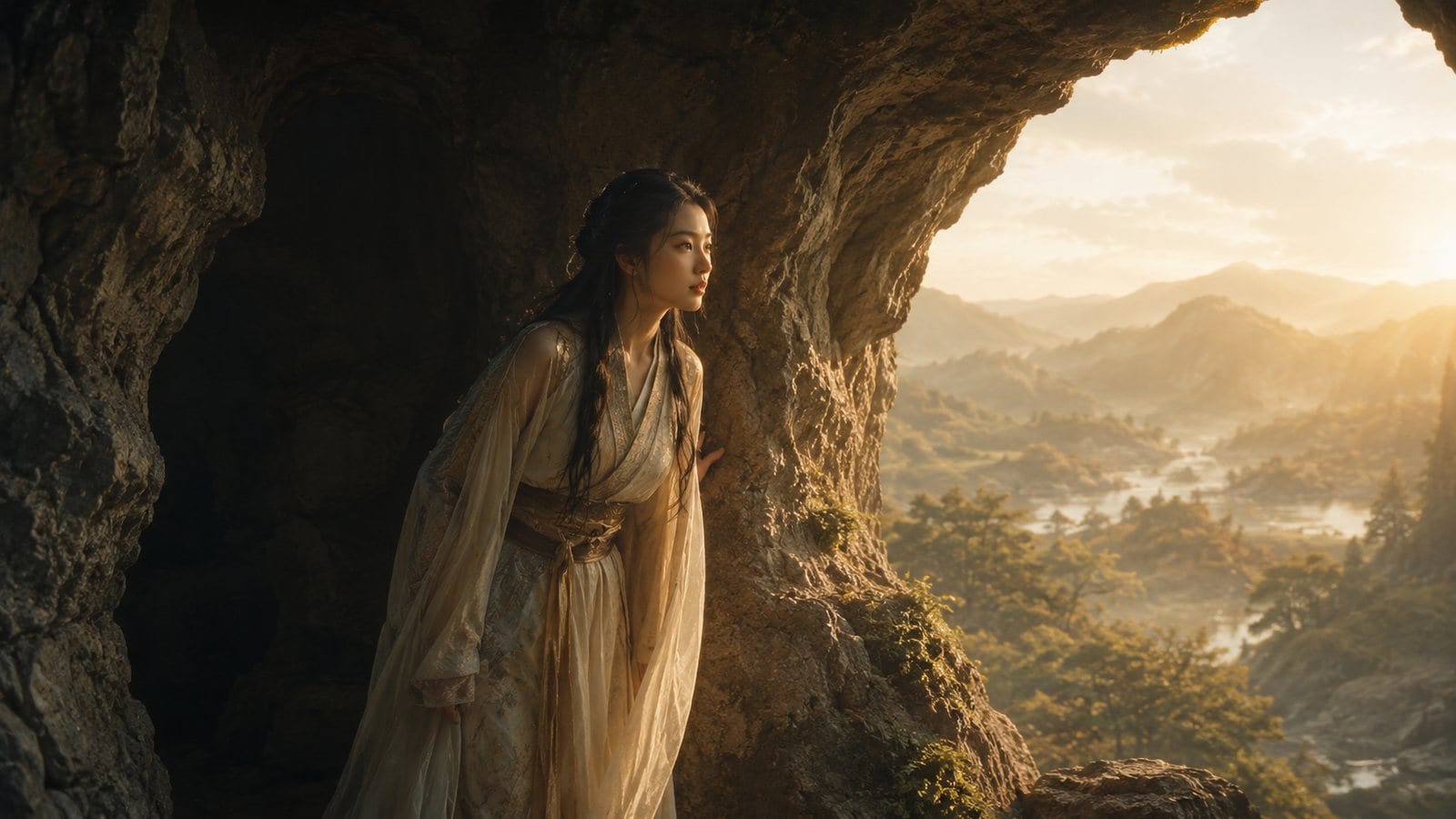
If you’ve visited Ise Jingū, you might remember the quiet forest and the long, straight approach — the particular stillness of the place.
The kami enshrined there is Amaterasu (天照大御神).
Most people have heard her name. But if you ask who she is, it gets harder to answer. “Sun goddess” doesn’t quite contain her. What the Kojiki actually preserves is a more layered figure — one who shines, but also hides.
Who she is
Amaterasu is a goddess — a female deity. The Kojiki and Nihon Shoki both describe her in feminine terms: working at her weaving loom, dealing with her younger brother Susanoo, and appearing in stories as an older sister.
She is associated with the sun, daylight, the harvest, and order — the things that depend on light and continuity. She also sits at the structural center of the Kojiki’s mythology, with many key stories revolving around her.
But the figure in the stories is not always serene or all-powerful. She shines fiercely. She also gets hurt, deeply, and retreats from the world.
The story of the cave
The story most often told about Amaterasu is the Amano-Iwato — the heavenly rock cave.
Her younger brother, Susanoo, came to the high heavens behaving badly. He destroyed rice paddies, defiled sacred spaces, and finally threw a flayed horse into the hall where Amaterasu was weaving.
She was deeply wounded by what he did.
In response, she entered a cave and pulled a great stone across the entrance, shutting herself away.
The sun goddess had withdrawn. The world went dark. Crops failed, calamities multiplied.
The other gods gathered outside the cave to discuss what to do. They didn’t choose force. Instead, they decided to hold a noisy, joyful festival right outside the entrance.
Laughter and dancing rose. A goddess named Ame-no-Uzume danced wildly, and the gods burst into laughter together.
Inside the cave, Amaterasu became curious. The world was supposed to be dark and grieving — why were the gods laughing?
She opened the cave door a crack to peek. In that small opening, the other gods reached in, gently, and led her back out.
What the story tells us about her
This single story shows her personality in layers.
- A sensitivity that withdraws when wounded, rather than lashing out
- A central presence that the rest of the world depends on
- A simple, almost endearing curiosity — she peeked because she wanted to know
- A willingness to come back when met with warmth, rather than force
She is not a perfect, dazzling figure. She is the sun, and also someone who gets hurt and hides — and is coaxed out by the kindness of others.
That coexistence of strong light and quiet vulnerability is what makes the Kojiki’s Amaterasu compelling.
Note: in the Nihon Shoki, the cave episode appears in several alternate versions, each differing slightly in details — why she enters, what draws her out. There isn’t one “official” telling. The plurality is part of how the story has survived.
Other gods around her
Amaterasu doesn’t carry her stories alone.
The closest figure in her stories is Susanoo, her younger brother — the one whose violence drove her into the cave. He’s punished and exiled to earth, where his story changes completely: he becomes the hero who defeats the eight-headed serpent.
Same god, two halves. We cover his side in a separate article.
Where to meet her today
Shrines that enshrine Amaterasu are everywhere in Japan.
The most famous is Ise Jingū (Inner Shrine), in Mie Prefecture — known for its long forest path and the sense of quiet it preserves.
Beyond Ise, many shrines called Shinmei-sha (神明社) or Tenso Jinja (天祖神社) also enshrine Amaterasu. Small neighborhood shrines often carry her name, too.
The Amaterasu enshrined at Ise and the one in a small town shrine are the same kami.
Shrine etiquette doesn’t change for her — same approach as any other shrine. For practical guidance, see How to Visit a Shrine and Why Some Shrines Are Tiny.
A closing note
Amaterasu is the sun, and also someone who hides. She is at the center of the mythology, and also the figure the other gods had to coax out of a cave with laughter.
If you carry that double sense with you when you stand at the entrance of Ise — or in front of a small neighborhood Shinmei-sha — the moment of putting your hands together becomes a little different.