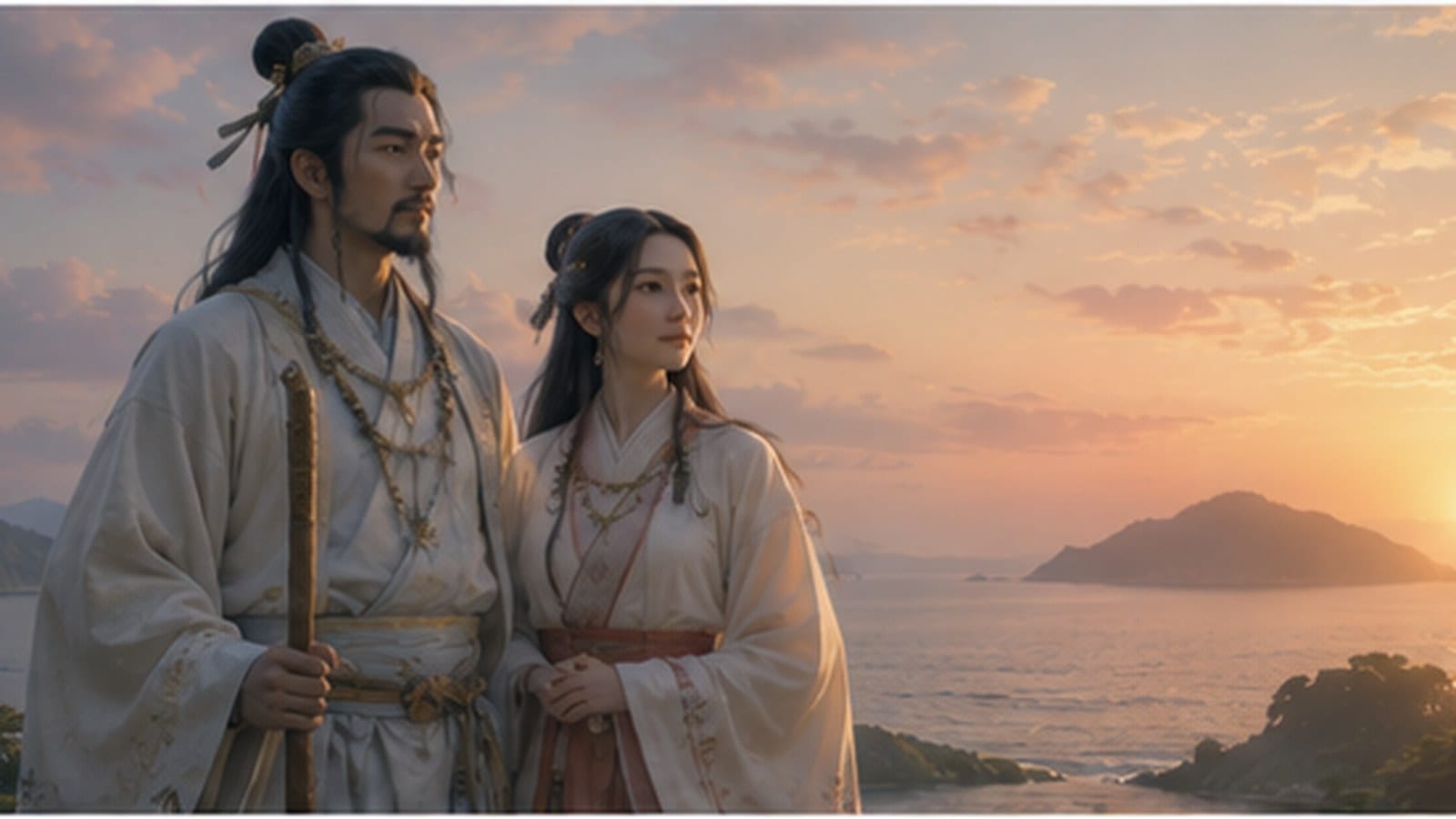
At the very beginning of Japan’s mythology, there is a married couple — Izanagi (伊邪那岐命) and Izanami (伊邪那美命).
They make a country. They make gods. And then they are parted.
Theirs is one of the most clearly human stories in the Kojiki — full of love, broken promises, grief, and anger.
Who they are
Izanagi is a male god, Izanami is a female god. They are husband and wife.
They are associated with the making of the country, the making of the gods, marriage, and — through their later separation — the boundary between life and death. The two are almost always read together.
The story begins when the elder gods of the heavens charge them with shaping the drifting land below into something solid.
Making the country
Standing on the heavenly floating bridge, Izanagi and Izanami stir the sea below with a long jeweled spear.
When they lift the spear, drops of brine fall, and one drop hardens into the first island: Onogoro.
They descend to that island, build a house, and stand facing one another. The first time they unite, Izanami speaks first — and the child born from that union is weak. They go back to the heavens to consult, and try again, this time with Izanagi speaking first.
From that point, the islands of Japan are born one after another — Awaji, Shikoku, Kyūshū, Honshū. This is kuniumi, the birth of the land.
After the islands, they keep going: gods of the sea, gods of the mountains, gods of rivers and winds. Many of the kami of the natural world come from this couple.
The fire — and Izanami’s death
Izanami gives birth to many gods. But when she gives birth to Kagutsuchi, the god of fire, the flames burn her body, and she dies.
Izanagi grieves. The intensity of the grief is great enough that he kills the newborn fire god in his sorrow.
And then he descends to Yomi, the land of the dead, to bring his wife back.
Yomi
In Yomi, Izanagi finds Izanami.
“Come back with me to the world above,” he asks.
She answers: “I have already eaten the food of Yomi, and I cannot leave at once. Let me speak with the gods of this place. But while you wait — do not look at me.”
Izanagi waits. And waits. And then, unable to wait any longer, he lights a tooth of his comb as a torch and looks inside.
The figure of Izanami is no longer the wife he remembers.
He runs. Izanami, in rage and humiliation, sends the women of Yomi after him. He throws objects behind him as he flees. At last, he closes the passage between Yomi and the world above with a great boulder.
Through that closed passage, they speak one final time.
Izanami declares: from this day on, I will take a thousand of your people each day.
Izanagi answers: then I will give birth to fifteen hundred each day.
The balance between death and life — the Kojiki says — began here.
The Nihon Shoki preserves several alternate versions of this descent and parting. The flow of the journey and the meaning of the closing stone differ slightly between books.
What the stories say about them
Both halves of the marriage are vivid:
- Izanagi — a god whose love is real, and who also breaks his promise
- Izanami — a goddess who gives birth to a country and to gods, and who loses her life in that birth
- As a couple — the beginning-makers, who also experience the first grief
The Kojiki here is unusually candid: it doesn’t depict perfect deities. It depicts a husband and wife who try, lose, grieve, and rage at each other across the line between worlds.
Other gods around them
Their descendants populate much of what follows.
- Amaterasu, Tsukuyomi, Susanoo (the Three Noble Children) — born when Izanagi cleansed himself after returning from Yomi
- Many gods of mountains, rivers, winds, and the elements — born during the kamiumi before Izanami’s death
In a meaningful sense, most of the major figures in the rest of the Kojiki trace back to this couple.
Where to meet them today
Major shrines:
- Taga Taisha (Shiga) — an old shrine enshrining Izanagi and Izanami
- Izanagi Jingū (Hyōgo, Awaji Island) — on the island said in the Kojiki to be the first born
- Kumano Hongū Taisha and other Kumano shrines — long associated with Izanami in particular
- Local Ise or Izanagi shrines
Awaji Island is the place where, in the Kojiki, the first island was born. Visiting Izanagi Jingū there lets the geography and the mythology line up in front of you.
For shrine etiquette in general, see How to Visit a Shrine.
A closing note
Izanagi and Izanami are the gods who began things, and the gods who first knew loss.
Because they are described as a couple — not as individual figures — their stories preserve some of the most recognizably human emotions in the Kojiki. When you read the opening chapters of Japan’s mythology with them in mind, the beginning feels closer to a familiar shape than it might otherwise.