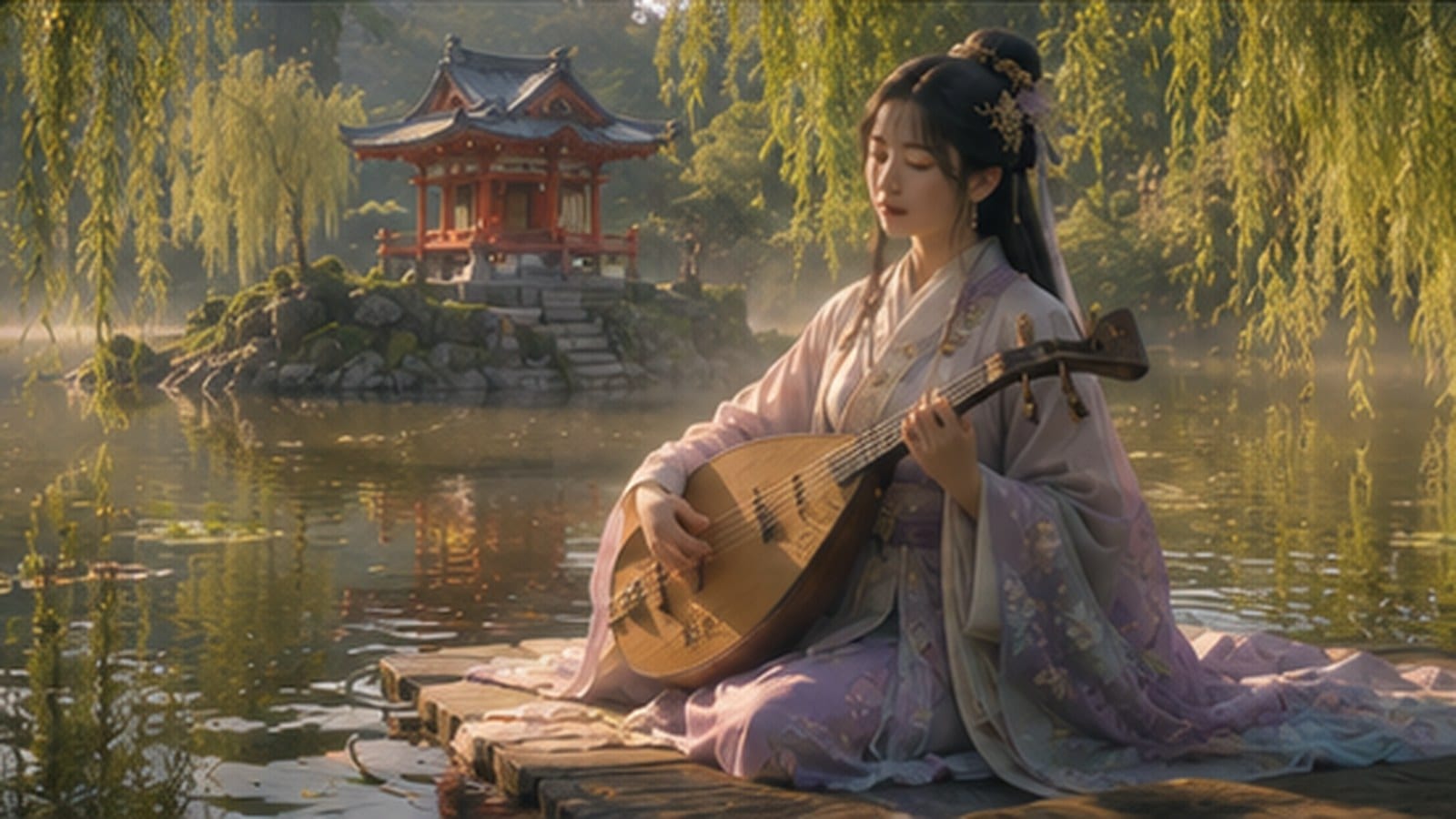
A small island in the middle of a pond. A shrine floating on a lake. A modest altar on a coastal rock. Wherever there is water in Japan, you’ll almost always find the name of a particular goddess nearby.
Benzaiten (弁財天 / 弁才天).
She is the only goddess among the Seven Lucky Gods (Shichifukujin), and is most often depicted carrying a biwa (a stringed instrument).
But Benzaiten differs from the other gods in this series in one important way: she does not appear in the Kojiki or Nihon Shoki.
Who she is
Benzaiten is a goddess — a female deity.
She is associated with the arts, music, wisdom, water, eloquence, and wealth. Written 弁才天, the emphasis is on talent. Written 弁財天, the emphasis is on wealth. Both forms have circulated in Japan.
She is most often enshrined near water — by ponds, lakes, rivers, or coastal rocks.
A goddess from India
The original of Benzaiten is the Indian goddess Saraswati.
Saraswati appears in old Indian texts as a goddess of rivers, music, and wisdom. As Buddhism spread, she traveled with it to Japan, and as she settled in, she blended with Japan’s existing kami traditions and became part of the broader Japanese religious world.
So she doesn’t appear in the Kojiki or Nihon Shoki. Her presence in Japan took shape later — from the Heian period (794–1185) through the Kamakura period (1185–1333).
She’s included in this series for a reason. Not every kami in Japan comes from the Kojiki. The Japanese religious imagination has welcomed figures from many traditions over many centuries. Benzaiten is one of the clearest examples of that openness.
Less a narrative, more an image
The Kojiki gods each carry stories — hiding in a cave, slaying serpents, giving birth in fire.
Benzaiten, by contrast, carries an image more than a narrative.
- She holds a biwa
- She is beautiful
- She is near water
- She is making something — playing, speaking, expressing
In paintings and statues, she is almost always shown mid-expression. Less a goddess who moves through plot, and more a goddess whose presence is the act of making.
What kind of presence she is
With less narrative to draw from, her character is read mostly through iconography and worship:
- Quiet, graceful
- The settled calm of someone who lives by water
- Beautiful, but not insistent on it
- A god of words and music, who values the act of expressing
Water flows continuously. So does music. So does wisdom. The metaphor of flow is probably the closest entry point to thinking about Benzaiten.
Other gods around her
She is one of the Seven Lucky Gods, and is often depicted with:
- Ebisu — fishing and commerce
- Daikoku — food and wealth
- Bishamon — martial virtue
- And the others: Hotei, Fukurokuju, Jurōjin
These figures come from different traditions — Shintō, Buddhism, Daoism. The Seven Lucky Gods as a group is a small symbol of how comfortable Japan has been with mixing.
Where to meet her today
Benzaiten is enshrined near water. Major sites:
- Enoshima Jinja (Kanagawa, Enoshima) — a shrine on an island in the sea
- Itsukushima Jinja (Hiroshima, Miyajima) — famous for its torii in the sea; has deep ties to Benzaiten in older traditions
- Chikubu-shima (Shiga, Lake Biwa) — a shrine on a small island in the lake
- Tenkawa Daibenzaiten-sha (Nara) — an old shrine deep in the mountains
These three (Enoshima, Itsukushima, Chikubu-shima) are sometimes called the Three Great Benzaiten of Japan. All three have water at the heart of their landscapes.
You’ll also find Benzaiten at small island-shrines in city ponds, in shrines tucked along riverbanks. If you spot a small torii at the water’s edge, more often than not, Benzaiten is inside.
For shrine etiquette in general, see How to Visit a Shrine.
A closing note
Benzaiten isn’t from the Kojiki. But over long centuries, she has become one of the kami who lives closest to the water in Japan.
Small island-shrines in city ponds, red torii rising out of lakes, a single jizō-sized stone by a coastal pool — many of the gods you meet at water, in Japan, are her. Knowing that, water in the landscape begins to feel a little closer.