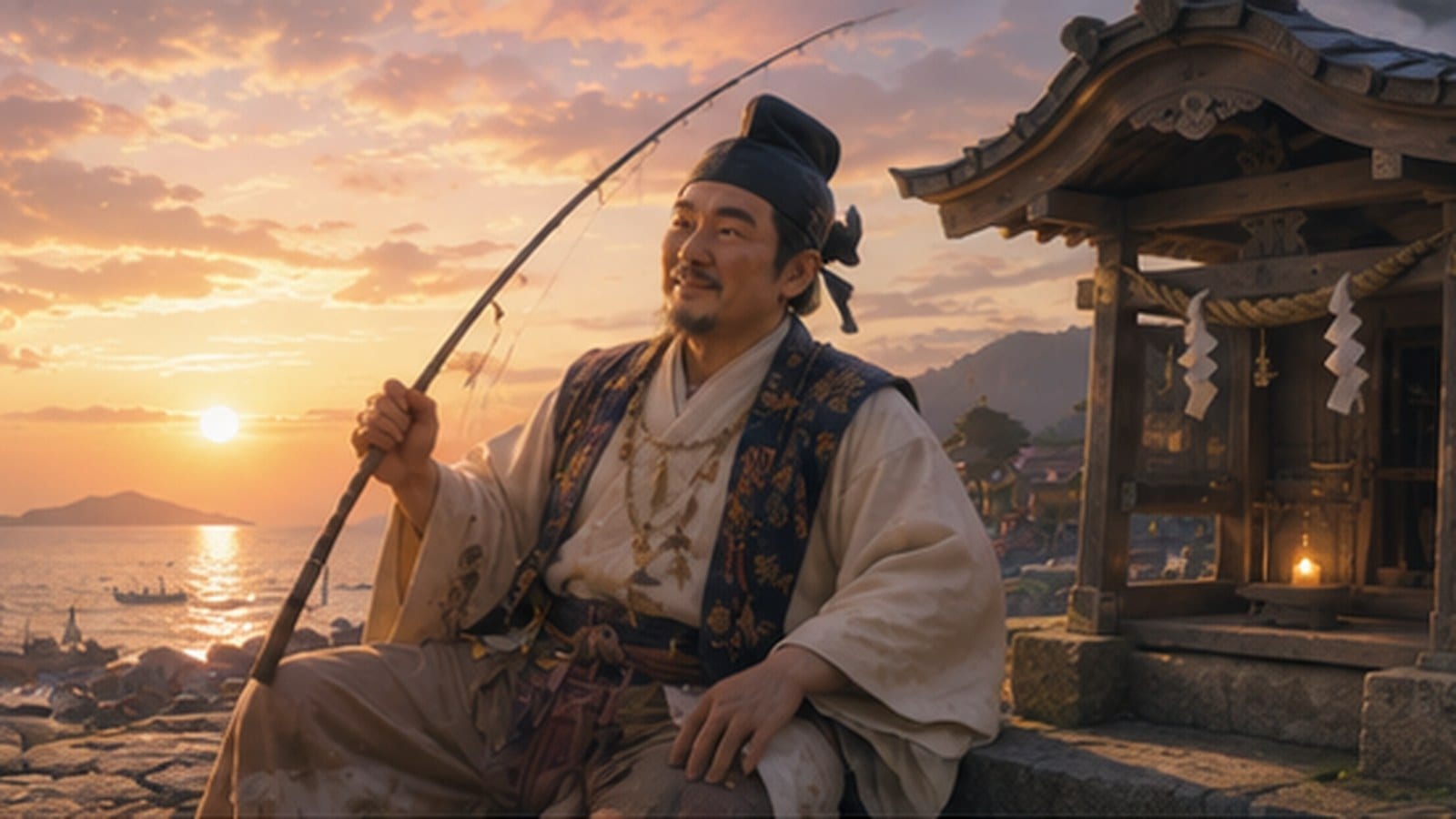
A fishing rod, a sea bream tucked under one arm, a wide and cheerful face — you’ve probably seen Ebisu near the doorway of a shop, next to a maneki-neko cat.
He is one of the most familiar gods of prosperity in Japan, and one of the Seven Lucky Gods (Shichifukujin).
But behind that cheerful image, the Kojiki origin story is, unexpectedly, a sad one.
Who he is
Ebisu is enshrined as a male god.
He is associated with fishing, commerce, good fortune, and — more broadly — things that come from the sea. The fishing rod and sea bream are visual remnants of his older identity as a sea-fishing kami.
What’s distinctive about Ebisu is that he is not the name of a single original kami. Several mythological figures have been identified as “Ebisu”:
- Hiruko, the first child of Izanagi and Izanami
- Kotoshironushi, son of Ōkuninushi
- Sometimes other regional kami
Different shrines tell different stories. This isn’t a case of one being correct. Ebisu is a figure whose identity has never been pinned to a single origin.
The Hiruko version — origin in the Kojiki
The earliest Kojiki figure associated with Ebisu is Hiruko (蛭子).
The Kojiki says Hiruko was the first child of Izanagi and Izanami. But the child couldn’t stand on his own legs, and the parents set him afloat on a reed boat on the sea.
It’s a difficult story, especially read with modern sensibilities. The first child cast away.
The reading that emerged in later worship is that the child eventually returned — from across the sea, as a god of fishing and fortune, welcomed back as Ebisu.
The recurring image of “the god who comes from the sea” carries this background.
The Kotoshironushi version
The other major lineage identifies Ebisu with Kotoshironushi, son of Ōkuninushi. Kotoshironushi is described in the Kojiki as a kami who liked fishing, and who played a key role in the kuni-yuzuri — the handing over of the land.
At Nishinomiya Shrine (Hyōgo), Ebisu is enshrined as Hiruko. At Mihō Shrine (Shimane), Ebisu is enshrined as Kotoshironushi.
Neither shrine is wrong. Both reflect long, locally rooted versions of Ebisu.
What kind of presence he is
The pattern across versions is:
- Cheerful, broad-faced, easy to approach
- The calm of a god who came from the sea
- The patience of someone who fishes at their own pace
- A figure who began with imperfection — and became a bringer of good fortune
Read through the Hiruko story, Ebisu becomes the one who was first cast adrift, then returned, then welcomed. That reading puts a quiet weight behind the cheerful statue at a shop door.
Other gods around him
Within the Seven Lucky Gods:
- Daikoku — often paired with Ebisu, sometimes identified with Ōkuninushi
- Benzaiten — the only goddess of the seven
- Izanagi and Izanami — his parents, in the Hiruko version
- Ōkuninushi — his father, in the Kotoshironushi version
The Seven Lucky Gods is a later assembly that mixed Shintō, Buddhist, and Daoist figures. Its formation gave Ebisu another platform to grow into.
Where to meet him today
Major shrines:
- Nishinomiya Shrine (Hyōgo) — the original “Ebessan.” Famous for the Tōka Ebisu festival in early January
- Imamiya Ebisu Shrine (Osaka) — known for the chant shōbai-hanjō de sasa motte koi (business prosperity, bring the bamboo!)
- Mihō Shrine (Shimane) — enshrines Ebisu as Kotoshironushi
Beyond these, you’ll find smaller Ebisu shrines and altars in shopping streets, marketplaces, and fishing ports. He’s the god who likes to live close to where people work.
For shrine etiquette in general, How to Visit a Shrine is the standard reference.
A closing note
Ebisu is a god who refuses a single origin.
The story of a child set adrift and the image of a fisherman with a sea bream live in the same figure. Knowing the length of the road behind that cheerful face can change how a familiar Ebisu statue at a shop entrance feels.