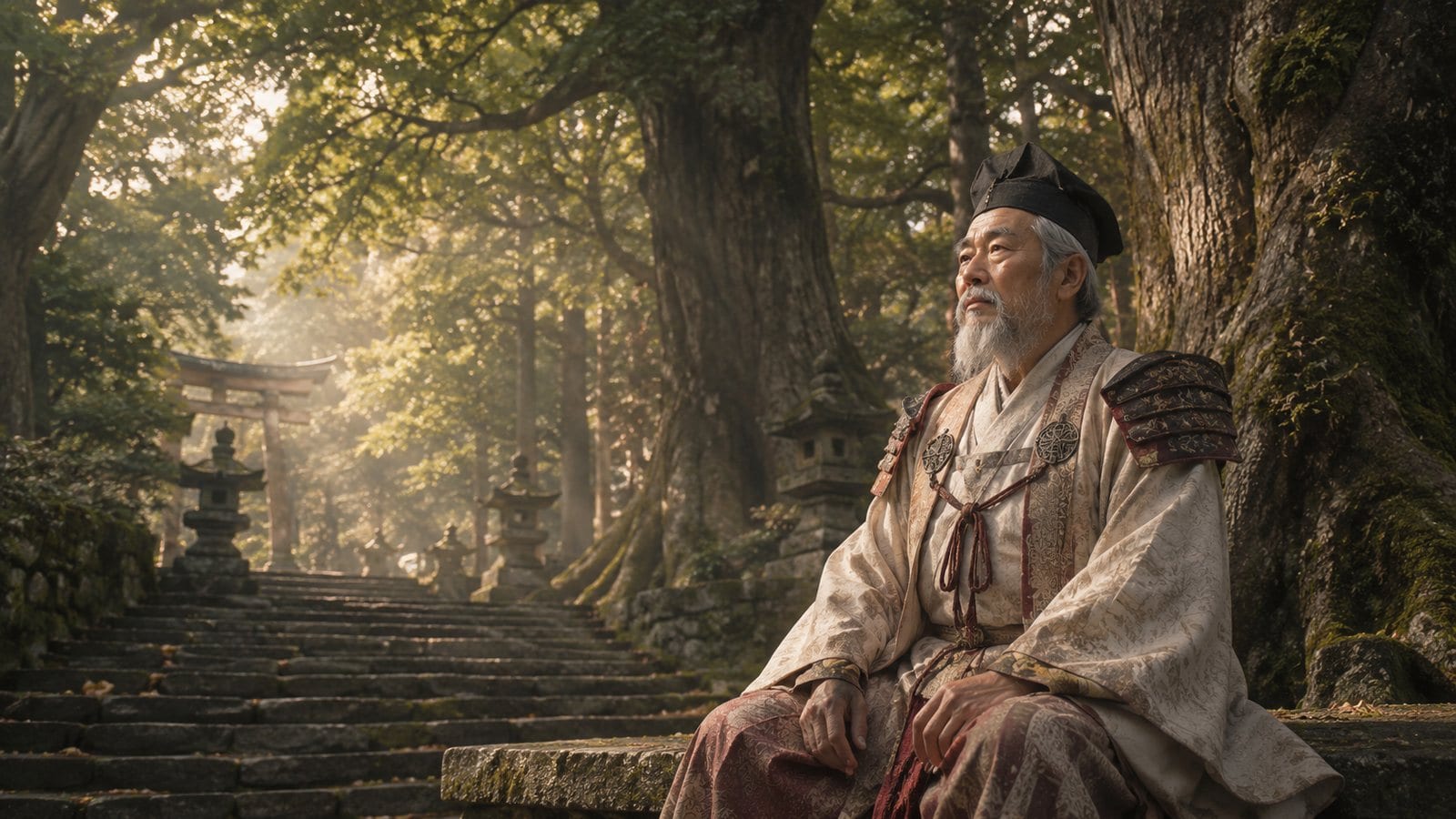
You’ve probably seen the character “八幡” on a torii — even if you didn’t know what it meant.
Hachiman shrines are, alongside Inari shrines, among the most numerous in Japan — over 40,000 of them, by some counts. Some are large and well-known, like Tsurugaoka Hachimangū in Kamakura. Many more are small neighborhood shrines.
The kami enshrined there is Hachiman.
Who he is
Hachiman is enshrined as a male god.
He is associated with martial fortune, victory, protection of the land, and — perhaps surprisingly — the safety of children and families. The image of “the warrior god” often comes first, but in everyday practice, Hachiman is also one of the most common kami for prayers at Shichi-Go-San (the children’s blessing), and for household safety.
Worship of Hachiman radiated outward from Usa Jingū in Ōita Prefecture, beginning in the Nara period (710–794 CE). In the Kamakura period (1185–1333), the Minamoto clan adopted Hachiman as their clan deity, and from then on, Hachiman became deeply tied to the warrior world.
But reading Hachiman only through the lens of war is one-sided. At the local level, Hachiman shrines have long been places people come to for festivals, for their children, for their homes.
Hachiman and Emperor Ōjin
What’s interesting about Hachiman is that the figure in mythology and the figure in worship don’t perfectly align.
From the Heian period (794–1185) onward, Hachiman came to be identified with Emperor Ōjin, who appears in the Kojiki and Nihon Shoki as the child born to Empress Jingū after her crossing to the Korean peninsula.
This identification — Hachiman = Ōjin — isn’t directly stated in the Kojiki itself. It developed later, as faith and old story converged.
So when you read about Hachiman, two streams are flowing together:
- The Kojiki/Nihon Shoki account of Emperor Ōjin
- The independent Hachiman worship that grew from Usa
Holding both in mind makes shrine inscriptions easier to read.
Empress Jingū’s story
Ōjin’s mother, Empress Jingū, has a striking story in both books. The Kojiki and Nihon Shoki tell of her crossing the sea while pregnant during a military campaign, then giving birth after her return.
How much of this is historical is debated by scholars. It’s most natural to read these accounts as long-transmitted stories rather than as straightforward history. The Nihon Shoki preserves several alternate versions of the same events, which itself shows how stories were retold.
Many Hachiman shrines enshrine both Empress Jingū (mother) and Emperor Ōjin / Hachiman (son) together.
What kind of presence he is
Hachiman, like Inari, is harder to describe in terms of “personality” — much of his form came from centuries of worship rather than from a single myth. Still, some threads are consistent:
- A war god, but not a bellicose one
- A kami who stands on the side of protecting a place
- A figure close to families and children
Less of a sword-wielding deity and more of a kami standing at the boundary, watching what’s inside.
Other gods around him
At a typical Hachiman shrine, you’ll often find:
- Empress Jingū (his mother)
- Hime-gami — a female deity whose identity varies by shrine
At Usa Jingū, the three central deities are Hachiman, Hime-gami, and Empress Jingū.
Where to meet him today
Major Hachiman shrines include:
- Usa Jingū (Ōita) — the original shrine of Hachiman worship
- Iwashimizu Hachimangū (Kyoto)
- Tsurugaoka Hachimangū (Kamakura) — closely tied to the Minamoto clan
- Hakozaki-gū (Fukuoka)
- Many local Hachiman jinja and Wakamiya Hachimangū
There are so many that a Hachiman shrine is probably somewhere near you in Japan. Place names containing Hachiman (sometimes read Yawata or Yahata) survive in many regions.
Etiquette is the same as any shrine — see How to Visit a Shrine.
A closing note
Hachiman is a god of war, and also a god of children and household safety.
These aren’t two separate roles. They are two expressions of the same posture — standing at the edge, watching what’s inside. When you stand in front of a Hachiman shrine and look up at the gate, that small reframing can change what you feel.