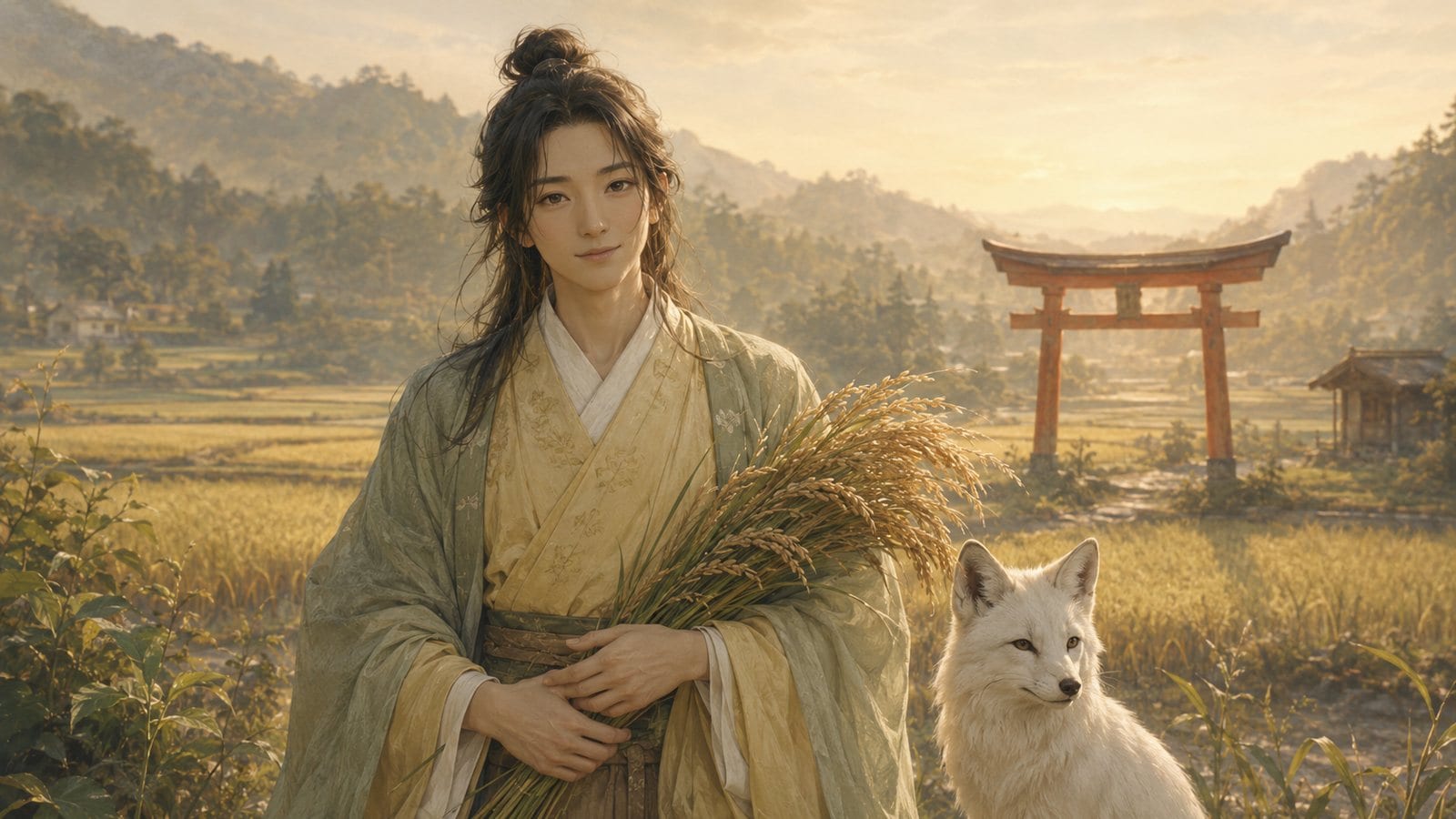
Inari shrines are said to be the most numerous in Japan.
You’ve probably seen them — rows of red torii, fox statues, small shrines tucked into hillsides and alleyways. Inari is, in a way, the kami who lives closest to everyday streets.
But the actual figure behind the name is less well-known. The foxes you see are not Inari themselves — they are Inari’s messengers. The kami at the center has another name entirely.
This article focuses on that center figure. For the broader scope of Inari worship — the diversity of practices, the foxes’ role, the layered history — see the existing article What Inari Really Means. Here, we’ll look at Ukanomitama, the kami the Kojiki names as the deity at the heart of Inari.
Who Inari is
The kami enshrined at Inari shrines is Ukanomitama (宇迦之御魂神). In the Kojiki, Ukanomitama appears as a child of Susanoo.
Gender, in Ukanomitama’s case, varies by tradition. The Kojiki describes Ukanomitama as a female deity, but in later folk worship Inari is sometimes depicted as an elderly figure carrying rice, sometimes as a young woman, sometimes as a figure of ambiguous gender. Not being fixed to one form is one of the defining features of Inari.
The domain has also widened over time:
- Rice and food
- Harvest and abundance
- Commerce and prosperity
- Household safety
- Safe travel
Originally a rice and food deity, Inari kept absorbing new roles as people’s lives changed.
In the Kojiki
Ukanomitama appears in the Kojiki as a child of Susanoo and Kamu-Ōichi-hime, born after Susanoo’s life on earth had begun.
There is no major story attached. The Kojiki gives the name and lineage, and that’s about it.
But in the centuries that followed, Ukanomitama’s name became tied to Inari, and the worship spread enormously. Fushimi Inari Taisha in Kyoto became the central shrine, and Inari was welcomed into farming villages, merchant houses, and craft guilds alike.
A quiet entrance in the mythology — and a vast, expansive presence in lived religion. That gap is part of what makes Inari distinctive.
The role of the fox
Foxes (kitsune) are often associated with Inari shrines, but the fox is not the kami.
The fox serves as Inari’s messenger — a go-between for the human world and the world of the kami. Several theories try to explain why the fox took on this role:
- Foxes eat the rats that damage rice paddies, so they became tied to agriculture
- An old word miketsu sounds close to an old name for the fox
- Foxes live at the boundary of mountains and villages, moving between worlds
None of these is complete. It’s better understood as the result of long association, not a single decisive myth.
For the meaning behind what each fox statue holds in its mouth, and how Inari shrines read as a kind of “active exchange” space, see What Inari Really Means.
What kind of presence Inari is
With such a thin direct mythology, “personality” is hard to pin down for Inari. But the pattern of the worship itself tells us something:
- Inari doesn’t stay in one fixed form
- Inari accepts a wide range of human prayers, from harvest to commerce to safety
- Inari is found in great central shrines and in tiny back-alley shrines alike
Rather than a fixed character, Inari might be best understood as a presence that has shaped itself around the daily lives of the people who turn to it.
Other gods around Inari
Ukanomitama’s father in the Kojiki is Susanoo — the same figure central to the Izumo myth cycle. In actual Inari worship, the relationship to family lineage is less emphasized than the appearance of Inari itself and its messengers.
Where to meet Inari today
Inari shrines exist everywhere in Japan.
The most famous is Fushimi Inari Taisha (Kyoto), known worldwide for its long rows of vermillion torii gates. Other major Inari shrines include Toyokawa Inari (Aichi), Kasama Inari Jinja (Ibaraki), and Yūtoku Inari Jinja (Saga).
But more than any of these, the small Inari shrines tucked into street corners, on the rooftops of buildings, inside shopping arcades, in the corners of other shrines — that’s where most people actually encounter Inari, day to day.
For the visual language of an Inari shrine and how to read what you see, What Inari Really Means and Why Foxes Guard Japanese Shrines are good companions.
A closing note
Inari is a kami who refuses a single fixed form.
A small mention in the Kojiki has, over centuries, become one of the most everyday presences in Japan. That expansion itself — the way Inari moved into so many parts of ordinary life — is the most interesting thing about this kami.