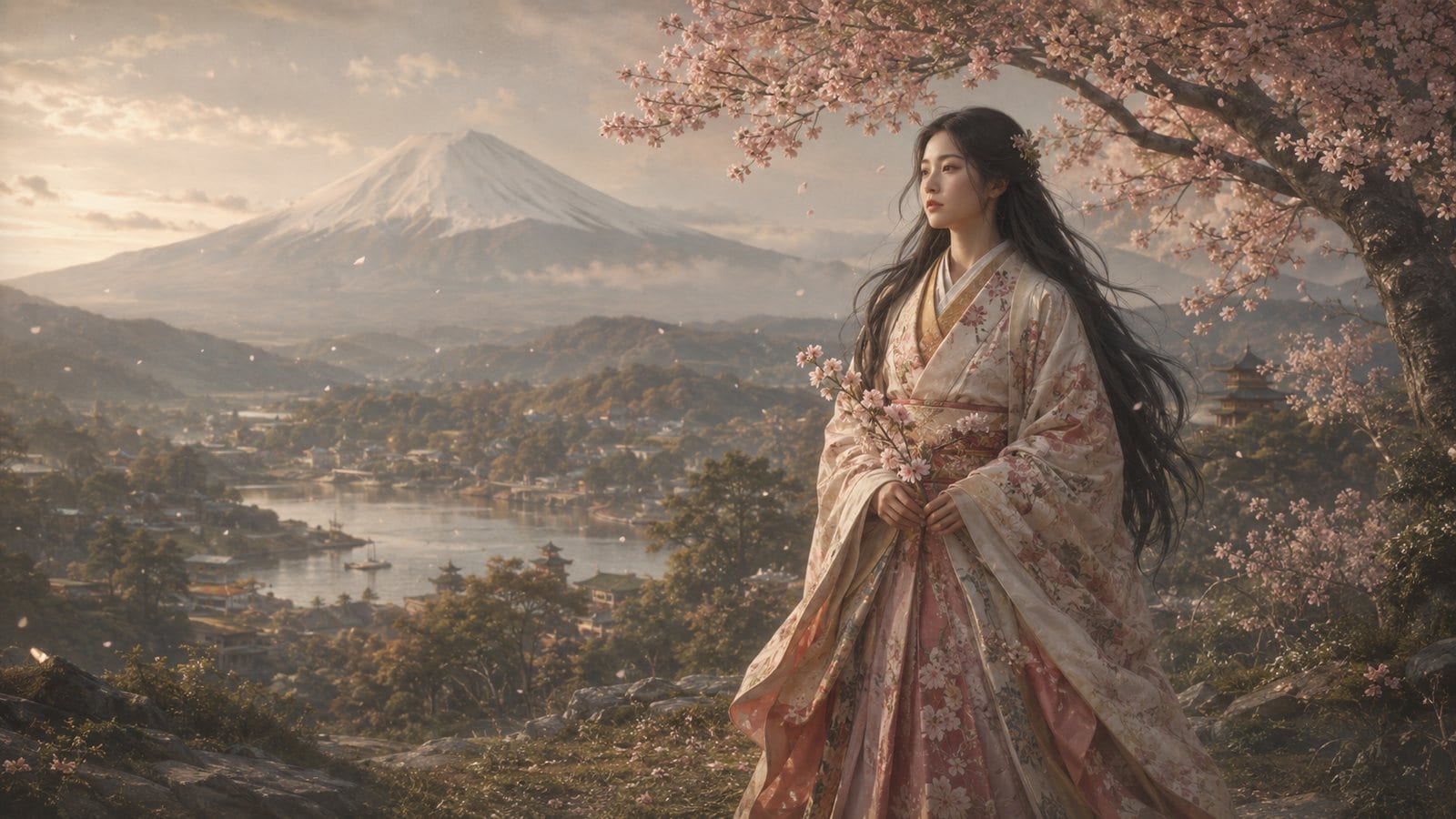
Wherever Mount Fuji is visible, there’s usually a Sengen shrine nearby.
The goddess enshrined at Sengen shrines is Konohanasakuya-hime (木花之佐久夜毘売).
Her name means something like the princess who blooms like a tree flower — elegant, often associated with cherry blossoms. But the story of her in the Kojiki isn’t only about elegance. It’s about a moment of fierce will.
Who she is
Konohanasakuya-hime is a goddess — described in the Kojiki as a female deity.
She is associated with Mount Fuji, cherry blossoms, mountains, safe childbirth, and the calming of fire. The worship of Mount Fuji and the worship of this goddess are deeply intertwined.
The image of “the beautiful blossom-like princess” is the part of her name that travels easily. But in the story itself, when the moment calls for it, she is the one who walks into fire.
Meeting Ninigi — and being doubted
Her story begins when she meets Ninigi, the grandson of Amaterasu, who has just descended from the heavens.
Ninigi falls for her at first sight at Cape Kasasa. He asks her father, Ōyamatsumi, for her hand. Her father is delighted and sends both daughters together — Konohanasakuya-hime and her elder sister, Iwanaga-hime.
But Ninigi looks at the elder sister and sends her back, calling her unattractive. He keeps only Konohanasakuya-hime.
Her father grieves and says: he had sent the two sisters together for a reason. The elder represented the strength to last like a stone. The younger represented the beauty of a flower in bloom. By sending the elder back, Ninigi had condemned their descendants to live like flowers — beautifully, but briefly.
The Kojiki places the origin of human mortality at this moment.
Then Konohanasakuya-hime spends one night with Ninigi — and becomes pregnant. Ninigi, hearing this, says: one night? Can the child really be mine?
She is deeply wounded by the doubt.
The burning birth hut
Her response is not despair. It’s a declaration:
If this child is truly yours, no harm will come to it, whatever happens.
She enters a hut prepared for birth, sets it on fire herself, and gives birth in the flames. All three sons are born unharmed. Their names — Hoderi, Hosuseri, Hoori — all carry the character for fire.
The princess of cherry blossoms turns out to be the one who walks into fire. Faced with doubt, she did not weep. She let the fire prove her.
The Nihon Shoki preserves several alternate versions of this birth — different reasons for the fire, different numbers and names of sons. It isn’t a single fixed account, but a story carried across many tellings.
What the stories say about her
The Konohanasakuya-hime preserved in the Kojiki has:
- A reputation for beauty, paired with strong will
- A response to doubt that takes action, not lamentation
- The capacity to use fire on her own terms
- A motherhood that arrives through strength
The elegance of the cherry blossom and the courage of the fire live in the same goddess. Being enshrined at Mount Fuji — a mountain of both beauty and eruptive force — fits that double nature.
Other gods around her
- Ninigi — her husband (covered in his own article)
- Ōyamatsumi — her father, the kami of mountains
- Iwanaga-hime — her elder sister, sent back by Ninigi
- Hoderi, Hosuseri, Hoori — her three sons, born in fire
Read alongside Ninigi’s article, the pair becomes more complete.
Where to meet her today
Major shrines:
- Fujisan Hongū Sengen Taisha (Shizuoka) — the central shrine of Mount Fuji worship
- Kitaguchi Hongū Fuji Sengen Jinja (Yamanashi) — the climbing-route shrine on the north side
- Many local Sengen Jinja
Shrines with “Sengen” (also read asama) in their name typically enshrine her — and you’ll find them at the foot of many mountains beyond Fuji as well.
Etiquette is the same as any shrine — see How to Visit a Shrine.
A closing note
Konohanasakuya-hime carries the beauty of a cherry blossom and the resolve to give birth in fire.
When you look up at Mount Fuji and know that the goddess enshrined there is both of those things, the mountain feels a little closer to its story.