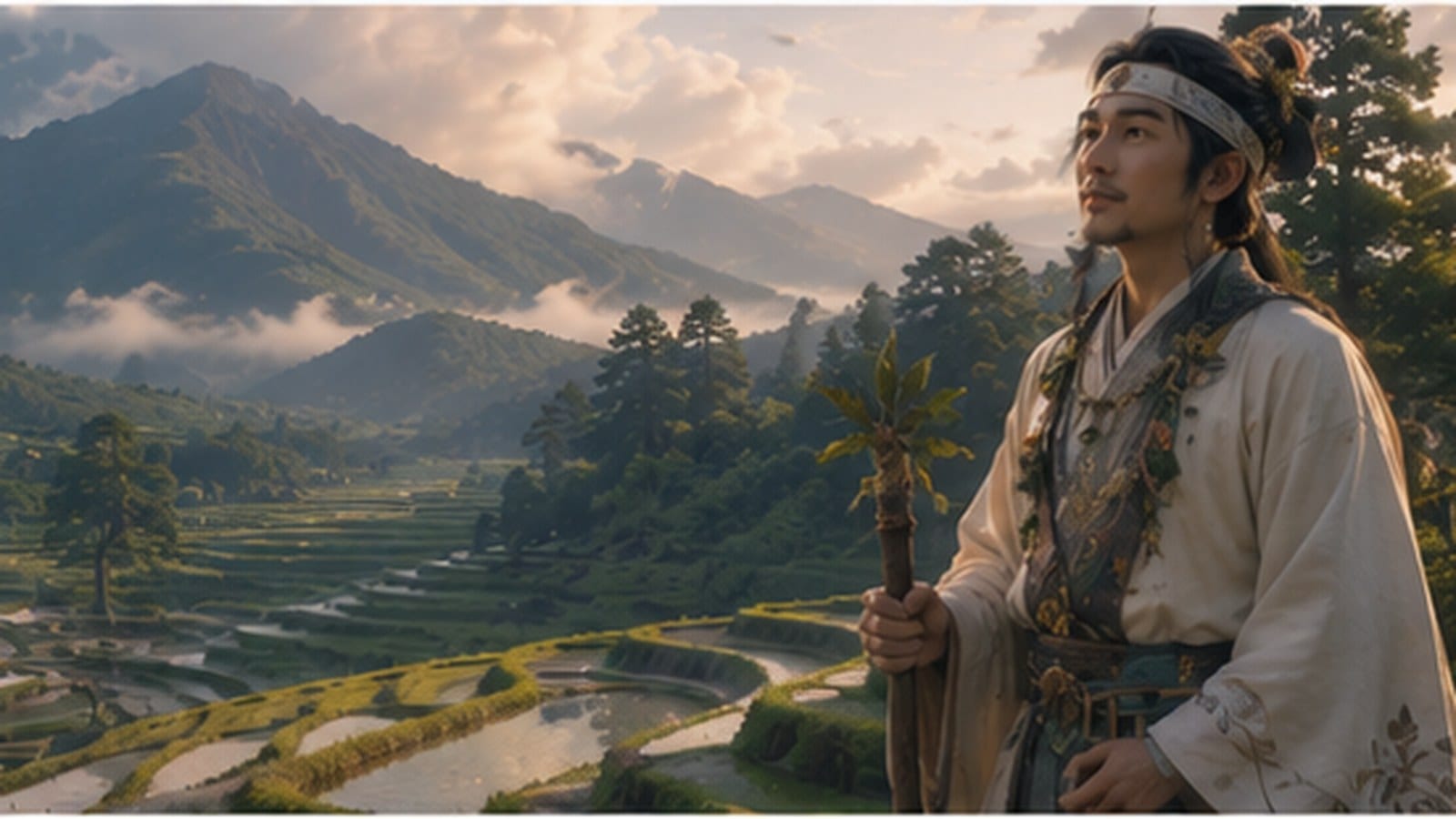
The Kirishima mountains in Kyūshū. Cape Kasasa on the Satsuma peninsula. These are the landscapes that hold the Kojiki’s story of the descent from heaven to earth.
The god at the center of that descent is Ninigi (邇邇芸命 / 瓊瓊杵尊).
He arrives with rice, and with a charge from the heavenly gods to live on the earth below. But the Kojiki’s Ninigi is not depicted as a flawless sovereign. He is young, and the story preserves the mistakes that come with youth.
Who he is
Ninigi is a male god, grandson of Amaterasu.
He is associated with rice cultivation, the abundance of the earth, and the link between heaven and earth. Amaterasu gave him rice grains to bring with him when he descended.
The story is traditionally called tenson kōrin — the descent of the heavenly grandson. In this article, we’ll read it as the beginning of life on earth and the start of cultivation, rather than as a political founding.
The descent
Amaterasu decides to send a descendant down to live on the earth. After some back-and-forth, the choice settles on her grandson Ninigi.
He sets out with rice grains and the three sacred objects — mirror, sword, jewel.
On the way, his party encounters a very large, strange-looking deity standing in the middle of the road: Sarutahiko.
When the others hesitate, Ame-no-Uzume — the same goddess who danced in front of the rock cave — steps forward to ask who he is. Sarutahiko answers: I’m here to guide you down to earth.
With Sarutahiko’s guidance, Ninigi and his company arrive in the high lands of Takachiho, in Kyūshū.
Konohanasakuya-hime and Iwanaga-hime
On the earth, at Cape Kasasa, Ninigi meets a beautiful young woman — Konohanasakuya-hime.
He asks her father, Ōyamatsumi, for her hand. Her father is happy and sends both sisters — Konohanasakuya-hime and her elder sister Iwanaga-hime.
But Ninigi sees Iwanaga-hime, finds her unattractive, and sends her back. He keeps only the younger sister.
Her father grieves and says: he had sent the two together to give Ninigi’s descendants both the stone-like endurance of the elder sister and the blossoming beauty of the younger. By sending the elder back, Ninigi had condemned the line to live like blossoms — beautifully, but briefly.
The Kojiki places the origin of human mortality at this moment.
What the stories say about him
What’s preserved:
- A young god, asked to step into a new role
- Cautious enough to hesitate at a strange figure in the road, but humble enough to accept guidance
- And — making the mistake of choosing by surface, by appearance
- That single choice ends up shaping the lifespan of his descendants
He isn’t portrayed as a perfect ruler. He’s portrayed as a young god whose mistake leaves a real mark. That a foundational myth would build the brevity of human life on a young god’s misjudgment is striking, and it’s part of why the Kojiki feels less like a sacred dogma and more like a long, honest story.
The Nihon Shoki preserves alternate versions of the descent, his meeting with Sarutahiko, and the story of the sisters. The differences between the books are part of what makes Ninigi’s story worth reading in two ways.
Other gods around him
- Amaterasu (grandmother) — gave him rice and sent him down
- Konohanasakuya-hime (wife) — covered in her own article
- Iwanaga-hime (elder sister sent back) — the one who would have given lasting life
- Sarutahiko — the earth-side god who guided his descent
- Hoderi, Hosuseri, Hoori (sons) — born in the burning birth hut
Read alongside Konohanasakuya-hime and Sarutahiko, his story sits at the meeting point of three article threads.
Where to meet him today
Major shrines:
- Kirishima Jingū (Kagoshima) — the central shrine of Ninigi in the Takachiho region
- Takachiho Jinja (Miyazaki) — another sacred site bearing the Takachiho name
- Nitta Jinja (Kagoshima) — an old shrine enshrining Ninigi
Southern Kyūshū holds the geographic concentration of his story. The mountains of Kirishima still feel adjacent to the mythology.
Shrine etiquette is the same as anywhere — see How to Visit a Shrine.
A closing note
Ninigi is the god who came down from heaven, and also the young god who chose by surface.
Holding rice, meeting Konohanasakuya-hime, sending Iwanaga-hime back — those three choices, in a row, set in place the rhythm of human cultivation and human mortality. When you stand in the Kirishima area with that sequence in mind, the landscape and the myth begin to share a single shape.